[ Vulnerability Management ]
Top 8 vulnerability management tools for risk prioritization in 2026

Summarize with AI


Summarize with AI

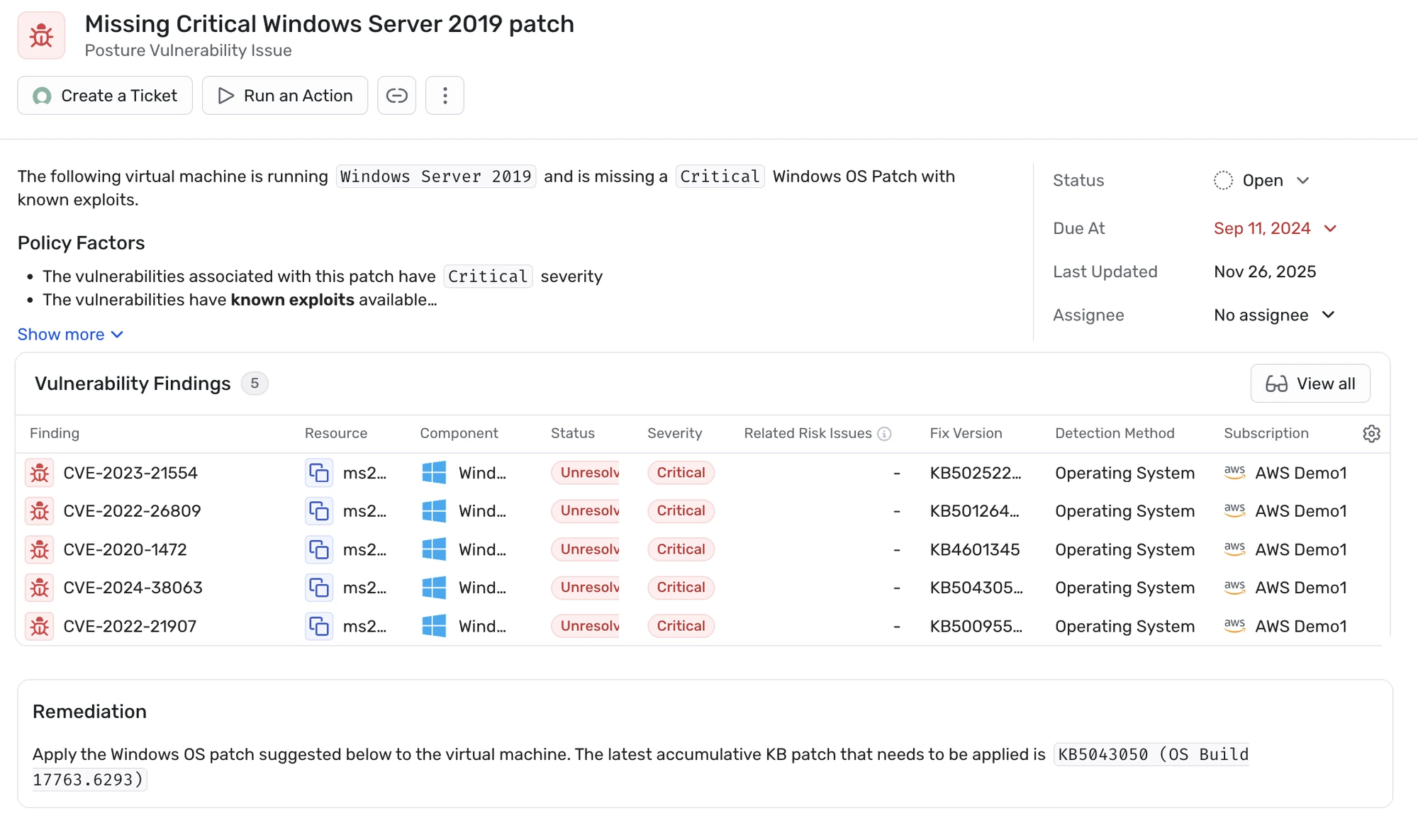
TL;DR: Vulnerability management tools for risk prioritization rank findings by whether they can actually be exploited, not just by their CVSS score. Maze is best for AI investigation of exploitability across code and cloud, Wiz for cloud attack path graphs, Sysdig for filtering to packages in use, and Tenable for scanning hybrid infrastructure.
Vulnerability management tools find, assess, and prioritize the security flaws across an organization’s infrastructure, cloud, and code, then help teams fix them. The best tools for risk prioritization rank each finding by how likely it is to be exploited and how much damage it would do, using exploit intelligence, exposure, asset criticality, and the context of your environment instead of raw CVSS (Common Vulnerability Scoring System) severity alone.
Key prioritization signals to look for:
The table below compares the tools in this guide, including what each one is built around and where teams report friction, and the sections that follow cover each tool in more detail. We grouped the tools by generation, starting with AI-native platforms and ending with the tools that built the category.
| Category | Solution | Best for | Key strengths | Things to consider |
|---|---|---|---|---|
| AI-native platforms | 1. Maze | Teams looking for a unified vulnerability process for code and cloud vulnerabilities | AI that investigates every vulnerability, exploitability verdicts with evidence, and fixes where developers work | SaaS only, and you can’t bring your own LLM key |
| Second-generation platforms | 2. Wiz | Teams that want a graph view of cloud attack paths | Agentless scanning, Security Graph context, and AI agents for remediation and testing | The platform takes time to learn, and licensing can be hard to estimate |
| Second-generation platforms | 3. Sysdig Secure | Teams that want to cut vulnerability lists down to packages in use at runtime | In-use package filtering, an attack graph with CVE360 detail, and Sysdig Sage remediation guidance | Initial setup takes planning, especially for teams new to Kubernetes |
| Second-generation platforms | 4. Brinqa | Teams aggregating findings from hundreds of security tools into one data model | Normalization across 260+ sources, AI ownership attribution, and SmartFlows routing | Implementation and customization take dedicated time |
| First-generation platforms | 5. Tenable One Vulnerability Management | Teams that need scanning and risk rating across on-premises and hybrid infrastructure | VPR backed by Tenable Research, continuous discovery, and patching with guardrails | Asset-based licensing takes planning, and some teams export data for reporting |
| First-generation platforms | 6. Qualys VMDR | Teams that want assessment, prioritization, and patching on one platform across IT, OT, and IoT | TruRisk scoring, 25+ threat intelligence sources, and native patching | Some console areas feel older than others, and some modules are licensed separately |
| First-generation platforms | 7. Rapid7 InsightVM | Hybrid estates that want scan data combined with attack surface context | Attack surface context from Surface Command, plus remediation projects with SLAs | The console takes effort to maintain, and large scans use significant resources |
| First-generation platforms | 8. Snyk* | Developers who want security findings and fixes inside their IDE | A Risk Score combining reachability, exploit maturity, and EPSS, plus Snyk Agent Fix | Code scanning can be noisier than the dependency side, and costs rise at scale |
*Snyk now positions itself as an AI security platform, led by Evo, its agentic security product line.
Most security teams carry a backlog of thousands of open vulnerabilities across their infrastructure, cloud, and code, and new ones arrive faster than anyone can patch them. Fixing every finding promptly isn’t realistic, and treating them all as equally urgent spreads engineering time across issues that will never be used against you while the dangerous ones wait in the same queue. Every fix also takes a developer away from other work and can disrupt the systems the business depends on, which is why the order you fix things in matters as much as how fast you fix them.
Prioritization points that effort at the vulnerabilities most likely to be used against your organization. Context such as asset value, exploitability, and exposure tells a team which issues an attacker could actually reach, shortens the window in which the critical ones stay open, and ties security work to the systems the business cares about most.
Many organizations still fix vulnerabilities in CVSS order, starting with every finding scored critical. A CVSS score measures severity, meaning how much damage a vulnerability could do in the worst case on a generic system, and it is calculated without any knowledge of your environment. Risk is a different question, because it depends on how likely the vulnerability is to be exploited where it actually runs and how much harm that would do to your business.
The gap between the two is wide. A critical CVSS vulnerability often needs conditions that don’t exist on your systems, such as a module that is disabled, a configuration you don’t use, input an attacker can’t control, or network access they can’t get, and if any one of those conditions is missing, the vulnerability carries little risk despite its score. A vulnerability scored medium on an internet-facing service that handles customer payments can be both easy to exploit and expensive when it is, which makes it far riskier than a critical one on an isolated build server.
Prioritizing by risk means using the CVSS score as a starting point and then asking whether the vulnerability can be exploited in your environment, how exposed the asset is, how sensitive its data is, and which controls already stand in the way. Teams that make that shift stop spending weeks on critical CVSS findings that can’t be triggered and put that time into the vulnerabilities that present a real threat.
Vulnerabilities that attackers are actively exploiting need attention first, because the means and the motivation to use them already exist. When threat intelligence shows active exploitation in the wild, every day a matching vulnerability stays open on a reachable system raises the odds of a compromise.
Exposure matters for the same reason, because attackers constantly scan the internet for vulnerable services, so a vulnerability on an internet-facing system or one reachable from an untrusted network is far more likely to be found and exploited than the same vulnerability on an isolated internal host. Fixing exposed and exploitable vulnerabilities first shrinks the attack surface where it is most likely to be tested and stops incidents before they turn into breaches.
Each of the signals below helps decide what to fix first, and each has a blind spot. Earlier tools combined them in a scoring formula, while AI-native tools use them as evidence in an investigation of whether a vulnerability can be exploited in your specific environment.
The Common Vulnerability Scoring System is the most widely used way to rate how severe a vulnerability is. It scores factors such as the attack vector, attack complexity, required privileges, and the impact on confidentiality, integrity, and availability, and vulnerability management tools use the result to sort findings into low, medium, high, and critical.
CVSS gives every team a shared baseline, which is why nearly every tool starts with it. The base score is calculated without any knowledge of the environment the vulnerability sits in, so most tools adjust it with data such as asset criticality and threat intelligence.
Even as a baseline, CVSS has gaps. The same CVE can receive different scores from the National Vulnerability Database (NVD), the affected vendor, and the CVE Numbering Authority (CNA) that published it, and the sources sometimes disagree on whether it can be exploited remotely or only locally. CVSS also ignores compensating controls and says nothing about whether exploitation is possible in your environment.
The Cybersecurity and Infrastructure Security Agency (CISA) maintains a public catalog of vulnerabilities with confirmed evidence of exploitation in real attacks. Vulnerability management tools pull in the KEV catalog to flag findings that attackers are already using, as opposed to those that are only exploitable in theory.
Cross-referencing findings against KEV is one of the most reliable ways to find urgent work, since every entry is backed by evidence of real attacker activity. U.S. federal agencies are required to fix KEV-listed vulnerabilities by set deadlines, and many private organizations follow the catalog for the same reason.
What a KEV listing can’t tell you is whether the vulnerability can be exploited in your environment, only that it has been exploited somewhere in the wild. A KEV-listed vulnerability may still be blocked by network segmentation, configuration settings, authentication requirements, or other controls.
The Exploit Prediction Scoring System is a data-driven model that estimates how likely a vulnerability is to be exploited in the wild in the next 30 days. It uses machine learning over vulnerability characteristics, public exploit code, and observed attack activity to produce a probability between 0 and 1.
EPSS helps teams separate vulnerabilities that attackers are likely to go after from ones that are severe on paper but rarely used, which can shrink a remediation backlog considerably. Scores change as new exploit evidence appears, so the best tools refresh them continuously rather than recording them once.
Because EPSS predicts exploitation across the internet as a whole, it doesn’t consider your configuration, network architecture, compensating controls, or whether the vulnerable code is even reachable in your environment.
Threat intelligence feeds show which vulnerabilities attackers are using right now, which exploit kits and ransomware groups have picked them up, and how quickly activity is growing. Vulnerability management tools that ingest these feeds can raise the priority of a finding the moment exploitation starts, which matters most for zero-days and fast-moving campaigns.
Live exploit data keeps priorities current in a way a static score can’t, because a vulnerability that was quiet last month can be the center of a campaign today. Tools that combine it with the other signals here adjust their rankings as the threat landscape changes.
Threat intelligence shows that exploitation is happening somewhere, but it rarely reflects the specifics of your environment. Feeds also vary in quality, coverage, and timeliness, so some exploit activity is missed or reported only after attacks have started.
Exposure analysis identifies which assets can be reached from the public internet, and raises the priority of vulnerabilities on those systems because attackers can target them directly. Most tools map internet-facing assets automatically and flag the vulnerabilities on them for faster action.
Attack-path analysis goes a step further by mapping how an attacker could move from an entry point to critical assets, which highlights the vulnerabilities that enable lateral movement or privilege escalation. Fixing the vulnerabilities that sit on many paths at once breaks the most likely or most damaging attack scenarios.
The analysis is only as good as its inventory of assets, identities, network relationships, and controls, and incomplete or outdated data can produce misleading paths or miss routes an attacker could use.
Reachability analysis checks whether the vulnerable code in an application or dependency is actually called, and runtime context checks whether that code is loaded and running in production. Together they filter out vulnerabilities in packages that are installed but never used, which is often a large share of a container’s findings.
Earlier tools built reachability on call graphs, which tend to break at dynamic calls, framework routing, and calls into open source packages, and when the trace breaks the tool can’t say whether the code is reachable. AI-native tools read the code and follow the path through those gaps. Reachability is still not the same as exploitability, because a reachable vulnerability only matters if an attacker can control what reaches the vulnerable code.
Reachability and runtime analysis also depend on the quality of the code analysis and runtime visibility behind them, and they can miss configuration changes, newly exposed services, and attack techniques that fall outside the analysis.
Exploitability validation answers the question every other signal only estimates, which is whether a vulnerability can be exploited in your environment, and tools approach it in one of two ways. Breach and attack simulation (BAS) and automated penetration testing tools attack the environment under controlled conditions to prove an exposure can be used. AI-native investigation tools establish the conditions a vulnerability needs, such as a specific configuration, a loaded module, attacker-controlled input, or a reachable network path, and check whether those conditions exist in your code and cloud.
Validation replaces assumptions with evidence, and the payoff is large. If a vulnerability can’t be triggered in your environment, whether it is exploited in the wild matters far less, because an attacker has no way to use it there. Teams can prioritize vulnerabilities that are proven exploitable and set aside those blocked by compensating controls, with the reasoning recorded for auditors.
Validation is only as complete as its coverage, because attack-based testing reaches only the assets and scenarios it is pointed at and investigation depends on the context the tool can gather. The best tools cover every finding and re-check their verdicts as the environment changes.
Related content: Read our article about application security risks, strategies, and modern AppSec essentials.
How we selected these tools: We shortlisted vulnerability management tools based on how they determine exploitability and reachability, how they enrich findings with threat intelligence such as EPSS and CISA KEV, how they factor in asset criticality and internet exposure, and how they route prioritized work to the people who fix it. We grouped them by generation, from AI-native platforms to the tools that built the category.
AI-native platforms were built from the beginning around AI that investigates vulnerabilities, rather than adding AI to a scoring engine. Instead of weighting the same signals the same way for every finding, the AI decides what context each vulnerability needs, gathers it, and reaches a verdict on whether the vulnerability can be exploited in your environment, with the evidence behind it.

Best for: Teams looking for a unified vulnerability process for code and cloud vulnerabilities
Strengths: AI that investigates every vulnerability and returns exploitability verdicts with evidence, plus fixes where your developers work
Things to consider: SaaS only, and you can’t bring your own LLM key
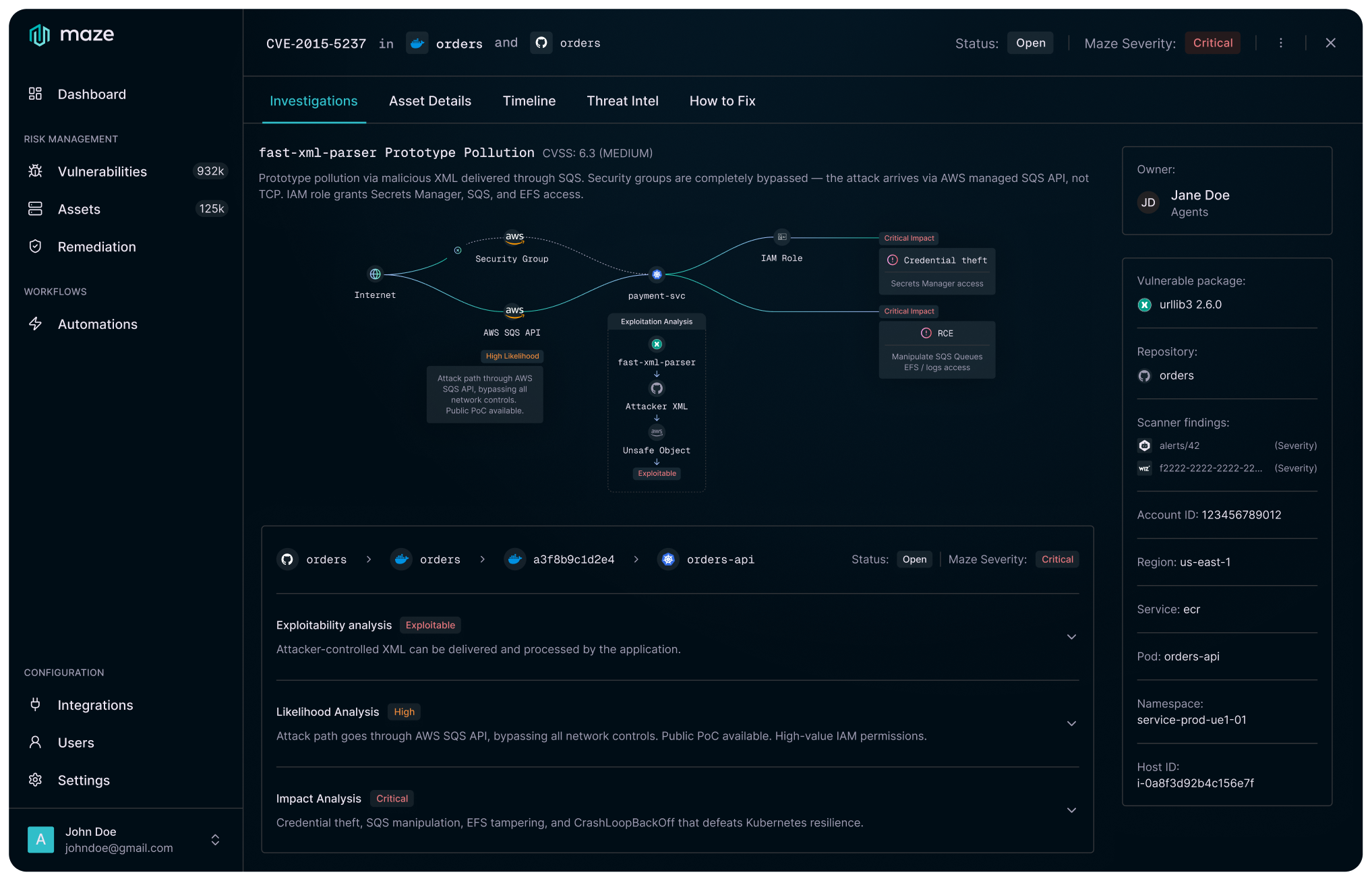
Maze is an AI-native vulnerability management platform, built from the ground up so its AI can gather the context it needs, reason through each vulnerability, and make decisions the way your best security engineer would. It investigates every vulnerability across your code and cloud to determine whether it can be exploited in your environment, and then helps your team fix the ones that can. Maze Code uses AI to find the vulnerabilities in your code with AI-SAST and in your dependencies with AI-SCA, and Maze Cloud investigates the vulnerabilities your existing scanners find in the workloads running in your cloud.
Vulnerability tools have struggled to prioritize for years because they couldn’t gather the context needed to judge each finding accurately, so security teams ended up sorting thousands of findings by severity score. Maze’s founders saw that firsthand working with security teams and started Maze to fix it. Instead of applying static rules, Maze’s AI works the way your security engineer would, pulling context from your code, your build, and your cloud for every finding and giving your team its time back.
Key features include:
Second-generation platforms arrived as infrastructure moved to the cloud and scanner output outgrew what a team could sort by hand. Cloud-native application protection platforms (CNAPPs) such as Wiz and Sysdig brought agentless scanning, runtime visibility, and graph-based context that connects a vulnerability to exposure, identities, and data, and risk aggregation platforms such as Brinqa pulled findings from every scanner into one model with ownership attached. Most are now adding AI on top of those foundations, which builds on mature data and also means fitting AI into architectures designed around scoring and rules.

Best for: Teams that want a graph view of cloud attack paths
Strengths: Agentless scanning, Security Graph context, and AI agents for remediation and testing
Things to consider: The platform takes time to learn, and some reviewers find the licensing model hard to estimate
Wiz Unified Vulnerability Management assesses, centralizes, prioritizes, and remediates vulnerabilities across cloud, code, and on-premises environments. Agentless-first scanning covers cloud workloads, and Wiz UVM connects existing third-party scanners, penetration tests, DSPM, SAST, and DAST tools so their findings sit alongside Wiz’s own.
Prioritization runs on the Wiz Security Graph, which correlates each finding with network exposure, identity access, and data sensitivity, while Wiz ASM validates external exposure. That puts vulnerabilities on critical attack paths ahead of those that only score high on severity, with an owner and remediation guidance attached. Wiz joined Google Cloud in March 2026 and continues to operate under its own brand across all major clouds.
Key features include:

Best for: Teams that want to cut vulnerability lists down to packages in use at runtime
Strengths: In-use package filtering, an attack graph with CVE360 detail, and Sysdig Sage remediation guidance
Things to consider: Initial setup takes planning, especially for teams new to Kubernetes
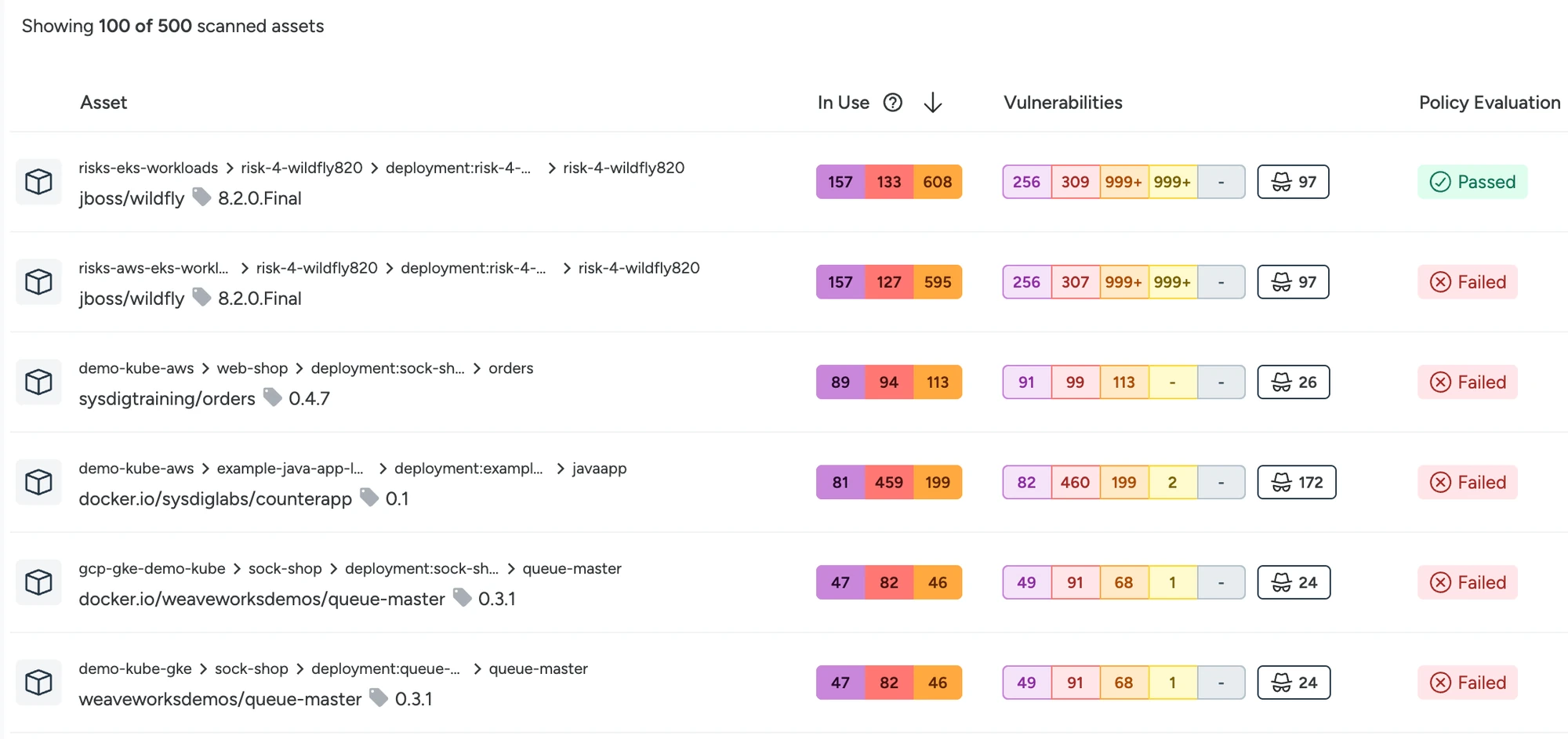
Sysdig Secure prioritizes vulnerabilities using runtime insight, narrowing the list to packages that are actually loaded and in use and enriching those findings with exploitability, exposure, and asset criticality. Correlating vulnerability data with what is running gives teams a much shorter list than a static scan of every installed package.
Sysdig builds its remediation guidance on that prioritization, and Sysdig Sage, the platform’s AI security analyst, turns vulnerability data into step-by-step remediation instructions with specific commands and can open tickets, and the platform finds fixes at the source, such as a base image update that resolves many downstream vulnerabilities at once. Sysdig Secure runs as SaaS or can be self-hosted, including in air-gapped environments.
Key features include:

Best for: Teams aggregating findings from hundreds of security tools into one data model
Strengths: Normalization and deduplication across more than 260 sources, AI ownership attribution, and SmartFlows routing
Things to consider: Implementation and customization take dedicated time and platform knowledge
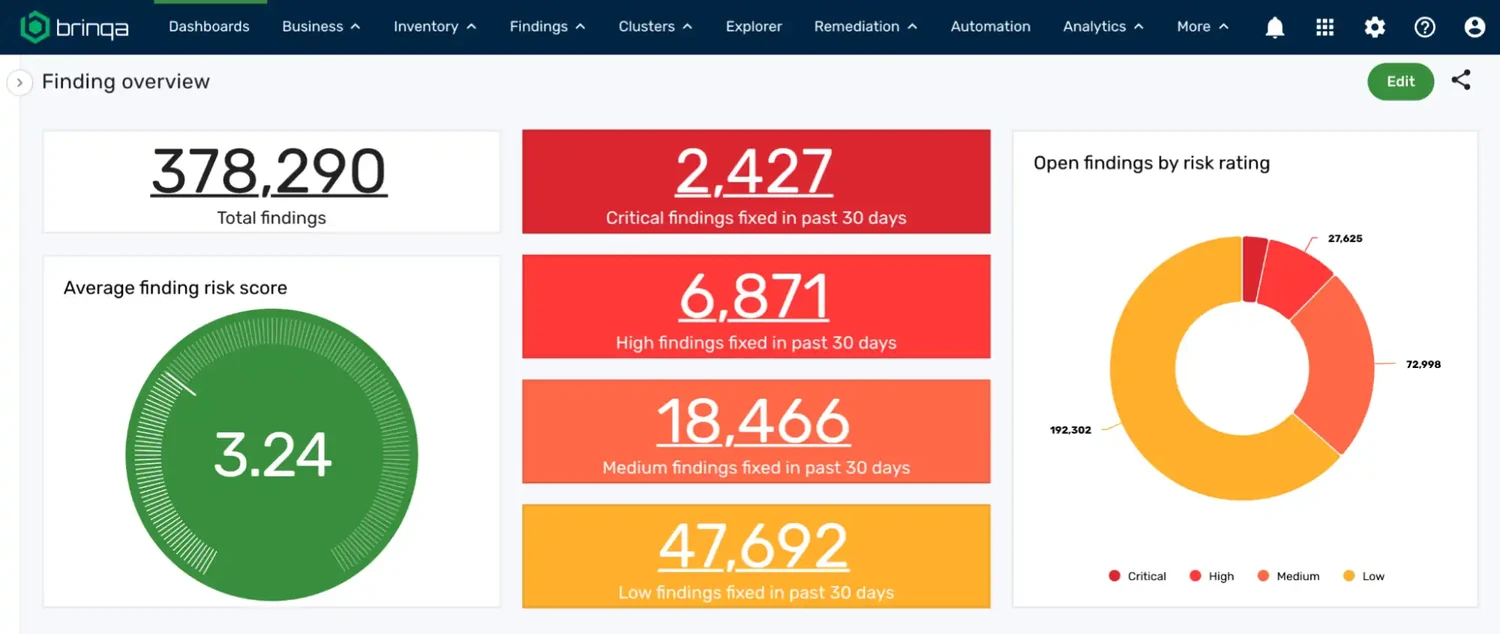
Brinqa treats risk-based vulnerability management as a data and orchestration problem rather than a scanning one. It aggregates findings from your existing scanners, along with assets, threat intelligence, and business context, into a single exposure model, and prioritizes vulnerabilities on exploitability, asset criticality, and business impact instead of severity scores alone.
The platform works in three layers, where a data layer ingests and normalizes output from more than 260 systems while preserving the asset relationships that risk scoring depends on, AI agents resolve ownership and consolidate duplicates, and an orchestration layer routes work and produces program metrics for technical teams, executives, and auditors.
Key features include:
First-generation platforms built the vulnerability management category. Tenable, Qualys, and Rapid7 turned network scanning into an enterprise practice, with broad asset discovery, deep vulnerability coverage, compliance reporting, and on-premises options that keep them the standard across large hybrid estates. Snyk did more than anyone to bring security to developers. All four now add AI-assisted prioritization and remediation on top of the mature scoring models they built.

Best for: Teams that need scanning and risk rating across on-premises and hybrid infrastructure
Strengths: Vulnerability Priority Rating backed by Tenable Research, continuous discovery, and patching with guardrails
Things to consider: Asset-based licensing takes planning, and some teams export data to build the reports they need
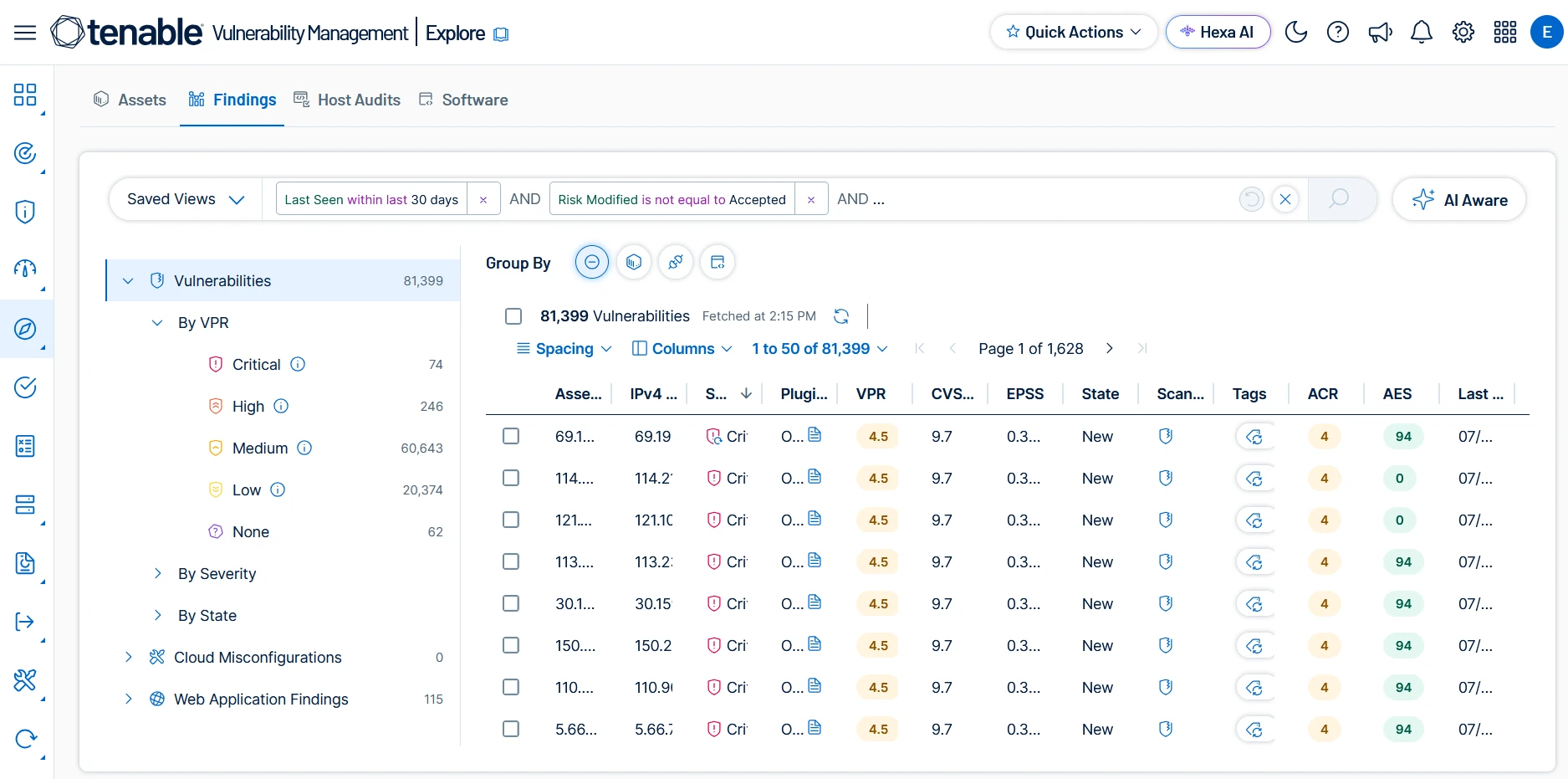
Tenable One Vulnerability Management is a cloud-managed platform built on Nessus scanning technology and delivered within the Tenable One exposure management platform. Continuous, always-on discovery and assessment covers known and unknown assets, including dynamic cloud resources and remote workforce endpoints, and findings are put in context with intelligence from Tenable Research.
Prioritization runs on the Vulnerability Priority Rating (VPR), which uses generative AI, enriched threat intelligence, and context-aware scoring to surface the vulnerabilities that pose the most risk. Remediation runs through bidirectional ticketing and Tenable Patch Management, and Hexa AI serves as the agentic layer of Tenable One. Tenable Security Center and Tenable Enclave Security cover on-premises and air-gapped environments.
Key features include:

Best for: Teams that want assessment, prioritization, and patching on one platform across IT, OT, and IoT
Strengths: TruRisk scoring, more than 25 threat intelligence sources, and native patching
Things to consider: Some console areas feel older than others, and some modules are licensed separately
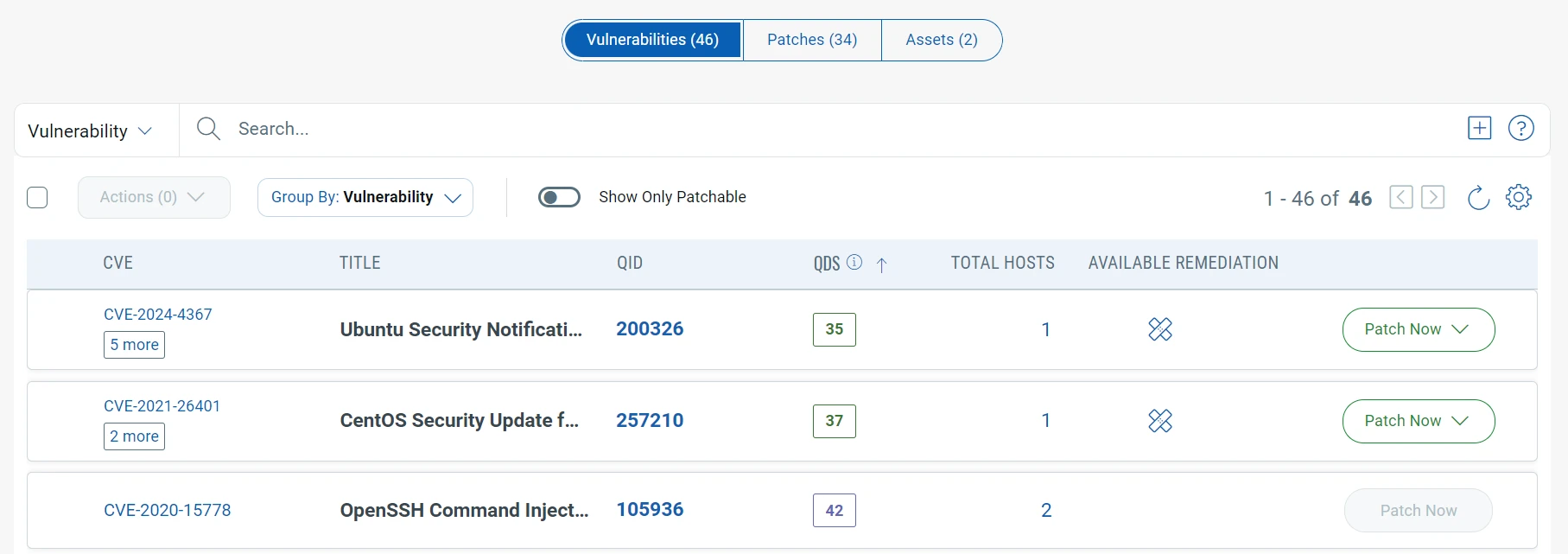
Qualys VMDR combines asset discovery, vulnerability and configuration assessment, risk-based prioritization, and response across hybrid cloud, IT, OT, and IoT environments on the Qualys Enterprise TruRisk Platform. Assets are detected and scanned using virtual scanners, cloud agents, passive sensors, agent gateways, and container sensors.
Prioritization runs on Qualys TruRisk, which weighs exploit code maturity, evidence of active exploitation, asset criticality, and asset location, and produces risk scores at the vulnerability, asset, and asset-group level so teams can track risk reduction over time. Response covers patch deployment, mitigations when no patch is available, and automatic ticket creation in ITSM tools.
Key features include:

Best for: Hybrid estates that want scan data combined with attack surface context
Strengths: Attack surface context from Surface Command, plus remediation projects with SLAs
Things to consider: The console and scan engines take effort to maintain, and large scans use significant resources
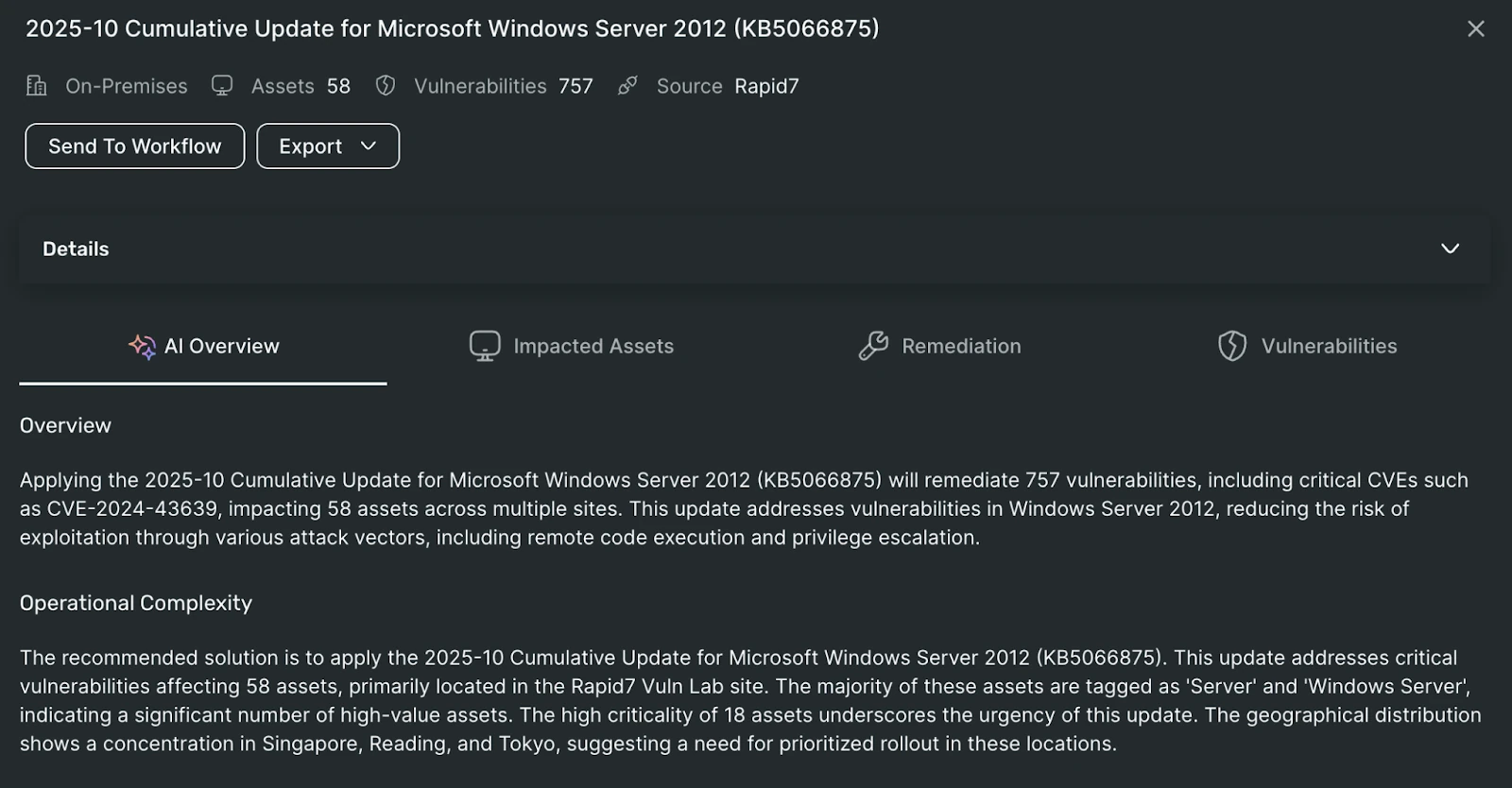
InsightVM is Rapid7’s vulnerability management technology and is now delivered as part of Exposure Command, which combines the InsightVM scanner with attack surface, cloud, and application context. Teams that only need vulnerability management can still run InsightVM on its own, including on-premises.
Prioritization weighs exploit likelihood, reachability, severity, and business context, and combines Rapid7 telemetry with third-party data to find toxic combinations across cloud, network, and applications. Surface Command adds the external attacker’s view to internal scan data, and Remediation Hub, now open to all InsightVM users, ranks remediation work by risk score.
Key features include:

Best for: Developers who want security findings and fixes inside their IDE
Strengths: A Risk Score that combines reachability, exploit maturity, and EPSS, plus Snyk Agent Fix
Things to consider: Some reviewers find code scanning noisier than the dependency side, and costs rise at scale
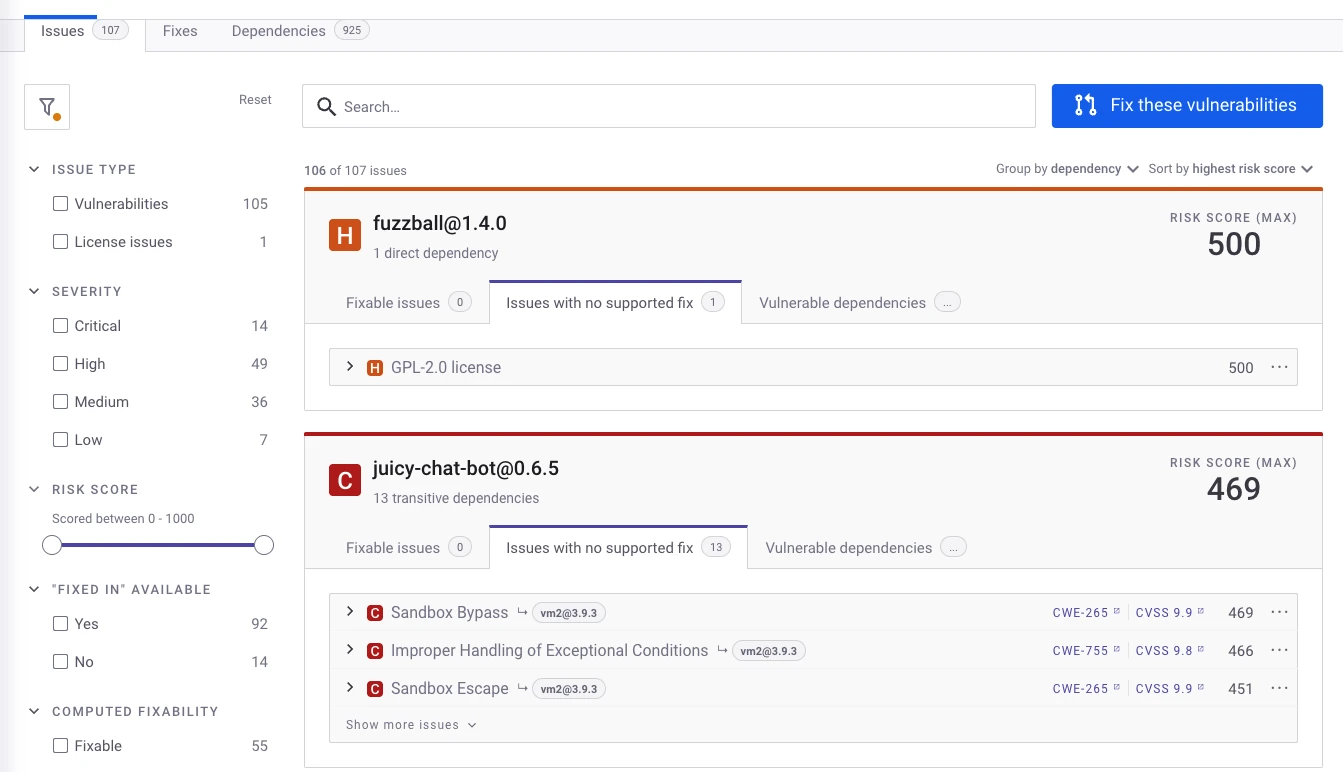
Snyk built developer-first security, putting scanning in the IDE and the pull request, and now describes itself as an AI security platform covering code, open source dependencies, containers, and infrastructure as code. Snyk Essentials maps repositories, container images, dependencies, and their owners into one inventory, and Snyk AppRisk builds on it with runtime context and findings from non-Snyk tools.
Prioritization runs on the Snyk Risk Score, which ranks open source and container issues on exploit maturity, EPSS, CVSS, reachability, transitive depth, social trends, and the business criticality of each project. Scores appear in the interfaces developers already use, and Snyk Agent Fix generates fixes for prioritized issues.
*Snyk now positions itself as an AI security platform, led by Evo, its agentic security product line.
Key features include:
Risk-based vulnerability management points remediation at the vulnerabilities that present the greatest practical risk, rather than the ones with the highest severity scores. Exploit intelligence, exposure, asset criticality, attack paths, and runtime context each narrow the list, and the newest tools go further by investigating whether each vulnerability can be exploited in your environment before anyone is asked to fix it. The right choice depends on your environment, the scanners and platforms you already run, and how much of the investigation you want the tool to do for your team.
[ Vulnerability Management ]

[ Vulnerability Management ]

[ Vulnerability Management ]