[ Vulnerability Management ]
Vulnerability management lifecycle: 10 stages and best practices

Summarize with AI


Summarize with AI

The vulnerability management lifecycle is a continuous, repeating process that organizations use to discover, prioritize, fix, and monitor security weaknesses in their IT systems. It provides a structured way to manage vulnerabilities from discovery through remediation instead of treating vulnerability scanning as a one-time task.
The lifecycle typically follows these core stages to reduce cyber risk:
New vulnerabilities appear continuously as software, infrastructure, and configurations change. A vulnerability management lifecycle gives security teams a repeatable process for managing these weaknesses and reducing exposure before attackers can exploit them. Key benefits include:
The lifecycle starts by identifying the assets that could contain vulnerabilities. This inventory can include servers, endpoints, cloud resources, containers, applications, APIs, network devices, and software dependencies. Discovery should cover both known assets and unmanaged or newly deployed resources.
Each asset should include useful context such as its:
Keeping this inventory current is important because assets change frequently, especially in cloud and container environments. Vulnerabilities cannot be managed reliably when affected assets are missing from the inventory.
Security teams scan and analyze assets to identify known vulnerabilities, insecure configurations, outdated software, exposed services, and other weaknesses. Data can come from:
Identification should occur continuously or at intervals appropriate for the environment. Teams should also correlate findings from multiple tools because the same vulnerability may appear in several data sources. Normalizing and deduplicating findings creates a more accurate set of vulnerabilities to manage.
A vulnerability record becomes more useful when technical findings are combined with information about the affected application and its runtime environment. Relevant context includes whether the vulnerable component is:
This context helps distinguish theoretical exposure from vulnerabilities that present a practical attack path. For example, a vulnerable library may exist in an application package but never execute in production. Even a component that is running and exposed may not be exploitable, because the configuration, controls, or inputs an attacker would need may not exist in that environment, so the most useful enrichment answers that question as well. Enrichment reduces unnecessary remediation work and gives later risk assessments better information.
Related content: Read our guide to reachability analysis
Teams assess each vulnerability to understand the potential impact if it is exploited. Common inputs include:
Severity alone should not determine risk, because a critical vulnerability on an isolated test system may require less urgent action than a lower-scored vulnerability on an internet-facing production service with a working exploit. Signals like EPSS and the CISA KEV catalog show whether a vulnerability is being exploited somewhere in the world, but not whether it can be exploited on this system. Risk assessment combines technical severity with the organization’s actual environment.
Prioritization determines which vulnerabilities teams should address first. Rather than treating every finding equally, organizations can rank vulnerabilities using factors such as:
The result should be an actionable remediation queue rather than a large list sorted only by severity. Clear priorities help security and engineering teams direct limited time toward weaknesses most likely to cause harm. Priorities should also change when new threat intelligence or environmental context becomes available.
Related content: Read our guide to vulnerability prioritization
Once vulnerabilities are prioritized, they need to reach the teams that can fix them. Ownership may depend on the:
Integration with asset inventories and development systems can help map findings to responsible teams automatically. Assignments should include enough information for owners to act without repeating the security team’s investigation. This can include the affected resource, vulnerable component, recommended fix, risk level, remediation deadline, and supporting evidence. Clear ownership prevents findings from remaining unresolved because responsibility is unclear.
Remediation removes the underlying weakness, commonly by:
Teams should test changes where appropriate to avoid introducing outages or compatibility problems. When immediate remediation is not possible, teams can apply mitigating controls to reduce the likelihood or impact of exploitation. Examples include restricting network access, disabling vulnerable functionality, adding firewall rules, or isolating affected systems. Mitigation reduces risk but usually does not replace a permanent fix.
A vulnerability should not be considered resolved simply because a patch or configuration change was deployed. Teams need to verify that the affected asset was updated successfully and that the original weakness can no longer be detected or exploited. Verification may involve:
Fixes that fail verification should go back into the remediation workflow. This step also helps detect incomplete deployments where a vulnerability was fixed on some systems but remains present on others.
Vulnerability management continues after remediation because infrastructure and software change constantly. Factors that can alter an organization’s exposure include:
Continuous or scheduled monitoring helps detect new vulnerabilities and identify previously fixed issues that reappear. Teams should also watch for changes in vulnerability risk, such as publication of exploit code or evidence of active exploitation, because these changes may require reprioritizing existing findings.
Organizations should track metrics that show whether the vulnerability management process is reducing risk. Useful measures include:
Metrics should identify process problems rather than simply count vulnerabilities. For example, repeated SLA failures may indicate unclear ownership, difficult patching processes, or inadequate engineering capacity. Reviewing these patterns helps teams improve discovery, prioritization, remediation workflows, and preventive security controls over time.
Security tools can generate thousands of vulnerability findings across applications, endpoints, cloud resources, containers, and dependencies, and many of them are false positives that can’t be exploited in the environment where they were found. Security teams often lack the capacity to investigate and remediate every finding, creating large backlogs that make important vulnerabilities harder to identify.
How to overcome: Teams can reduce this workload by consolidating findings and filtering them using asset criticality, exploitability, exposure, and runtime context. AI-native platforms go a step further by investigating each finding the way a security engineer would, checking whether the conditions it needs exist in your environment and closing the ones that can’t be exploited with the evidence attached. This shifts vulnerability management from processing every alert to addressing weaknesses that represent meaningful risk.
Scanner severity ratings provide useful technical information, but they do not show how a vulnerability affects a specific environment. A critical vulnerability may exist in an isolated system, while a medium-severity issue could expose an internet-facing application to a practical attack.
How to overcome: Effective prioritization combines severity with factors such as active exploitation, available exploits, asset importance, network exposure, and reachability. CVSS, EPSS, and the CISA KEV catalog all come from public information about the vulnerability itself, so the context that changes a decision has to come from your own environment, such as how the affected workload is configured, what controls sit in front of it, and whether the vulnerable service is exposed to input an attacker controls. This context helps teams direct remediation work toward vulnerabilities with the highest actual risk.
Organizations commonly use several scanners and security platforms that inspect overlapping assets. The same vulnerability can therefore appear in multiple tools with different identifiers, severity ratings, or descriptions, increasing alert volume and making remediation status difficult to track.
How to overcome: Deduplication and correlation can combine related findings into a single vulnerability record. Normalizing asset identifiers, CVEs, software components, and scanner data gives teams a clearer view of affected resources and prevents duplicated remediation work.
Many vulnerability scanners identify weaknesses based on installed packages, source code, or software inventories without determining whether vulnerable components are actually used. As a result, teams may spend time investigating vulnerabilities that are not loaded, reachable, or exposed in production.
How to overcome: Adding runtime and deployment context helps determine where a vulnerable component executes and whether attackers can realistically reach it. Combining this information with application dependencies, network exposure, and asset criticality enables more accurate risk assessment and prioritization. The strongest signal is whether the specific conditions a vulnerability needs, such as a configuration, an input an attacker controls, or a missing control, actually exist in your environment. For code vulnerabilities found by SCA and SAST, that means looking beyond reachability, because code an application can call is not always code an attacker can exploit.
Here are some of the ways that organizations can improve their vulnerability management lifecycle.
Maintain an up-to-date inventory of applications, cloud resources, endpoints, containers, APIs, repositories, and software dependencies. Record useful context such as ownership, business criticality, environment, internet exposure, and data sensitivity. This information allows vulnerability findings to be connected to the systems and business processes they affect.
Automate asset discovery where possible because manual inventories become outdated as infrastructure changes. Compare information from cloud platforms, deployment systems, endpoint tools, service catalogs, and security scanners to identify unmanaged or unknown assets. Establish processes for adding new assets and removing decommissioned ones so vulnerability coverage remains accurate.
Scan for vulnerabilities throughout development, testing, deployment, and production instead of relying only on periodic assessments. This can include static application security testing, software composition analysis, container scanning, infrastructure-as-code checks, dynamic testing, cloud configuration scanning, and production monitoring.
Finding vulnerabilities earlier usually makes them easier to address because developers can fix issues while the relevant code is still being worked on. Production scanning remains necessary because new vulnerabilities are disclosed continuously and deployed environments change over time. Combining pre-production and production visibility provides more complete coverage of the application lifecycle.
Enrich vulnerability findings with information about where affected components are deployed and how they behave at runtime. Determine whether vulnerable code is running in production, loaded by the application, reachable through application execution, exposed to external networks, or connected to sensitive systems.
Runtime context helps distinguish vulnerabilities that create practical attack opportunities from findings that exist only in unused or unreachable components. If you’re looking at code vulnerabilities from SCA and SAST, look beyond reachability to exploitability, because a vulnerable function your code calls is only exploitable if an attacker can control what reaches it and nothing in your configuration turns the vulnerable feature off. Teams can also identify which applications and environments share the same vulnerable dependency. This additional context makes risk assessments more accurate and reduces time spent investigating low-impact findings.
Avoid using scanner severity or CVSS scores as the only basis for remediation decisions. Combine severity with factors such as known exploits, active exploitation, runtime reachability, network exposure, required privileges, asset criticality, and the potential impact of compromise.
This approach helps distinguish a technically severe vulnerability from one that presents an immediate threat to the organization. Known exploits and active exploitation tell you a vulnerability is dangerous somewhere, while exploitability in your environment tells you whether it is dangerous here, and the best prioritization uses both. Prioritization should also be dynamic, because a previously low-priority vulnerability may require urgent remediation if exploit code becomes available, attackers begin exploiting it, or the affected asset becomes externally accessible.
Map vulnerabilities directly to the developers or teams responsible for the affected code, component, service, or infrastructure. Repository ownership, commit history, service catalogs, deployment metadata, and code ownership files can help determine the appropriate remediation owner automatically.
Provide owners with enough information to investigate and fix the issue without repeating the security team’s analysis. Useful details include the affected component and version, code location, vulnerable dependency path, recommended fix, affected environments, risk context, and remediation deadline. Clear routing reduces delays caused by tickets moving between teams before reaching the correct owner.
Deliver vulnerability findings through systems developers already use, such as issue trackers, source control platforms, CI/CD pipelines, and development environments. Requiring developers to regularly check separate security dashboards creates additional work and increases the chance that findings will be overlooked.
Integrations can automatically create remediation tickets, notify relevant owners, suggest secure dependency versions, or prevent deployments when vulnerabilities exceed defined risk thresholds. They can also update or close findings when fixes are verified. These workflows make vulnerability remediation part of normal software development rather than a separate security process.
Measure performance across discovery, prioritization, assignment, remediation, and verification rather than simply counting the total number of vulnerabilities. Useful metrics include mean time to remediate, vulnerability age, SLA compliance, recurrence rates, asset coverage, reopened findings, and the number of exploitable vulnerabilities in production.
Analyze these metrics by application, vulnerability type, severity, team, or environment to identify recurring problems. Long assignment times may indicate unclear ownership, while repeated dependency vulnerabilities may reveal weaknesses in upgrade processes. Tracking trends over time helps teams determine whether process changes are reducing exposure and improving remediation efficiency.
Maze’s founders spent years working alongside security teams and kept seeing the lifecycle stall in the same place. Scanners handed over far more findings than anyone could investigate, and the tools in between couldn’t gather the context needed to tell which ones mattered, so teams prioritized by severity score and sent engineering long lists of fixes for vulnerabilities that were never a real risk. They built Maze so that every vulnerability gets the investigation those teams never had time to run.
Given unlimited time, a security engineer would take each vulnerability, work out what has to be true for it to be exploited, and then check your cloud, your build, and your code to see whether those conditions exist. Maze’s AI was built to think the same way, deciding what context each finding needs and gathering it from your environment instead of applying static rules to public data like CVSS scores and the CISA KEV catalog, which describe a vulnerability in general but not how it behaves in your cloud and code. That changes the middle of the lifecycle, because enrichment, assessment, and prioritization become one investigation with evidence behind every verdict, and the work that reaches owners is limited to vulnerabilities that can actually be exploited.
Maze Cloud investigates the vulnerabilities your existing scanners find in the workloads running in your cloud, such as containers and virtual machines, and Maze Code brings the same investigation to your code, using AI to find vulnerabilities with AI-SAST for the code your team writes and AI-SCA for your dependencies. For the ones that are exploitable, Maze writes a fix that matches your code or environment and gets it to the person who owns it.
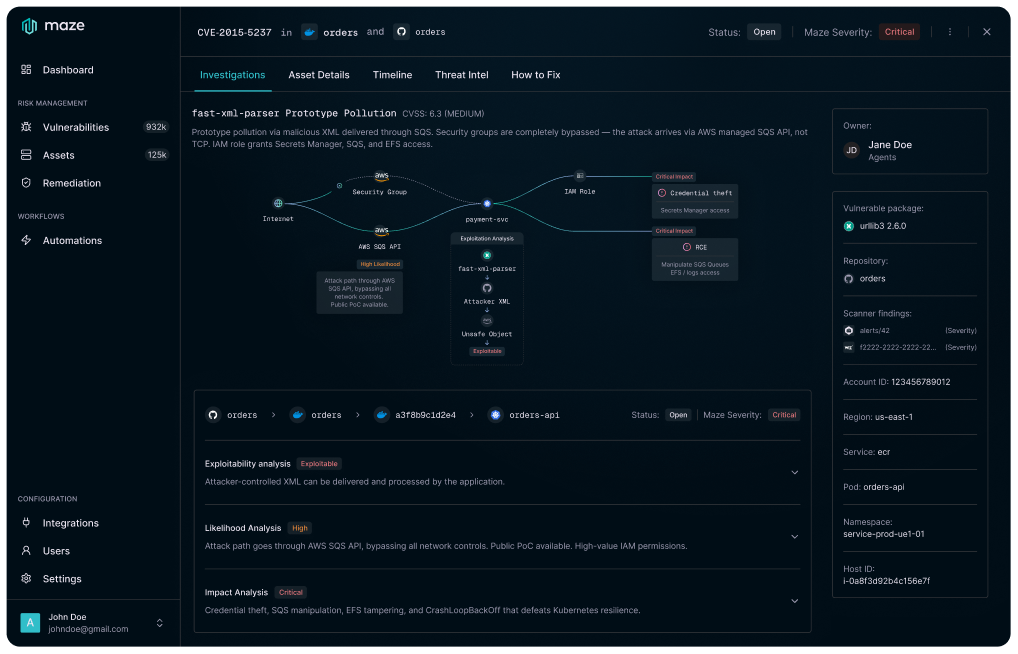
Key features include:
[ Vulnerability Management ]

[ Vulnerability Management ]

[ Vulnerability Management ]