[ Vulnerability Management ]
Top 9 AI vulnerability management tools that reduce false positives

Summarize with AI


Summarize with AI

TL;DR: AI vulnerability management tools reduce false positives by using context, reachability, and exploitability analysis to decide which findings are real risks in your environment and which are noise. Maze is best for a unified vulnerability process that investigates whether code and cloud vulnerabilities can be exploited in your specific environment, and Cogent for patching infrastructure with adjustable levels of autonomy. Endor Labs is best for catching malicious open source packages, Semgrep for teams that want to write their own detection rules, Wiz for attack path graphs across your cloud, Orca for filtering container findings down to the packages in use, and Nucleus for aggregating findings from hundreds of tools. Snyk is best for security checks inside the IDE, and Tenable for on-premises and hybrid vulnerability scanning.
AI vulnerability management tools use AI to decide which vulnerability findings are real risks in your environment and which ones are noise. Instead of ranking findings by a static severity score, they look at the context around each one, such as the code that calls the vulnerable function, the workload it runs on, how that workload is exposed, and the controls in front of it, and they weigh that alongside threat intelligence and business impact.
Most of these tools also shrink the backlog in other ways, by grouping duplicate findings from different scanners, routing each issue to the team that owns it, suggesting a fix, and confirming that the fix worked. The newest tools go a step further and investigate every finding the way a security engineer would, then close the ones that can’t be exploited and attach the reasoning so your team can check it.
Why are false positives a major vulnerability management challenge?
How do AI vulnerability management tools reduce false positives?
The table below summarizes how each tool in this guide reduces false positives, grouped by the kind of platform each one is, with AI-native platforms first, and the sections that follow cover each one in more detail.
| Category | Solution | Best for | Key strengths | How it reduces false positives |
|---|---|---|---|---|
| AI-native vulnerability investigation platforms | 1. Maze | Teams looking for a unified vulnerability process for code and cloud vulnerabilities | Accurate, evidence-backed exploitability verdicts and fixes where developers work | Investigates every finding and closes the ones that can’t be exploited in your environment, with the evidence attached |
| AI-native vulnerability investigation platforms | 2. Cogent Security | Teams that want to patch infrastructure with adjustable levels of autonomy | Root-cause patching plans, patch window controls, and fixes verified by a rescan | Scores findings on real exploitability and business impact instead of CVSS alone |
| Application security platforms | 3. Endor Labs | Teams that want to catch malicious open source packages | LLM-based malicious package detection and audit-ready evidence on each finding | Shows which vulnerable functions your code can actually invoke |
| Application security platforms | 4. Semgrep | Teams that want to write their own detection rules | Rules plus AI triage that learns from your past decisions | Uses the context around each SAST finding to filter likely false positives |
| Cloud-native application protection platforms (CNAPPs) | 5. Wiz | Teams that want attack path graphs across their cloud | Security Graph attack paths and the Wiz Agents | Ranks findings by exposure, identity access, and data sensitivity on the Security Graph |
| Cloud-native application protection platforms (CNAPPs) | 6. Orca Security | Teams that want container findings filtered to the packages in use | In-use package filtering for containers and attack path scoring | Narrows container findings to packages that can run or are running |
| First-generation vulnerability platforms | 7. Nucleus Security | Teams that need to aggregate findings from hundreds of tools | A large connector library and custom risk scoring models | Deduplicates findings and assets from every connected tool before prioritization |
| First-generation vulnerability platforms | 8. Snyk* | Developers who want security checks inside the IDE | IDE and pull request fixes across a broad set of scan types | Prioritizes dependency findings using reachability and application context |
| First-generation vulnerability platforms | 9. Tenable One Vulnerability Management | On-premises and hybrid vulnerability scanning | Nessus-based scanning across on-premises and hybrid estates, backed by Tenable Research | Adds exploitation likelihood and asset context to severity scores |
False positives send engineers to investigate issues that don’t exist, can’t be exploited, or don’t apply to the affected environment. Closing one properly can take hours, because someone has to reproduce the finding, read the code, check package versions, test the configuration, and write down why no fix is needed.
The cost multiplies when the same false positive shows up across many systems, because one incorrect detection can open hundreds of tickets that each need a review. That work lands on security analysts, developers, system owners, and the managers who track it to closure, and it interrupts planned development when engineers pause feature work or hold a release to look at a finding marked critical that turns out not to matter.
When most of what a scanner reports turns out to be noise, analysts stop treating each alert as urgent. They start reviewing faster and leaning on severity labels, which makes it more likely that a real vulnerability gets closed without enough investigation, and in a large environment even a small drop in review quality can leave serious weaknesses in place.
Alert fatigue also wears on the team itself. Security engineers who spend most of their week clearing noise instead of reducing risk burn out faster, respond more slowly, and lose confidence in the tools they depend on.
False positives compete with real vulnerabilities for analyst attention, remediation capacity, and change windows, so a critical issue can sit unresolved while the team works through findings with little or no security impact. That delay is most dangerous when a vulnerability has a public exploit, affects an internet-facing asset, or leads to sensitive data, because attackers often start scanning for exposed systems within days of a disclosure.
A large backlog of invalid findings also makes escalation harder. When high-risk issues are mixed in with noise, security leaders struggle to see which findings need emergency action, which slows decisions about patching, isolating a system, or putting a temporary control in place.
Developers who keep receiving tickets for invalid, duplicate, or low-risk findings start to push back on every request, including the legitimate ones. Security teams then see developers as unresponsive, developers see security work as disruptive and poorly targeted, and that tension carries into release planning, risk reviews, and every negotiation over remediation deadlines.
False positives also blur ownership, because a finding can be assigned to the wrong application team, or sent to developers when the root cause is in infrastructure or configuration, and the ticket can move between teams several times before anyone confirms whether action is needed at all.
The approaches below are how today’s tools cut false positives, and each one has changed as vulnerability management has moved from rules and scoring formulas to AI.
Most organizations run several security tools, including vulnerability scanners, cloud security platforms, software composition analysis (SCA), static application security testing (SAST), dynamic application security testing (DAST), endpoint detection and response (EDR), and configuration assessment tools. These tools often report the same underlying issue in different ways, which creates duplicate and sometimes conflicting findings.
Aggregation platforms made a big step forward by pulling those results into one place and matching them on identifiers like the CVE, the asset name, and the package version. Matching on identifiers breaks down when scanners name the same component differently or describe the same issue at different layers, such as an image, a host, and a repository. AI-based correlation compares the evidence behind each finding instead, so it can tell when alerts from different tools describe the same problem, raise confidence when independent tools agree, and flag isolated findings with little supporting evidence for a closer look before anyone starts remediation.
The same vulnerability can be critical on an internet-facing production server and close to irrelevant on an isolated development machine, so a finding only makes sense in the context of where it runs. The relevant context includes application code, dependencies, cloud resources, network exposure, asset criticality, user access, and system configuration.
Earlier tools apply that context as fixed adjustments to a score, for example lowering every finding on an asset tagged as internal. AI-native tools reason over the context directly and work out what each finding needs, so they can recognize when a vulnerable library is never loaded, when a required kernel feature is disabled, or when a system with broad access to sensitive data deserves to move up the list, and they can explain the reasoning in terms your team can check.
Many vulnerabilities sit in libraries that are installed but never called. Traditional scanners report them anyway, because they only check whether a vulnerable package version is present.
Reachability analysis fixes much of that by checking whether the vulnerable function can be reached from an application entry point. Most tools do it by building a call graph with static analysis, which works well for direct calls but tends to break at dynamic calls, framework routing, and reflection, so it either loses the path or plays it safe and reports the finding anyway. Newer tools have AI read the code and trace the path from an entry point to the vulnerable function, following it through the places where call graphs get stuck. Reachability is also only part of the answer, because reachable code isn’t necessarily exploitable, and the best tools go on to check whether an attacker can control what reaches the vulnerable function and whether that code is deployed and exposed.
Every vulnerability needs certain conditions to be exploited, such as a specific configuration, an enabled feature, a loaded module, an exposed network path, or the absence of a control that would block it. Whether a vulnerability is exploitable in your environment depends on whether those conditions exist there, not on how severe it is in general.
Tools validate exploitability in one of two ways, and penetration testing platforms attack the environment to prove an exposure can be used, while investigation-based tools research the conditions each vulnerability needs and check whether they exist, using configuration data, runtime state, and the controls in place. Either way, the result is a short list of findings that present a real opportunity to an attacker, instead of a queue in which every high-severity finding looks equally urgent.
Attackers rarely rely on a single vulnerability. They chain weaknesses, misconfigurations, and exposed services together to move through an environment toward valuable systems.
Graph-based platforms changed cloud security by modeling those relationships across network connectivity, identity permissions, cloud resources, and trust relationships, so teams could see which vulnerabilities sit on a realistic path to sensitive data. A vulnerability that isn’t on any path may matter less than its severity suggests, while a medium-severity issue that enables lateral movement toward a critical asset may need fixing first. AI adds a check that graphs alone can’t make, which is whether each step on the path can actually be exploited in the environment rather than only connected on paper.
Threat intelligence adds context that vulnerability databases don’t, including ransomware campaigns, exploit kits, proof-of-concept code, and attacker behavior. Signals like the Exploit Prediction Scoring System (EPSS) and CISA’s Known Exploited Vulnerabilities (KEV) catalog were a real improvement over CVSS alone, because they tell teams which vulnerabilities attackers are likely to use or already using.
Those signals describe the outside world, though, and say nothing about whether a vulnerability can be triggered in your environment. A KEV-listed vulnerability in a component that isn’t loaded, or behind a control that blocks the required conditions, can’t be used against you regardless of how widely it’s exploited elsewhere. The most useful tools combine both views, using threat intelligence to decide how urgently to act on vulnerabilities that can be exploited in your environment.
Security teams make similar triage decisions again and again, identifying recurring false positives, documenting accepted risks, and settling how certain systems should be handled. Earlier tools captured those decisions as suppression rules and exceptions, which save time but apply wholesale and can quietly go stale when the environment changes.
AI-based tools treat past decisions as context rather than as filters. They apply what the team has already decided to similar findings while still checking each new finding on its merits, which keeps decisions consistent and cuts repetitive work. Human oversight stays in place, because analysts review unusual or high-impact cases and can correct the tool when it gets something wrong.
Large environments often generate several findings for the same underlying vulnerability, because different scanners detect it on the same asset, report it under different identifiers, or raise separate alerts for each affected component. Without deduplication, analysts investigate and track the same problem several times, and developers get several tickets for one fix.
Deduplication compares vulnerability identifiers, affected assets, software versions, dependency relationships, and detection evidence, then groups related alerts into one finding with all the evidence attached. Your team gets an accurate count of the vulnerabilities it actually has, and developers fix the underlying problem once instead of closing the same issue in several tools.
How we selected these tools: We shortlisted tools based on how they reduce false positives, including correlating findings across scanners, analyzing code, asset, and runtime context, determining whether vulnerable code is reachable and exploitable, deduplicating related findings, and applying threat intelligence to remediation priorities. We grouped them by the kind of platform each one is, starting with AI-native platforms. This list is a snapshot of the market, not every tool that exists.
AI-native platforms were built with the infrastructure that lets AI gather context quickly and reason through each vulnerability the way a security engineer would. They look at every finding, decide whether it can be exploited in your specific environment, and show the evidence behind each decision so your team can check it.

How it reduces false positives: Investigates every finding and closes the ones that can’t be exploited in your environment, with the evidence attached
Strengths: Accurate, evidence-backed exploitability verdicts across code and cloud, and fixes where your developers work
Things to consider: SaaS only, and you can’t bring your own LLM key
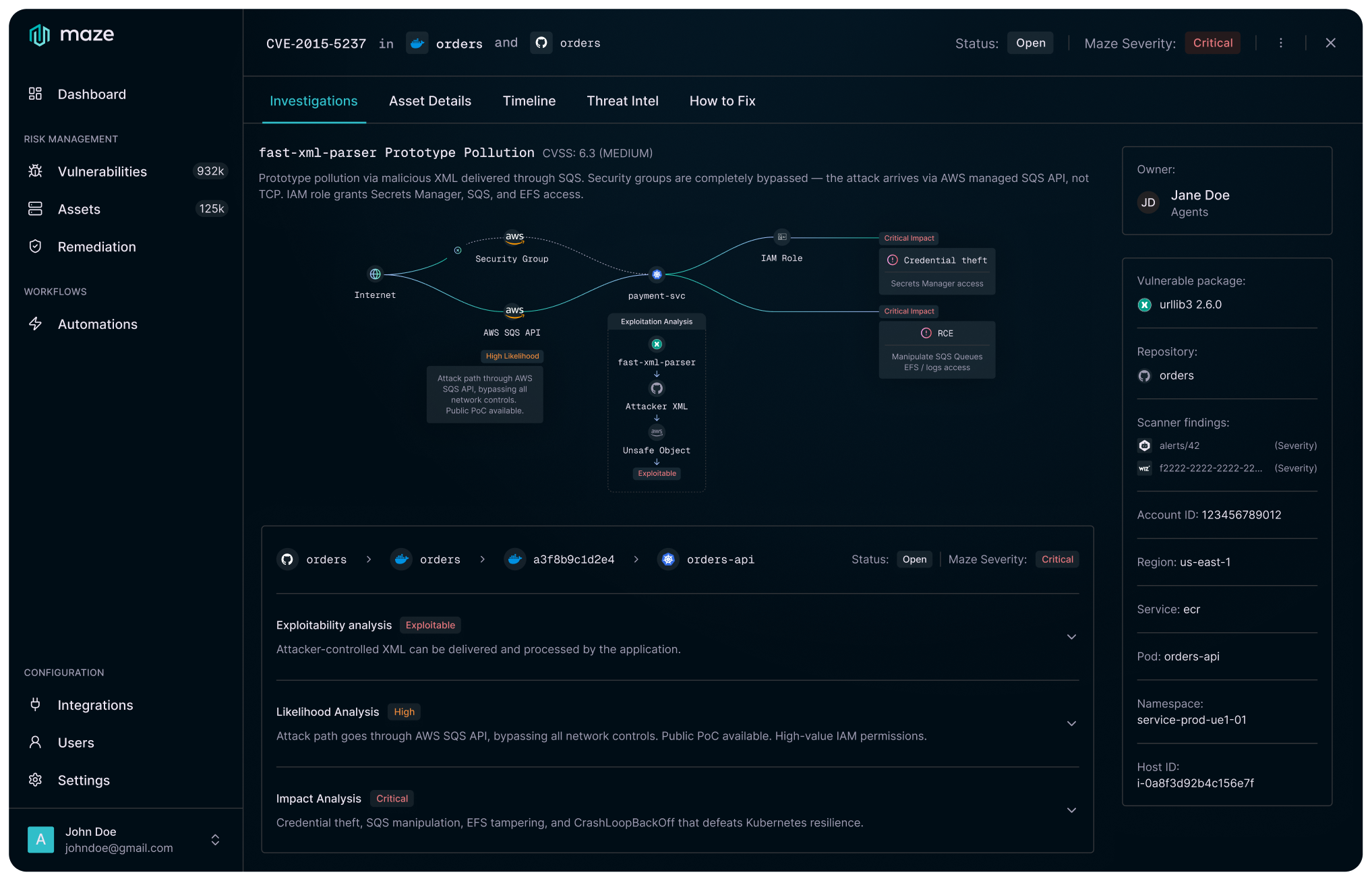
Maze is an AI-native vulnerability management platform, designed from its first version around AI that collects the context behind each vulnerability and reasons through it the way your best security engineer would. Maze uses AI to find the vulnerabilities in your code, investigates every finding across your code and cloud, and tells you which ones an attacker could actually exploit in your environment, with the evidence behind every answer. AI-SAST runs on every pull request and across your entire codebase, AI-SCA covers your open source dependencies, and Maze Cloud investigates the vulnerabilities your existing scanners find in the workloads running in your cloud.
Given unlimited time, a good security engineer would take each finding, read the advisory, check whether the vulnerable code actually runs, look at how the workload is exposed and which controls sit in front of it, and only then decide whether it matters. Maze’s founders watched security teams try to do that by hand across thousands of findings and fall back on severity scores because no tool could gather the context for them, so Maze’s AI was built to run that investigation on every finding, working out what context each one needs and pulling it from your code, your build, and your cloud instead of applying static rules about what matters.
Key features include:

How it reduces false positives: Scores findings on real exploitability and business impact instead of CVSS alone
Strengths: Root-cause patching plans, patch window controls, and fixes verified by a rescan
Things to consider: A newer platform focused on infrastructure, endpoint, and cloud vulnerabilities from existing scanners
Cogent describes itself as an AI workforce for vulnerability management, with AI that works like a skilled security analyst, IT admin, or engineer across four stages: discover, assess, remediate, and report. It identifies vulnerable software within minutes of a new disclosure, scores each finding on whether it can be exploited given the setup of the environment and on its business impact, and plans and carries out fixes through the tools a team already uses.
Cogent pulls findings from vulnerability scanners such as Tenable, Qualys, and Rapid7, cloud security tools such as Wiz and Orca, and EDR tools such as CrowdStrike, Microsoft Defender for Endpoint, and SentinelOne. It checks whether key mitigations are in place, traces what is reachable from the internet, and shows a factor-by-factor breakdown with a confidence level behind every score, so low-confidence findings can go to a person before they’re escalated.
Key features include:
Application security platforms focus on the code your team writes and the open source it depends on. Endor Labs and Semgrep built their reputations on reachability analysis and rule engines you can customize, and both now add AI on top of those foundations to triage findings and to catch issues that rules miss.

How it reduces false positives: Shows which vulnerable functions your code can actually invoke
Strengths: LLM-based malicious package detection and audit-ready evidence on each finding
Things to consider: Some reviewers would like a more polished interface and faster scans on large repositories
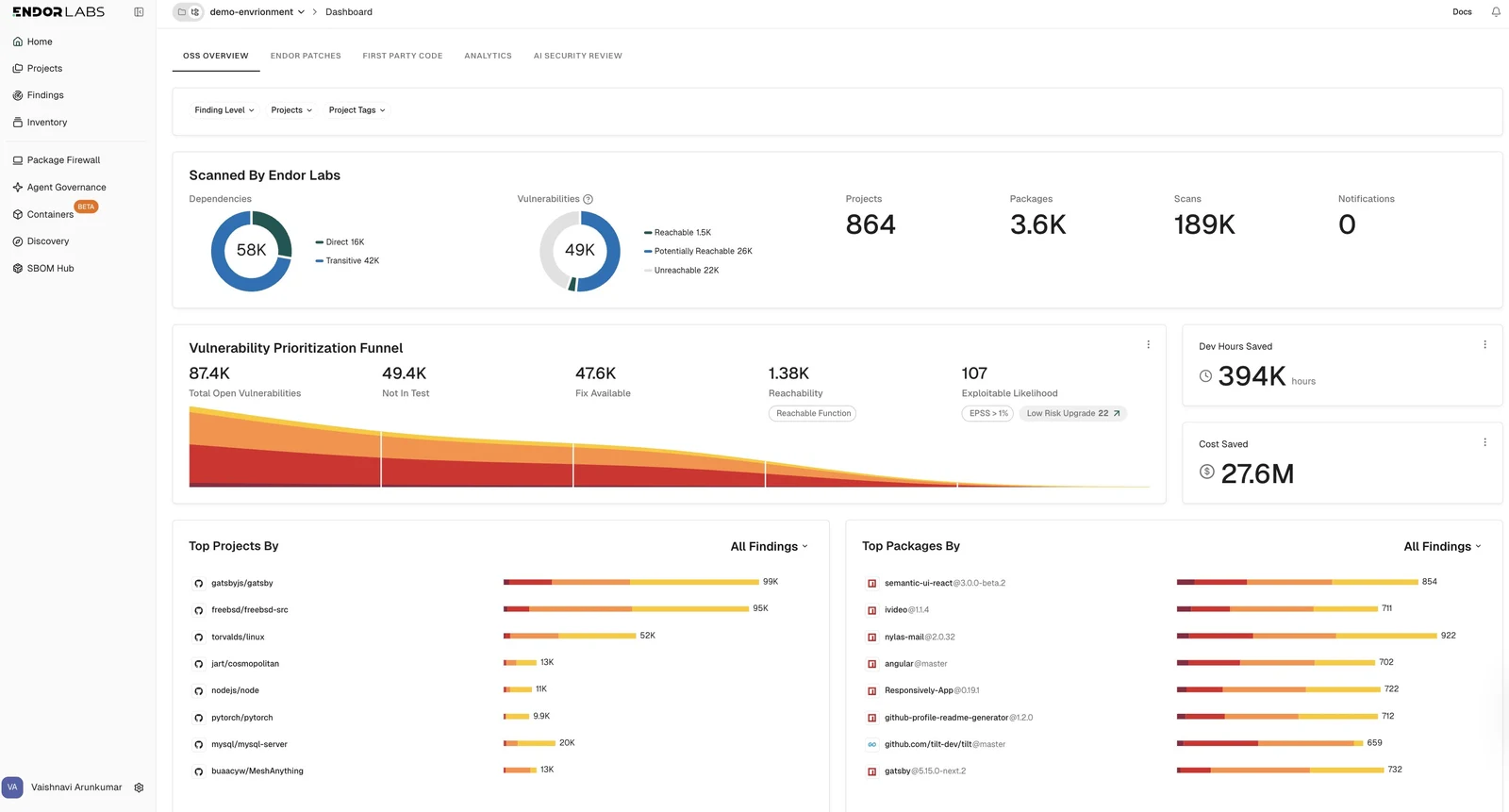
Endor Labs’ platform is AURI, an AI-native application security platform that combines agentic reasoning with deterministic program analysis in one engine. Its foundation is a code context graph built from call graph analysis, data flow analysis, code summarization, and code navigation, which models how first-party code, dependencies, container images, and services connect, along with code owners and change history.
AURI uses that graph to trace whether a vulnerable function can actually be invoked through your code, your direct and transitive dependencies, and your container image layers, and Endor reports that this cuts noise by up to 95%. It runs in AI code editors, code review, CI pipelines, and cloud agents through Hooks, Skills, MCP, or a CLI. Endor cites support for more than 40 languages and frameworks across the platform, and function-level reachability covers a narrower set.
Key features include:

How it reduces false positives: Uses the context around each SAST finding to filter likely false positives
Strengths: Rules plus AI triage that learns from your past decisions
Things to consider: Custom rules take time to learn, and default rules can be noisy until tuned
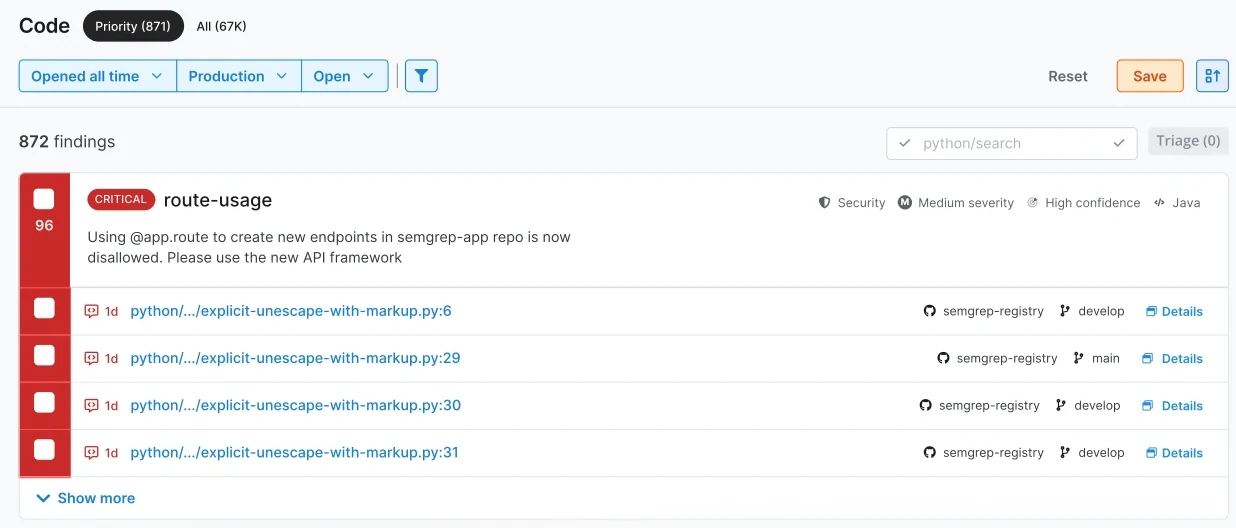
Semgrep Multimodal combines AI reasoning with Semgrep’s rule-based static analysis across detection, triage, and remediation. It goes after the false positives that static analysis alone can’t catch by reading the context around a finding, not only the pattern that triggered it, and it focuses mainly on findings from Semgrep Code.
Semgrep reports that Multimodal cuts the number of findings to triage by 20% on the day it’s turned on and improves as it learns from triage decisions, and it cites more than 8 hours saved per week on triage for security engineers and 30 minutes saved per finding for developers. Semgrep Supply Chain separately uses codebase-aware reachability to filter dependency findings.
Key features include:
Cloud-native application protection platforms cover cloud security broadly, from misconfigurations and identities to workload vulnerabilities, and they assess cloud workloads without installing anything on each one. Their security graphs changed how teams think about cloud risk by showing how a vulnerability connects to exposure, identities, and sensitive data, and Wiz and Orca have both added agents on top of those graphs.

How it reduces false positives: Ranks findings by exposure, identity access, and data sensitivity on the Security Graph
Strengths: Security Graph attack paths and the Wiz Agents
Things to consider: The platform’s breadth takes time to learn, and some reviewers find licensing hard to forecast
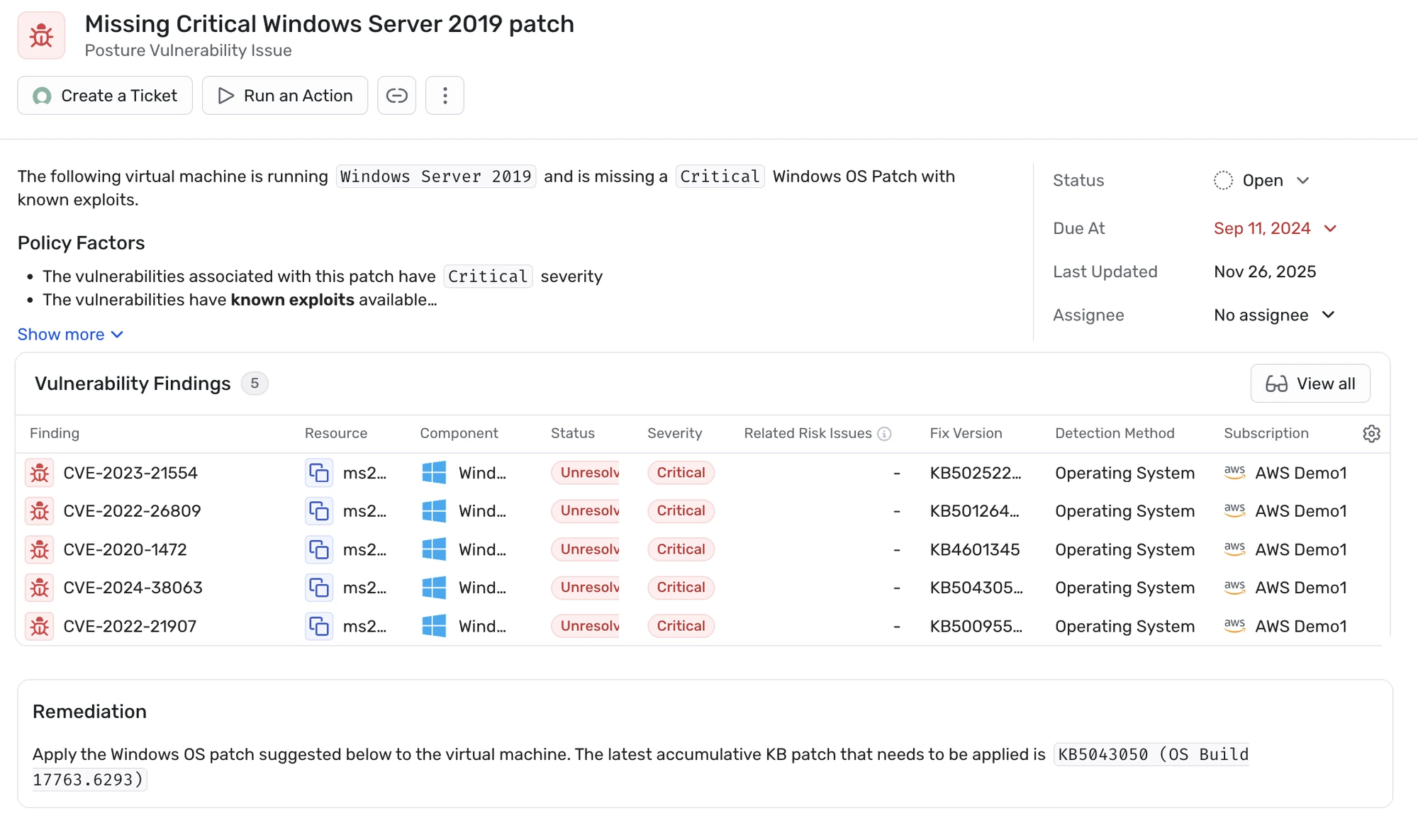
Wiz Unified Vulnerability Management, a capability within Wiz Exposure Management, centralizes assessment, prioritization, and remediation across cloud, code, and on-premises environments. Wiz cites a catalog of more than 120,000 supported vulnerabilities across more than 40 operating systems for its scanning, which runs without agents on cloud workloads, and its Sensor workload scanner extends coverage to on-premises environments.
Findings from Wiz’s own scanners and connected third-party tools are correlated on the Wiz Security Graph, and Wiz ASM checks whether an asset is genuinely exposed to the internet. Network exposure, identity access, and data sensitivity then decide which vulnerabilities sit on critical attack paths. Wiz has also added agents to the platform, including the Green Agent, now in public preview, which investigates high-risk issues and returns a Remediate or Ignore verdict with a confidence score.
Key features include:

How it reduces false positives: Narrows container findings to packages that can run or are running
Strengths: In-use package filtering for containers and attack path scoring
Things to consider: First deployments can surface a lot of findings, and some reviewers describe scans as running on a daily cycle
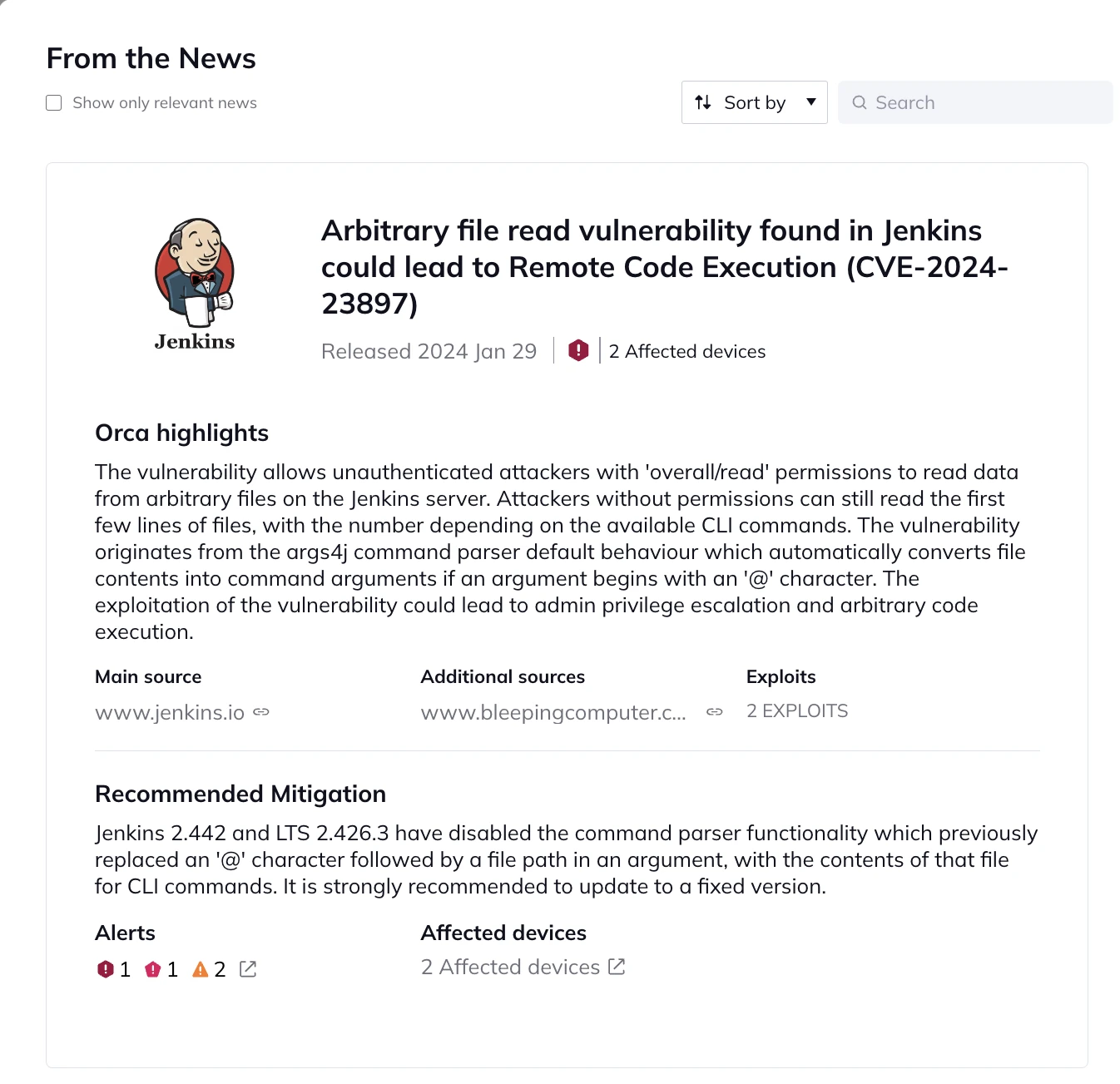
Orca uses SideScanning to collect data from cloud configuration and workload block storage out of band, building an inventory of the cloud estate without deploying agents on workloads. It draws on more than 20 vulnerability data sources and records the OS packages, applications, libraries, and versions on each workload.
Instead of ranking findings by CVSS alone, Orca combines workload data with cloud configuration in its Unified Data Model, so an asset’s context and connections decide which vulnerabilities come first. Attack Path Analysis then models how separate issues combine into routes toward valuable assets, and Orca has added agents of its own, including an AppSec Triage Agent that analyzes SAST findings to identify false positives.
Key features include:
First-generation vulnerability platforms built the categories this list grew out of. Tenable made vulnerability scanning standard practice across networks and infrastructure, Snyk did more than anyone to bring security to developers by putting scanning in the IDE and the pull request, and Nucleus gave teams one place to aggregate findings from every scanner they run. All three are adding AI to established platforms, which gives them broad coverage and a large customer base to build on.

How it reduces false positives: Deduplicates findings and assets from every connected tool before prioritization
Strengths: A large connector library and custom risk scoring models
Things to consider: Setup takes real configuration, and some reviewers would like faster reporting and search
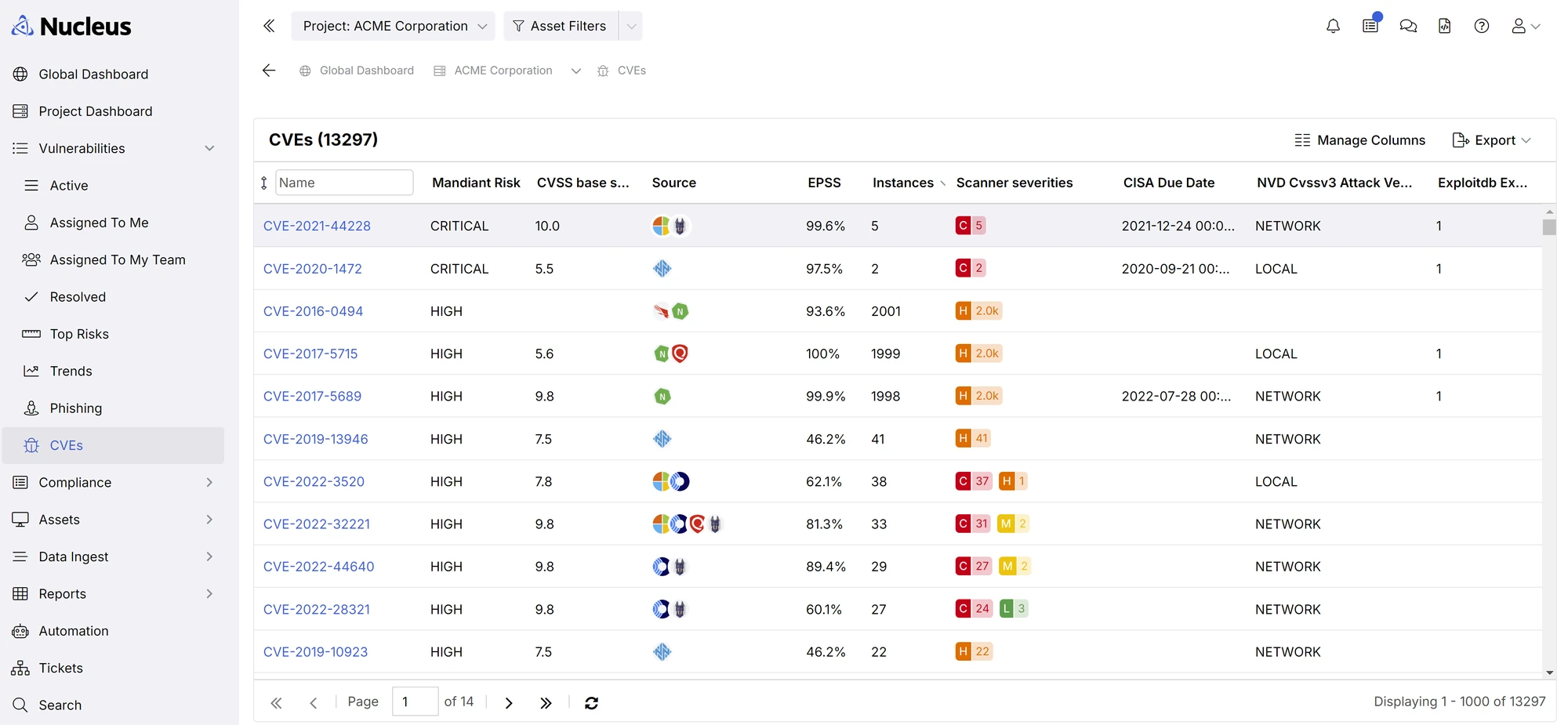
Nucleus is a vulnerability and exposure management platform that ingests, normalizes, and deduplicates data from security and asset tools into a single system of record. Its Live Data Core brings together assets, findings, threat intelligence, and business context, so ownership, business and threat risk factors, and multi-layered applications are all represented.
Nucleus cites more than 200 connectors, plus its FlexConnect integration framework for other sources, covering scanners, cloud security tools, asset management systems, ITSM platforms, threat intelligence feeds, EDR, CSPM, SAST, DAST, and OT tools. Custom risk scoring models sit on top, so prioritization reflects each organization’s own risk tolerance and SLAs.
Key features include:

How it reduces false positives: Prioritizes dependency findings using reachability and application context
Strengths: IDE and pull request fixes across a broad set of scan types
Things to consider: Some reviewers find code scanning noisier than dependency scanning, and costs rise between tiers
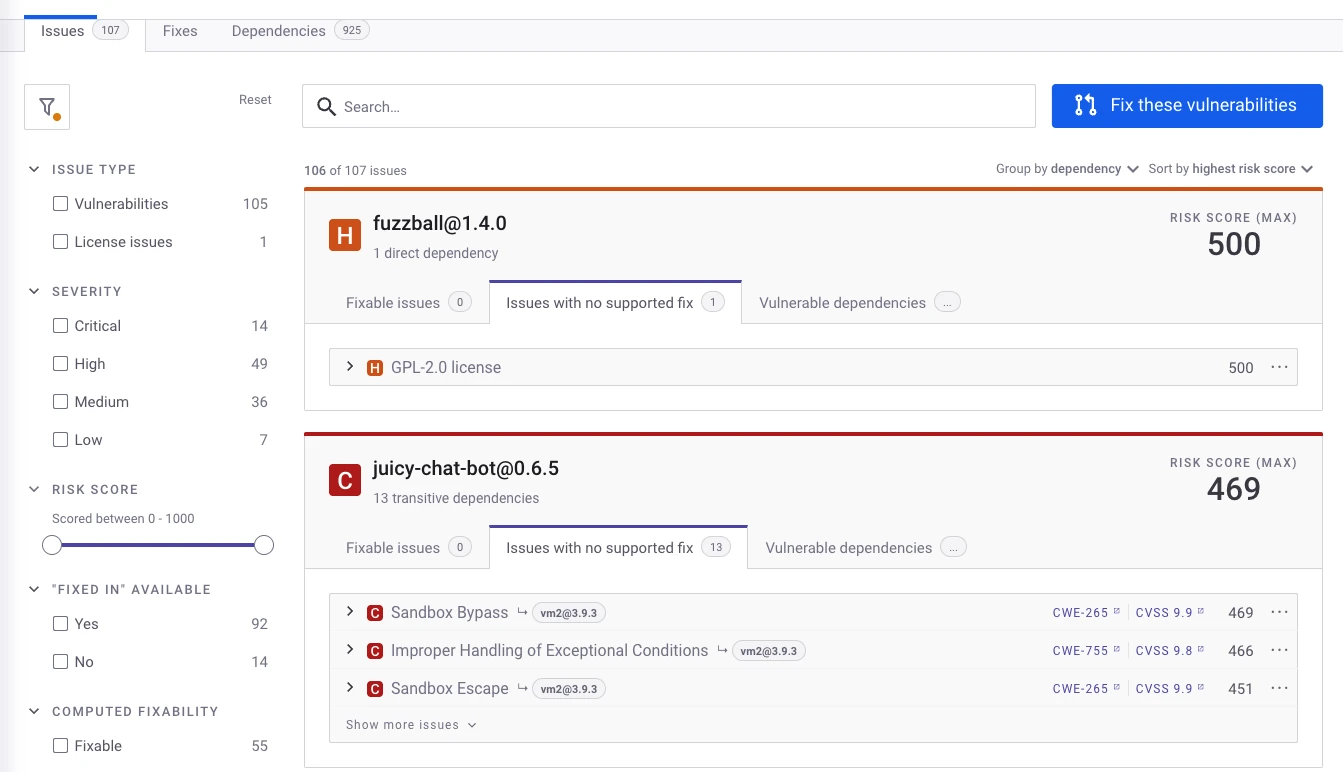
The Snyk AI Security Platform combines proprietary security engines, self-hosted models, and third-party frontier models, with the aim of pairing model reasoning with the repeatability of deterministic validation. Snyk positions itself as an independent validator for AI-generated code, on the principle that the tool generating code shouldn’t be the one validating it.
The platform is organized around six steps, from foundational visibility and prevention guardrails through strategic prioritization, AI-accelerated remediation, governance and measurement, and agentic orchestration through Snyk Evo. Prioritization uses application intelligence, risk scores, and reachability analysis, which is generally available for Java, JavaScript and TypeScript, and Python dependencies.
*Snyk now positions itself as an AI security platform, led by Evo, its agentic security product line.
Key features include:

How it reduces false positives: Adds exploitation likelihood and asset context to severity scores
Strengths: Nessus-based scanning across on-premises and hybrid estates, backed by Tenable Research
Things to consider: Version-based detection can flag backported fixes, and some teams export data to build reports
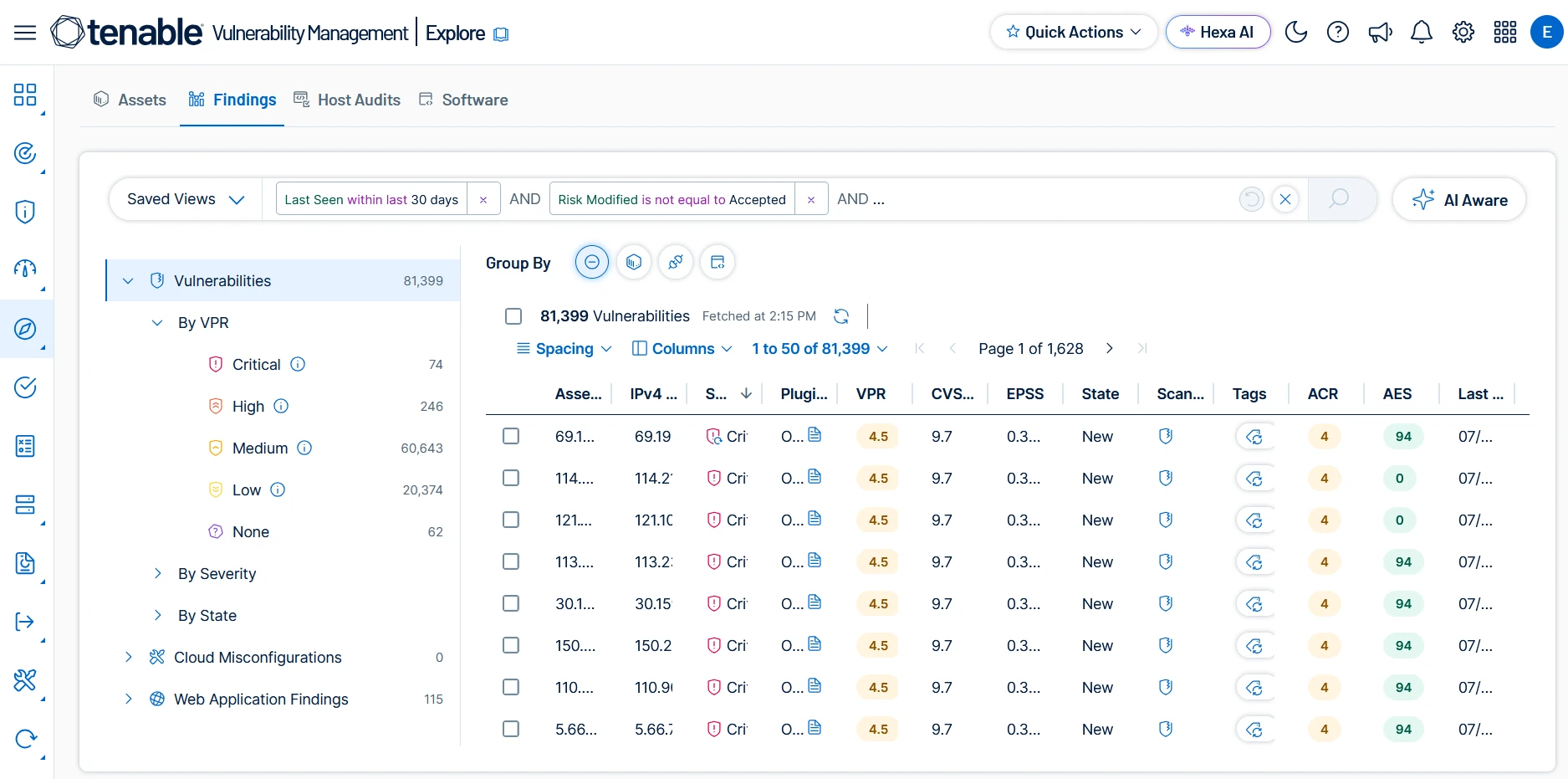
Tenable One Vulnerability Management brings vulnerability data together with broader security data inside the Tenable One exposure management platform. It’s built on Nessus scanning technology and managed in the cloud, with continuous discovery and assessment of known and unknown assets, including dynamic cloud resources and remote workforce endpoints.
Prioritization runs on the Vulnerability Priority Rating (VPR), a machine learning model that predicts how likely a vulnerability is to be exploited, combined with the CVSS impact score. Generative AI tags CVEs that are targeted by ransomware, exploited in the wild, or zero days, and writes threat and remediation summaries. Across the wider Tenable One platform, coverage extends to AI platforms, cloud workloads, containers, OT systems, and identity systems.
Key features include:
AI vulnerability management tools reduce false positives in different ways. Application security platforms, CNAPPs, and first-generation vulnerability platforms add context to scanner output through reachability analysis, attack path graphs, threat intelligence, and aggregation across tools, and that context has made backlogs far more manageable than CVSS alone ever did. AI-native platforms go further and investigate each finding the way a security engineer would, checking whether the conditions for exploitation exist in your environment and closing the ones that can’t be exploited with the reasoning attached.
When you compare tools, ask each vendor to show you the evidence behind a finding it closed. A tool that removes noise without showing its work asks your team to trust a verdict it can’t check, and the point of cutting false positives is to give your team more time and more confidence about what’s left.

[ Vulnerability Management ]

[ Vulnerability Management ]

[ Vulnerability Management ]