[ Vulnerability Management ]
How automated vulnerability management reduces remediation time: 8 solutions compared

Summarize with AI


Summarize with AI
TL;DR: Automated vulnerability management cuts remediation time by removing the manual work between finding a vulnerability and fixing it, and the newest platforms also stop teams from fixing vulnerabilities that can’t be exploited in their environment. Maze is best for AI investigation and fixes across code and cloud, Nucleus Security and Brinqa for consolidating findings from many tools, ServiceNow for routing remediation through ITSM workflows, Tenable for on-premises and hybrid scanning, Qualys for patch correlation across IT, OT, and IoT assets, Rapid7 for attack path analysis, and Automox for automated endpoint patching.
Automated vulnerability management uses software to handle the steps between finding a vulnerability and fixing it, including discovery, deduplication, prioritization, ownership, ticketing, and the fix itself. Most remediation time goes into the work around the fix rather than the fix itself, because someone has to decide whether a finding matters, work out who owns it, and figure out what change will resolve it before anyone touches the code. Automation takes that work off the security team, and AI-native platforms go a step further by investigating each finding the way a security engineer would, so nobody spends time fixing vulnerabilities that can’t be exploited.
Key ways automation reduces remediation time:
Earlier vulnerability management tools scanned on a schedule, often weekly or monthly, so a vulnerability disclosed the day after a scan could sit undetected until the next one. Automated platforms now discover vulnerabilities continuously, through agents on endpoints, API connections to cloud accounts, and scans that run on every pull request, which matters because attackers often start exploiting newly disclosed vulnerabilities within days of publication.
Continuous discovery also removes scan windows and staff availability from the equation, which shortens remediation time in three ways:
Most teams run several scanners, so the same vulnerability often shows up in a cloud scanner, a container scanner, and an SCA tool at once, each with its own ticket. Automated platforms pull findings from every source into one place and merge duplicates into a single record, which keeps two teams from fixing the same issue and gives security one accurate count of what is open.
Earlier tools deduplicated on exact matches, such as the same CVE on the same host, and missed duplicates that looked different from one tool to the next. Newer platforms use AI to recognize that a vulnerable library in a repository, in the container image built from it, and in the workload running that image are one issue with one fix, and they group findings that share a fix so a single change closes all of them.
CVSS rates how severe a vulnerability could be in general, so prioritizing by CVSS alone sends teams after critical findings that may not matter in their environment. Earlier risk-based platforms improved on that by adding exploit signals such as EPSS and the CISA Known Exploited Vulnerabilities (KEV) catalog, along with asset criticality and internet exposure, and many score the result on impact, the damage exploitation would cause, and likelihood, the chance an attacker would actually exploit it. That was a real step forward, but EPSS and KEV describe how attackers use a vulnerability across the internet, not whether it can be triggered in your environment.
AI-native platforms answer that question first, so risk prioritization starts from what an attacker could actually do. They investigate the conditions each vulnerability needs in order to be exploited and check whether those conditions exist, using context from code and cloud, such as:
Only the vulnerabilities that can be exploited are then scored on likelihood and impact, so a critical finding in a staging service that never sees real traffic doesn’t outrank a medium finding in a payment flow. This is where most of the time savings come from, because in Maze’s data 70 to 90% of vulnerabilities can’t be exploited in the environment where they’re found, and every one of those is a fix nobody has to make.
Working out who owns a vulnerable server, container, or repository is one of the slowest parts of remediation, because the answer often lives in someone’s head or in a CMDB that’s out of date. Automated platforms map each vulnerability to an owner using asset ownership, cloud tags, repository ownership, and organizational policy, so the work lands with a person on the day the finding appears instead of sitting unclaimed.
Ownership changes as people move teams and services are re-architected, so the best platforms keep the mapping current by pulling from:
Platforms that trace a vulnerability to its root cause can route it more precisely, because the team that owns a vulnerable base image or dependency is often not the team that owns the workload where the scanner found it.
A ticket that only names a CVE, a host, and “upgrade to the latest version” sends the engineer back to security with questions, and that back-and-forth often takes longer than the fix itself. Automated platforms generate tickets with everything the owner needs to start, including:
Earlier tools usually recommended upgrading to the latest patched version, which is accurate but can break things when it means a major version jump. AI-native platforms trace the root cause and propose a fix that fits the code and the environment, and some open it as a pull request or hand it to a coding agent, so the developer reviews a change instead of researching and writing one.
Automated platforms trigger workflows from policy, based on severity, asset type, business criticality, or SLA, and those workflows can deploy patches, push configuration changes, request approvals, or escalate overdue work. Running each step in order without manual coordination removes the handoffs where remediation usually stalls, especially between security, IT, and engineering.
Orchestration also tracks every step, so stakeholders always know where a fix stands through:
That tracking keeps fixes from going quiet and gives teams the record they need to show auditors that vulnerabilities were remediated on time.
Automated vulnerability management platforms connect to network scanners, cloud and container security tools, and application security testing tools such as SAST, DAST, SCA, and API scanners, and they pull in findings as soon as they’re detected, so nobody has to export and merge spreadsheets.
Bringing infrastructure, application, container, and cloud findings into one workflow also lets a team see when a code vulnerability and a cloud vulnerability are the same problem. Some newer platforms use AI to find code vulnerabilities themselves rather than only collecting findings from other scanners, which removes an integration and a source of duplicates.
Software composition analysis (SCA) finds vulnerable open-source libraries and third-party packages, direct and transitive, across the software development lifecycle, and alerts teams when a newly disclosed vulnerability affects code they’ve already shipped. Most of these findings never matter in practice, because the vulnerable function is never called or an attacker can’t reach it.
Earlier SCA tools used call graphs to check reachability, which cut noise but tends to break at dynamic calls, framework routing, and calls through other open-source packages, leaving many findings unresolved. Newer tools use AI to trace the path from an entry point to the vulnerable function and then check whether the dependency is exploitable where the code runs, and they recommend the version change that fixes the vulnerability without breaking the build.
Threat intelligence integrations add exploit availability, ransomware use, proof-of-concept code, and evidence of exploitation in the wild to each finding, which helps teams separate vulnerabilities that attackers are actively using from those that only look severe on paper. Risk enrichment combines that external view with internal context such as asset criticality, internet exposure, and existing controls, and updates scores as threats change.
Threat intelligence works best as one input rather than the final answer, because a vulnerability in the CISA KEV catalog still can’t be used against a system where its prerequisites don’t exist. The best platforms combine threat intelligence with an investigation of whether the vulnerability can be triggered in that specific environment.
Automated platforms integrate with CMDBs, cloud inventory services, endpoint management systems, identity providers, and source code repositories to keep an accurate inventory of assets and applications, which links each vulnerability to the system, service, and repository where it lives.
Ownership mapping then connects each asset or application to the responsible team or person, so the platform routes work automatically instead of someone working out who owns a vulnerable server or container. The most useful mapping also connects code to cloud, showing which repository built the image running in a given workload, because that’s the link a team needs to fix a vulnerability at the source rather than in production.
Integrations with Jira, ServiceNow, Azure DevOps, and GitHub Issues turn prioritized vulnerabilities into tickets automatically, with the technical details, remediation guidance, deadlines, and risk information an engineer needs, and two-way sync keeps status current in both systems.
Source code integrations link vulnerabilities to the repositories, pull requests, and developers they affect, so developers fix issues in the tools they already use. Platforms that open a pull request with the fix, or hand it to a coding agent such as Claude Code or Cursor, shorten remediation further because the developer reviews and merges a change instead of researching and writing it.
Automation integrates with patch management, endpoint management, infrastructure-as-code, and configuration management tools to deploy approved updates with little manual effort, applying operating system patches, application updates, dependency upgrades, and configuration changes according to policy.
Automated deployments also need a way back, so the best platforms test updates on a subset of systems first, validate the result, and roll back or notify administrators when a change causes problems. When no patch exists, some platforms push a mitigation instead, such as disabling a vulnerable service or tightening a configuration, which closes the exposure until a fix ships.
Policy engines decide how each vulnerability is handled based on severity, asset type, business criticality, regulatory requirements, or service-level objectives, and they trigger notifications, ticket creation, approvals, patch deployment, or escalation without anyone deciding each case by hand.
After remediation, automated validation rescans the asset or rechecks the configuration to confirm the vulnerability is gone, which keeps findings from being closed by mistake and gives teams accurate reporting on remediation progress and compliance.
The table below summarizes how each platform in this guide reduces remediation time, what it does best, and where users report friction, and the sections that follow cover each one in more detail.
| Category | Solution | How it reduces remediation time | Key strengths | Things to consider |
|---|---|---|---|---|
| AI-native vulnerability management | Maze | Investigates every code and cloud vulnerability with AI, so teams only fix the exploitable ones, and delivers fixes where developers work | AI that finds and investigates every vulnerability, exploitability verdicts with evidence, fixes routed to the owner | SaaS only, and cloud findings come from the scanners you already run |
| Risk-based vulnerability management | Nucleus Security | Consolidates findings from 200+ tools and automates ownership, ticketing, and SLAs | 200+ connectors, two-way ticketing with SLA tracking, Helix AI engine | Workflows take up-front setup, and some reviewers want more flexible reporting |
| Risk-based vulnerability management | Brinqa | Deduplicates exposure data with AI and enriches findings with ownership and business context before routing them | CyberRisk Graph, AI deduplication and attribution agents, SmartFlows automation | Takes time to learn, and connecting every data source takes effort |
| Risk-based vulnerability management | ServiceNow Unified Security Exposure Management | Maps vulnerabilities to CMDB assets and routes remediation through ITSM workflows with SLAs | CMDB mapping, SLA-driven routing, remediation in the same workflow IT already uses | Results depend on accurate CMDB data, and reports can be slow to generate |
| Vulnerability scanning and patch management | Tenable One Vulnerability Management | Discovers assets continuously across on-premises, cloud, and remote endpoints, and pushes work out through ticketing and patching | On-premises and hybrid scanning, two-way ticketing, guarded patching | Asset-based licensing takes planning, and teams often export data for custom reports |
| Vulnerability scanning and patch management | Qualys VMDR | Correlates vulnerabilities with the patches that fix them and builds ready-to-deploy patch jobs | Automatic patch correlation, IT, OT, and IoT asset coverage, no-code QFlow automation | Older and newer console areas sit side by side, and some modules are licensed separately |
| Vulnerability scanning and patch management | Rapid7 InsightVM | Groups vulnerabilities into remediation projects with SLAs and automates ticketing and workflows | Attack path analysis, remediation projects, no-code automation | The console takes expertise to maintain, and large scans use a lot of resources |
| Vulnerability scanning and patch management | Automox | Imports scanner findings, maps them to patches or mitigations, and deploys and validates the fix on endpoints | Vulnerability Sync, cross-platform patch policies, Worklet mitigations | No automatic patch rollback, and some reviewers want deeper reporting |
How we selected these platforms: We shortlisted automated vulnerability management platforms based on the capabilities that shorten remediation time, which are consolidation and deduplication of scanner data, risk-based and exploitability-based prioritization, automated ownership assignment and ticketing, workflow orchestration, and automated patch or configuration deployment.
AI-native platforms start from how a security engineer would investigate a vulnerability with unlimited time, gathering the context it needs and checking whether it can be exploited, and they build their AI to work that way. That cuts remediation time at the source, because the vulnerabilities that can’t be exploited never become tickets in the first place.
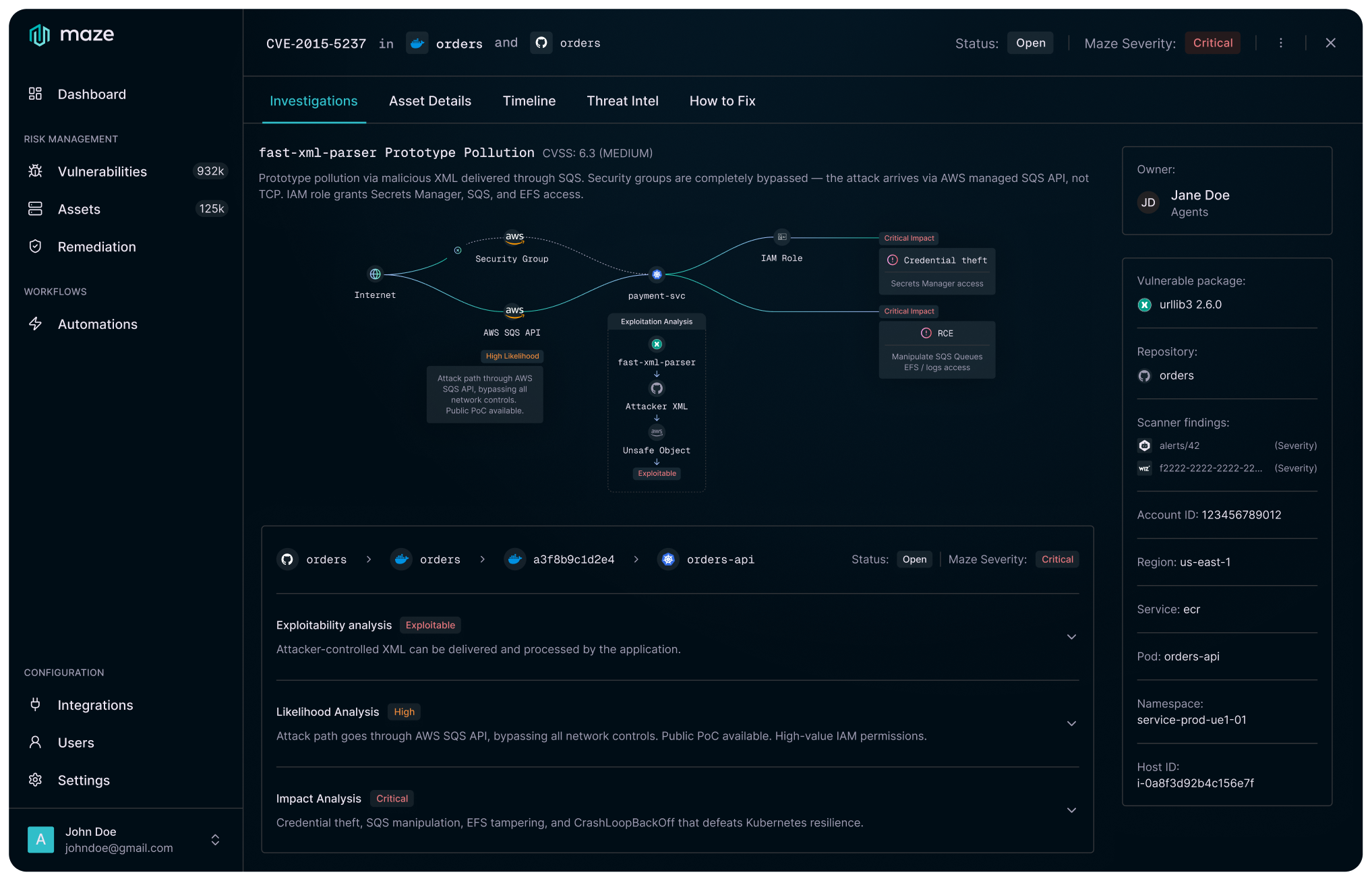
How it reduces remediation time: Investigates every code and cloud vulnerability with AI, so teams only fix the exploitable ones, and delivers those fixes where developers work
Strengths: AI that finds and investigates every vulnerability, exploitability verdicts with evidence, fixes routed to the owner
Things to consider: SaaS only, and cloud findings come from the scanners you already run
Maze’s founders worked closely with security teams and kept running into the same problem. Their tools flagged far more vulnerabilities than anyone could investigate and couldn’t gather the context needed to tell which ones mattered, so teams patched by severity score and spent much of their time fixing vulnerabilities that were never a real risk. Maze is the AI-native vulnerability management platform they built to change that.
Given unlimited time, a security engineer would handle each vulnerability by working out what has to be true for it to be exploited, then checking your code, your build, and your cloud to see whether those conditions exist. Maze’s AI was built to think the same way, deciding what context each finding needs and gathering it for itself, so every vulnerability gets that investigation instead of a score from static rules. That’s where most remediation time goes, because a team that can rule out the vulnerabilities that can’t be exploited has far fewer fixes to make and no longer has to argue with engineering about whether each one is real.
Maze uses AI to find the vulnerabilities in your code, with AI-SAST for the code your team writes and AI-SCA for your dependencies, and Maze Cloud investigates the vulnerabilities your existing scanners find in the workloads running in your cloud. For the ones that are exploitable, Maze traces the root cause, writes a fix that matches your code, and gets it to the developer who owns it with the evidence behind the verdict attached.
Key features include:
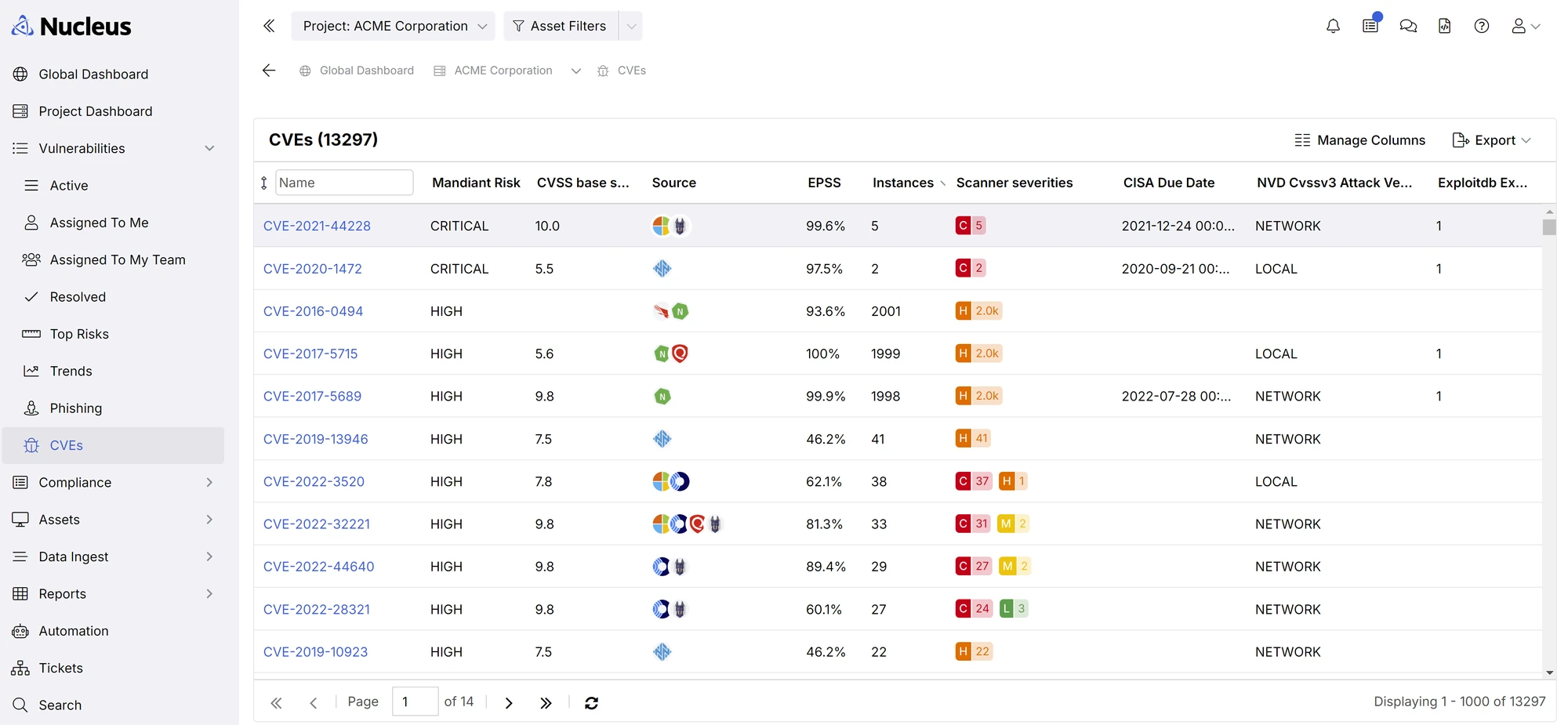
Risk-based vulnerability management platforms sit on top of the scanners a team already runs and pull every finding into one place. They shorten remediation time by deduplicating findings, scoring them with threat intelligence and business context, and automating ownership, ticketing, and SLAs, and several have since added AI to parts of that workflow, such as deduplication, ownership attribution, and analyst assistance.

How it reduces remediation time: Consolidates findings from 200+ tools and automates ownership, ticketing, and SLAs
Strengths: 200+ connectors, two-way ticketing with SLA tracking, Helix AI engine
Things to consider: Workflows take up-front setup, and some reviewers want more flexible reporting
Nucleus Security is a vulnerability and exposure management platform that sits above a team’s scanners rather than replacing them. Nucleus Data Core ingests findings from more than 200 sources, then normalizes, deduplicates, and enriches them into connected records for assets, findings, threat intelligence, users, and tickets.
On top of that data, teams define their own risk models, automate handling through the Dynamic Automation Framework, and query everything with Nucleus Query Language. Remediation workflows assign owners, open two-way tickets, track SLAs, and manage exceptions, and Nucleus Helix, launched in August 2026, adds an AI engine with reasoning agents across the platform. Nucleus is FedRAMP Moderate authorized, which makes it a common choice for public sector and regulated teams.
Key features include:
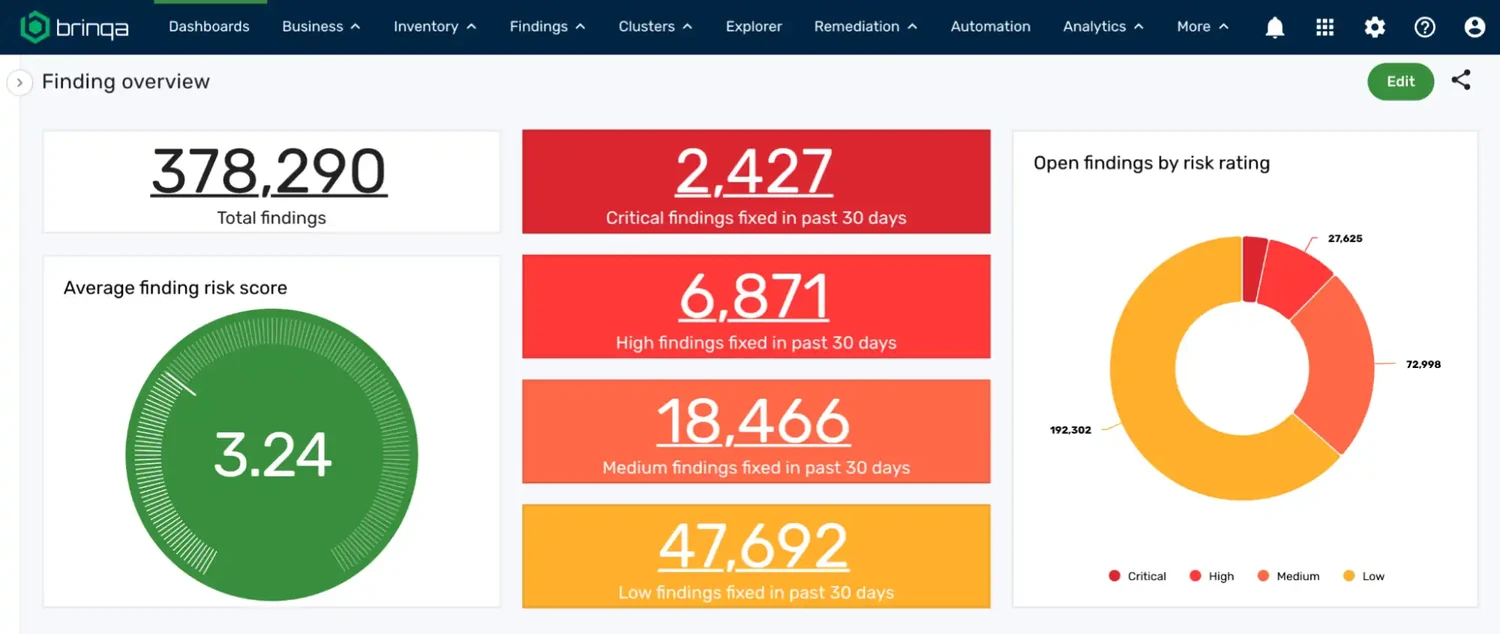
How it reduces remediation time: Deduplicates exposure data with AI and enriches findings with ownership and business context before routing them
Strengths: CyberRisk Graph, AI deduplication and attribution agents, SmartFlows automation
Things to consider: Takes time to learn, and connecting every data source takes effort
Brinqa is an exposure management platform built on a unified data model that ingests exposure data from more than 260 security, IT, cloud, identity, application, and business tools. The CyberRisk Graph keeps the relationships between assets, vulnerabilities, identities, environments, and business context, so prioritization draws on how things connect rather than on isolated findings.
Brinqa’s AI works on top of that graph. The AI Deduplication Agent merges findings that several tools report for the same underlying exposure into one record and explains why, and the AI Attribution Agent fills in asset relationships, ownership, and business context. SmartFlows then turns prioritized exposures into tickets, routing, and notifications through policy-driven automation, which removes the hand-offs where remediation usually stalls.
Key features include:

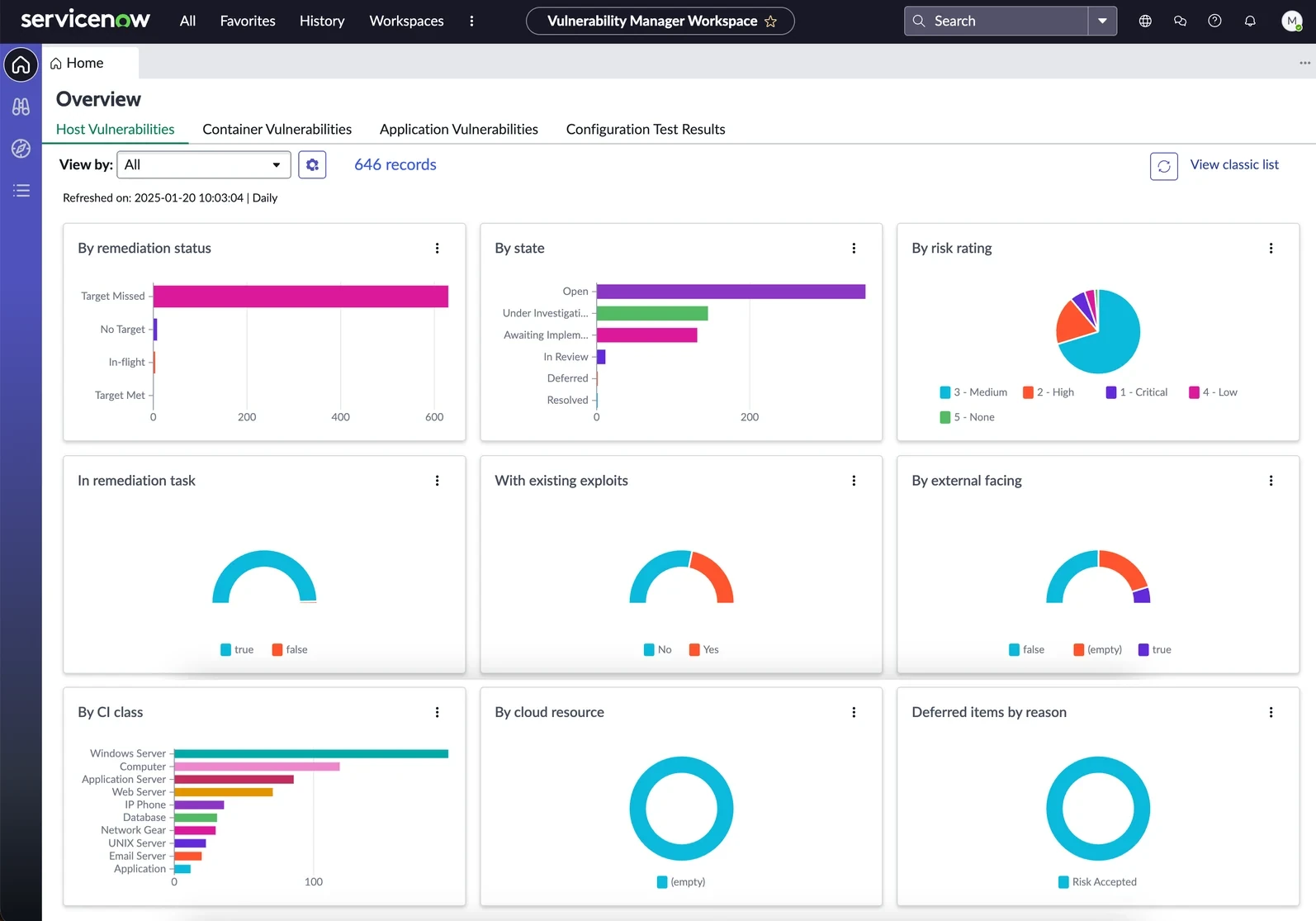
How it reduces remediation time: Maps vulnerabilities to CMDB assets and routes remediation through ITSM workflows with SLAs
Strengths: CMDB mapping, SLA-driven routing, remediation in the same workflow IT already uses
Things to consider: Results depend on accurate CMDB data, and reports can be slow to generate
ServiceNow Unified Security Exposure Management (USEM) is the next evolution of ServiceNow Vulnerability Response. It brings Vulnerability Response, Application Vulnerability Response, Container Vulnerability Response, and Configuration Compliance into one architecture on the ServiceNow AI Platform, and maps each finding to the CMDB so asset and business context travel with it.
Prioritization applies threat intelligence and AI risk scoring, and remediation is routed with SLAs to IT, development, and cloud teams through the same ticketing and change management processes used elsewhere in ServiceNow. For teams that already run IT on ServiceNow, that removes the hand-off between a security tool and the system where the work actually gets done. Existing Vulnerability Response customers move to USEM through a migration assistant.
Key features include:
These platforms find vulnerabilities on the assets they cover and help deploy the patches that fix them, so the step from detection to fix happens in one place. Tenable, Qualys, and Rapid7 scan on-premises, cloud, and hybrid environments and build remediation into the same platform, while Automox starts from patching, importing findings from those scanners and deploying the fix to every affected endpoint.
How it reduces remediation time: Discovers assets continuously across on-premises, cloud, and remote endpoints, and pushes work out through ticketing and patching
Strengths: On-premises and hybrid scanning, two-way ticketing, guarded patching
Things to consider: Asset-based licensing takes planning, and teams often export data for custom reports
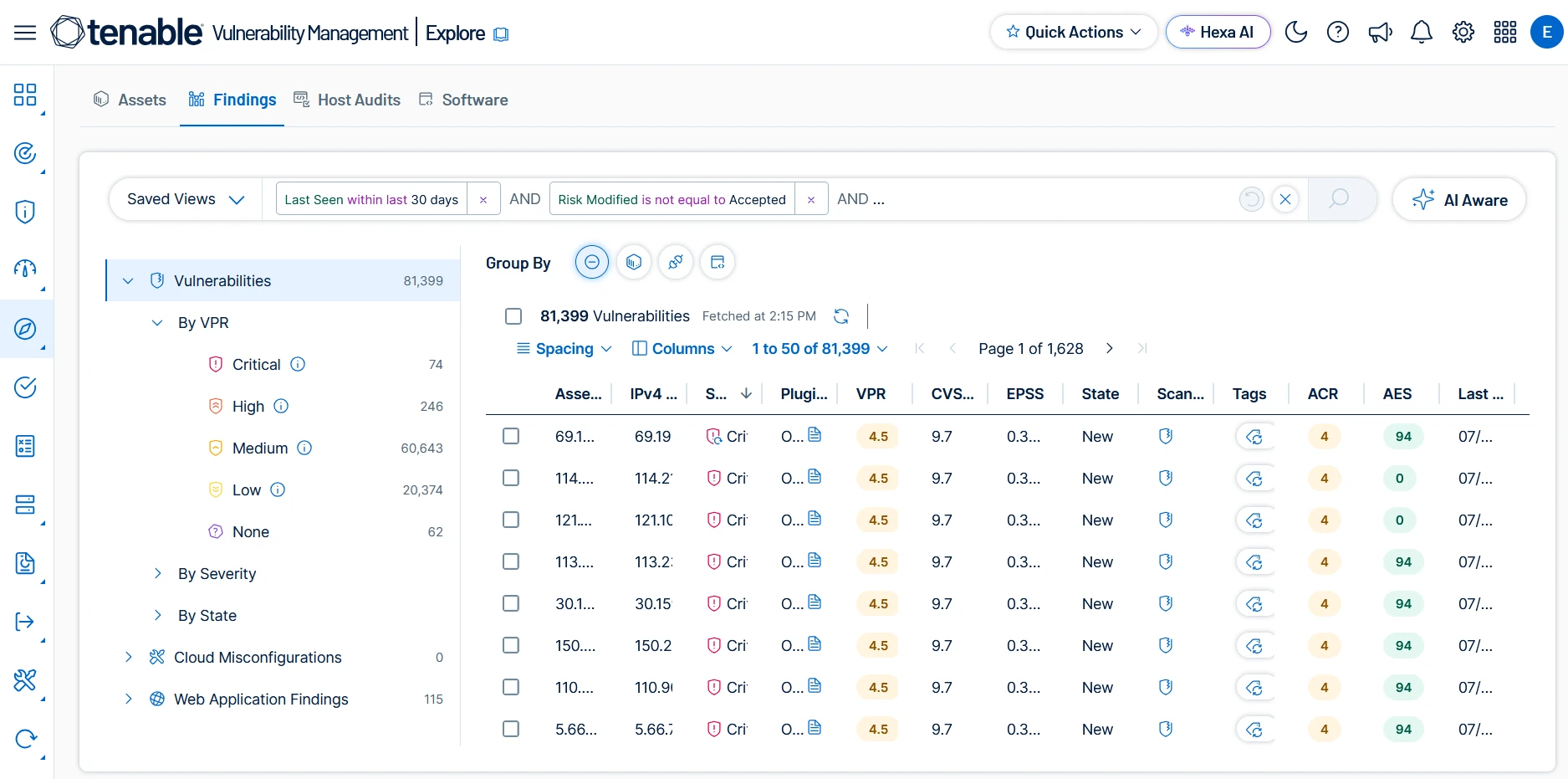
Tenable One Vulnerability Management is built on Nessus scanning technology and delivered within the Tenable One exposure management platform. Always-on discovery and assessment covers known and unknown assets, including dynamic cloud resources and remote workforce endpoints that periodic scans tend to miss, and findings are put in context with research from Tenable’s own team.
Prioritization runs on the Vulnerability Priority Rating, which combines generative AI, enriched threat intelligence, and context-aware scoring to show each vulnerability’s impact, how weaponized it is, and the action that fixes it. Remediation moves through two-way ticketing, and Tenable Patch Management adds autonomous patching under guardrails and SLAs, which shortens the gap between ranking a vulnerability and deploying the fix.
Key features include:
How it reduces remediation time: Correlates vulnerabilities with the patches that fix them and builds ready-to-deploy patch jobs
Strengths: Automatic patch correlation, IT, OT, and IoT asset coverage, no-code QFlow automation
Things to consider: Older and newer console areas sit side by side, and some modules are licensed separately
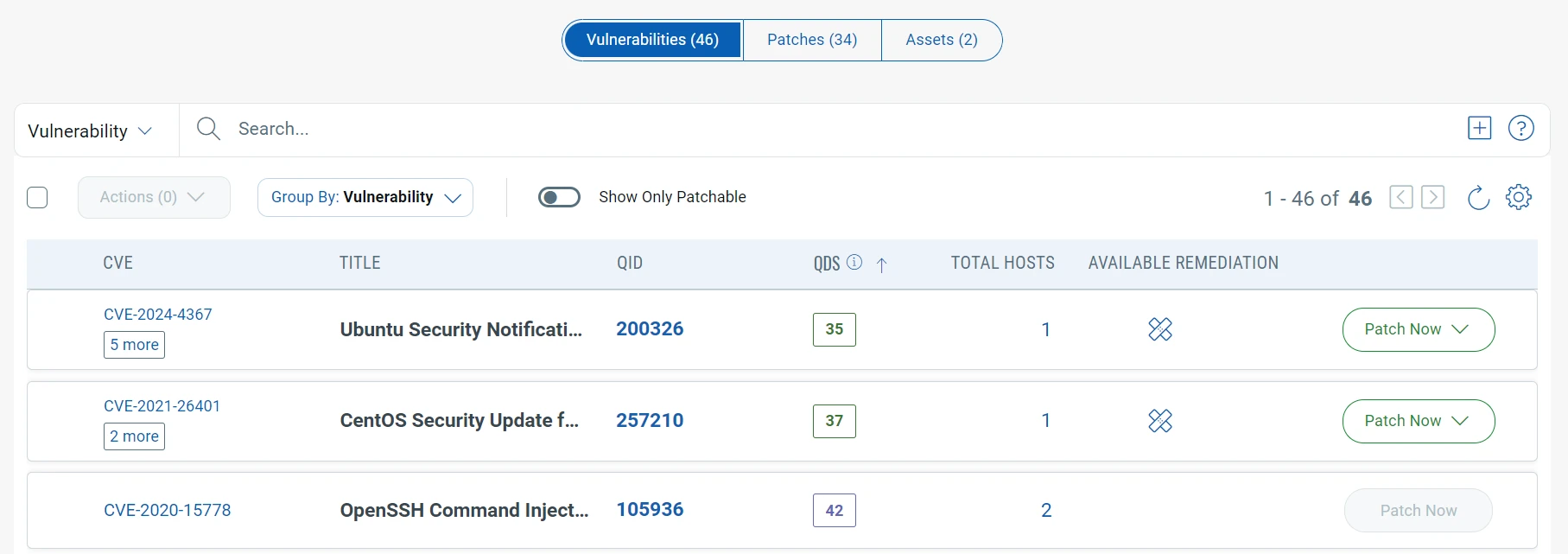
Qualys VMDR combines asset discovery, vulnerability and misconfiguration detection, risk-based prioritization, and patch deployment in one application on the Enterprise TruRisk Platform. It inventories IT, OT, and IoT assets along with cloud, container, mobile, and certificate inventory, and adds detail such as hardware and software end-of-life status.
TruRisk quantifies risk across vulnerabilities, assets, and asset groups, and threat indicators such as Exploitable, Actively Attacked, and High Lateral Movement show what is at risk right now. VMDR then correlates each vulnerability with the latest superseding patch and builds ready-to-deploy patch jobs, so the step from finding to fix happens in the same place.
Key features include:

How it reduces remediation time: Groups vulnerabilities into remediation projects with SLAs and automates ticketing and workflows
Strengths: Attack path analysis, remediation projects, no-code automation
Things to consider: The console takes expertise to maintain, and large scans use a lot of resources
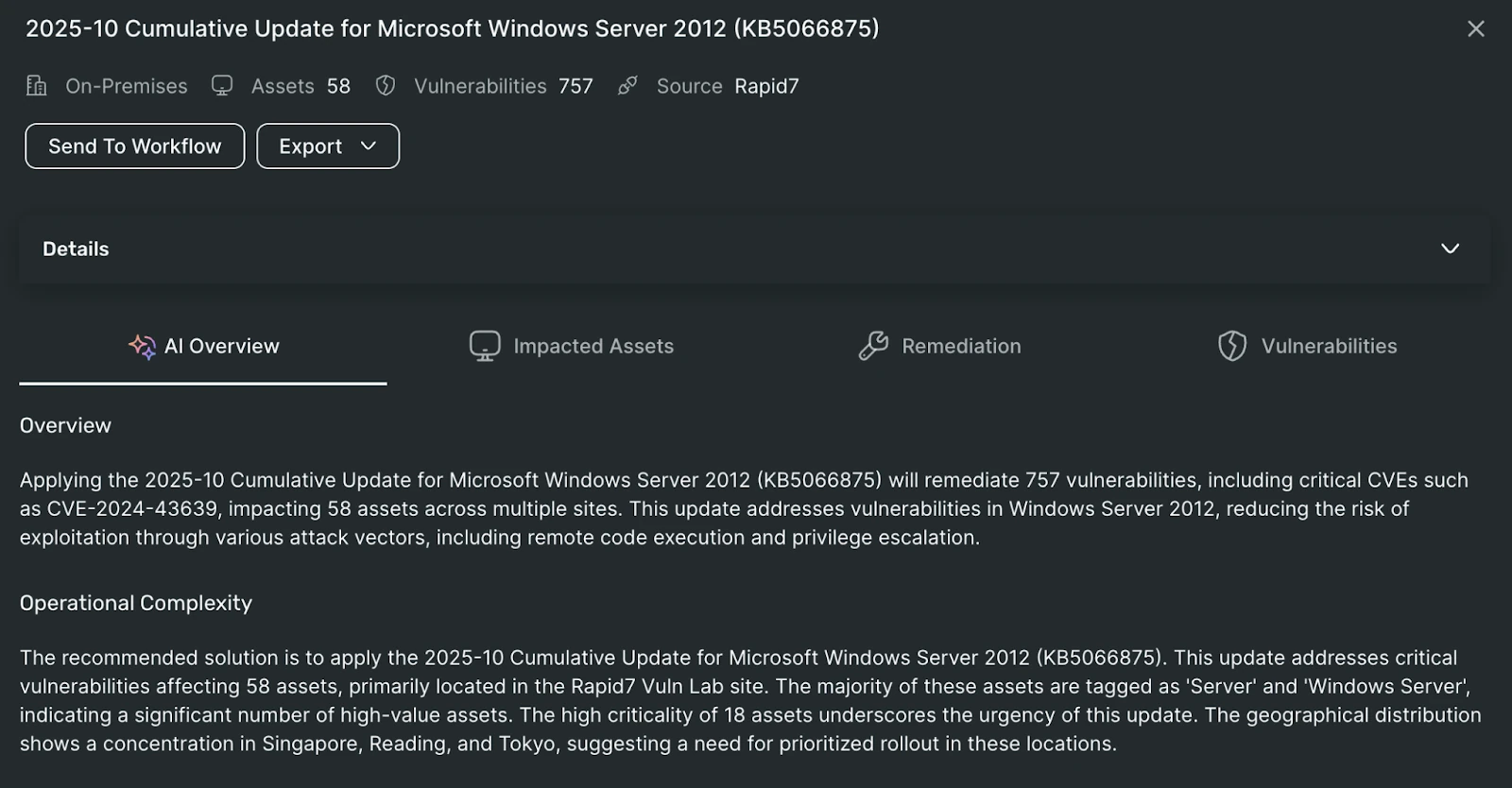
InsightVM is Rapid7’s vulnerability management technology and is now delivered as part of Exposure Command. Exposure Command Essentials pairs the InsightVM scanner with attack surface management, and Exposure Command Ultimate adds cloud and application security context, while a standalone InsightVM trial and on-premises deployment path remain available.
Prioritization uses exploit likelihood, reachability, severity, and business context, combining Rapid7’s own telemetry with third-party findings from tools a team already runs. Remediation runs through projects with SLAs, no-code automation, and automated ticketing, which gives each owner a defined scope of work and a deadline.
Key features include:
How it reduces remediation time: Imports scanner findings, maps them to patches or mitigations, and deploys and validates the fix on endpoints
Strengths: Vulnerability Sync, cross-platform patch policies, Worklet mitigations
Things to consider: No automatic patch rollback, and some reviewers want deeper reporting
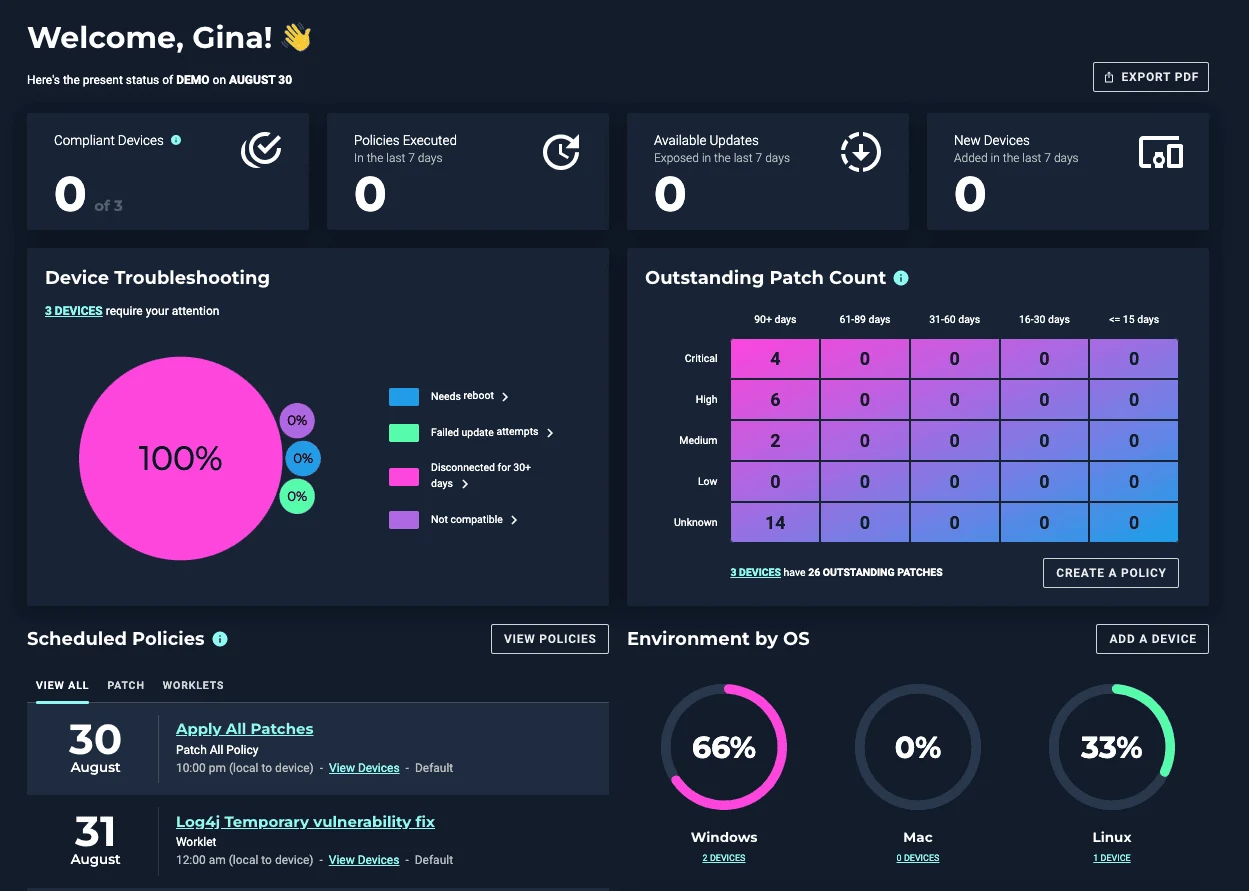
Automox is a cloud-native endpoint management platform, and its Vulnerability Sync feature turns scanner findings into patched endpoints from one console. Scanner reports are imported, mapped automatically to the patches that fix each CVE, and organized into prioritized batches that show what is patchable, what needs another action, and which endpoints are affected.
Patches are approved, scheduled, and deployed from policy, and when no patch exists, Worklets push the mitigation itself to every affected endpoint. Remediation status flows back into the same view as the findings, so IT and security work from one list instead of trading spreadsheets. Vulnerability Sync remediation tasks currently run on Windows and Linux and require the Automox agent.
Key features include:
Automated vulnerability management reduces remediation time by removing the manual work between finding a vulnerability and fixing it, from consolidating scanner output and assigning owners to opening tickets, deploying patches, and confirming the fix worked. The biggest gains now come from not fixing what doesn’t need fixing, because AI that investigates whether each vulnerability can be exploited in your environment clears most of the queue before a ticket is ever opened, and the fixes that remain arrive with the evidence and the change already written.
[ Vulnerability Management ]

[ Vulnerability Management ]
[ Vulnerability Management ]