[ Vulnerability Management ]



What Is Vulnerability Management?
Vulnerability management is the continuous, proactive process of identifying, evaluating, prioritizing, and mitigating security weaknesses across an organization’s digital assets. Its primary goal is to reduce exploitable risk and prevent cyberattacks before they can disrupt business operations.
Effective vulnerability management requires coordination across security, IT, and development teams to ensure vulnerabilities are addressed promptly and according to risk. Organizations must combine automated tools with human expertise to prioritize which vulnerabilities to fix based on potential business impact, exploitability, and regulatory requirements.
A mature vulnerability management program cycles through four core phases:
1. Identification:
- Asset discovery: Maintaining continuous visibility into all endpoints, servers, cloud workloads, and network devices.
- Scanning: Utilizing automated tools to detect known software flaws, misconfigurations, and outdated protocols.
2. Prioritization:
- Contextual analysis: Ranking vulnerabilities by severity (e.g., using CVSS scores) combined with real-world threat intelligence and asset importance.
- Exploitability: Factoring in the likelihood of a vulnerability being exploited in the wild.
3. Remediation:
- Patching: Applying vendor-issued software updates and patches to eliminate the flaw.
- Configuration & controls: Modifying system settings or applying compensating controls (like a web application firewall) if a patch isn’t immediately available.
4. Verification & reporting:
- Validation: Re-scanning patched or altered systems to verify that the vulnerability has been successfully mitigated.
- Metrics and auditing: Tracking the organization’s overall exposure score and compliance metrics over time.
In this article:
- Why Is Vulnerability Management Important?
- Vulnerability Management vs. Vulnerability Scanning
- Vulnerability Management vs. Vulnerability Assessment
- The Vulnerability Management Lifecycle
- Vulnerability Management Metrics
- Understanding Cloud Vulnerability Scanning
- Common Vulnerability Management Challenges
- Gartner’s Vulnerability Management Paradigm and the Shift Toward Exposure Management
- Vulnerability Management Best Practices
Why Is Vulnerability Management Important?
Vulnerability management reduces security risk and improves an organization’s security posture. As IT environments grow more complex, new vulnerabilities are discovered daily across operating systems, applications, cloud services, and third-party components. Without a structured process to identify and remediate these issues, organizations increase their exposure to cyberattacks, data breaches, and operational disruptions.
Key reasons vulnerability management is important include:
- Reduces the overall attack surface: Vulnerability management helps organizations identify outdated software, misconfigurations, and unpatched systems that attackers target. By fixing these weaknesses early, organizations reduce possible entry points.
- Prevents cyberattacks and data breaches: Many security incidents occur because known vulnerabilities remain unpatched. Continuous vulnerability management reduces the likelihood of ransomware attacks, unauthorized access, privilege escalation, and data theft.
- Improves risk prioritization: Not all vulnerabilities carry the same level of risk. Vulnerability management allows teams to evaluate vulnerabilities based on severity, exploitability, asset importance, and business impact.
- Supports regulatory compliance: Many regulations and security frameworks require vulnerability management programs. Standards such as PCI DSS, HIPAA, ISO 27001, SOC 2, and NIST include requirements for regular assessments, patch management, and remediation tracking.
- Enhances visibility into IT assets: Vulnerability management provides better visibility into devices, applications, operating systems, cloud resources, and third-party software.
- Strengthens patch management processes: Vulnerability management helps maintain consistent patching workflows by identifying missing updates and tracking remediation progress.
- Minimizes operational disruptions: Security incidents caused by exploited vulnerabilities can lead to downtime, service interruptions, financial losses, and reputational damage.
Vulnerability Management vs. Vulnerability Scanning
Vulnerability scanning is a component of vulnerability management, which refers to the automated process of detecting known vulnerabilities in an organization’s assets. It typically involves running tools that compare system configurations and software versions against databases of known issues, such as CVEs (common vulnerabilities and exposures).
Vulnerability management encompasses the workflow from detection to remediation and verification. It includes prioritizing vulnerabilities, coordinating remediation, verifying resolution, and reporting on progress. Scanning is the first step; without a management process, vulnerabilities may go unaddressed.
Vulnerability Management vs. Vulnerability Assessment
Vulnerability assessment is a discrete process that identifies, quantifies, and prioritizes vulnerabilities in a system. It often results in a point-in-time report detailing security gaps and recommendations. Assessments are typically conducted periodically or in response to events such as new deployments or compliance audits.
Vulnerability management is an ongoing discipline that incorporates assessment as one stage. While an assessment provides a snapshot, vulnerability management ensures continuous monitoring, prioritization, remediation, and verification. Organizations that rely only on periodic assessments may miss emerging threats.
The Vulnerability Management Lifecycle
Identification
Identification is the first phase of the vulnerability management lifecycle and involves discovering all assets within the organization’s environment, including on-premises, cloud, and remote endpoints. Asset discovery must be comprehensive to ensure no device, application, or service is overlooked. Unidentified assets can harbor unpatched vulnerabilities. Automated tools are typically used for scanning and asset inventory, but manual processes may be necessary for legacy or nonstandard systems.
Once assets are cataloged, vulnerability identification begins. This involves running scanners that check for outdated software, misconfigurations, and missing patches. The process should be frequent and consistent, as new vulnerabilities are discovered daily.
Prioritization
After vulnerabilities are identified, prioritization determines which issues require immediate attention. Not all vulnerabilities pose the same risk; some are difficult to exploit, while others have active exploits. Factors influencing prioritization include asset criticality, exploit availability, business impact, and internet exposure. Organizations often use frameworks such as CVSS in combination with threat intelligence to rank vulnerabilities.
Effective prioritization ensures limited resources focus on significant risks. Without this step, teams may patch low-impact vulnerabilities while ignoring those that could lead to breaches. Prioritization must adapt to changes in the threat landscape and business environment.
Remediation
Remediation is the process of fixing or mitigating identified vulnerabilities. This can involve applying patches, updating configurations, disabling vulnerable services, or implementing compensating controls. The strategy depends on the vulnerability, the criticality of the affected asset, and operational constraints such as uptime requirements or legacy system compatibility.
Remediation must be tracked to completion. This requires coordination between security, IT, and development teams, clear responsibilities, and defined timelines. If immediate remediation is not possible, temporary mitigations should be implemented while permanent solutions are developed.
Verification and Reporting
Verification ensures remediation efforts have addressed identified vulnerabilities. This typically involves re-scanning assets after patches or mitigations are applied, as well as manual validation for complex issues.
Reporting provides visibility into the vulnerability management process for stakeholders. Reports should detail remediation progress, outstanding vulnerabilities, trends over time, and compliance with internal or regulatory standards.
Vulnerability Management Metrics
Operational Metrics
Operational metrics measure the efficiency and effectiveness of daily vulnerability management activities. Common operational metrics include:
- Mean time to detect (MTTD)
Measures the average time required to identify vulnerabilities after they are introduced. - Mean time to remediate (MTTR)
Tracks how long it takes to fix vulnerabilities after discovery. - Patch compliance rate
Indicates the percentage of systems with required patches installed within defined service-level agreements (SLAs). - Vulnerability recurrence rate
Measures how often previously remediated vulnerabilities reappear. - Scan coverage
Tracks the percentage of known assets regularly scanned. - Open vulnerabilities by severity
Shows the number of unresolved vulnerabilities categorized by severity. - SLA compliance for remediation
Measures whether vulnerabilities are remediated within defined timelines. - False positive rate
Evaluates how many reported vulnerabilities are incorrectly identified.
Risk Metrics
Risk metrics focus on the organization’s exposure to security threats. Common risk metrics include:
- Critical vulnerability exposure
Measures the number of critical vulnerabilities affecting high-value or internet-facing assets. - Risk score by asset group
Aggregates vulnerability severity and asset importance into a risk score for business units or infrastructure segments. - Exploit availability
Tracks vulnerabilities with publicly available exploit code or active exploitation. - Internet-exposed vulnerabilities
Identifies vulnerabilities affecting systems accessible from the internet. - Unpatched vulnerability age
Measures how long vulnerabilities remain unresolved. - Asset criticality exposure
Evaluates vulnerabilities based on the business importance of affected assets. - Risk reduction over time
Tracks whether total vulnerability-related risk is decreasing. - Third-party and supply chain risk
Measures vulnerabilities associated with third-party software, vendors, and service providers.
Executive Metrics
Executive metrics provide high-level visibility into program effectiveness. Common executive metrics include:
- Overall security posture trend
Indicates whether vulnerability risk is improving, stable, or increasing. - Percentage of critical vulnerabilities remediated
Shows the proportion of critical issues resolved within target timelines. - Compliance status
Measures alignment with regulatory requirements and security frameworks. - Top business risks
Highlights the most significant unresolved vulnerabilities affecting critical systems. - Remediation performance by team
Shows how effectively business units or IT teams address vulnerabilities. - Vulnerability backlog trends
Tracks whether unresolved vulnerabilities are increasing or decreasing. - Incident correlation metrics
Measures how many security incidents were linked to known but unremediated vulnerabilities. - Program maturity indicators
Evaluates maturity based on automation, asset visibility, remediation speed, and reporting.
Understanding Cloud Vulnerability Scanning
Cloud vulnerability scanning is the process of identifying security weaknesses across cloud-based workloads, services, applications, and configurations. Unlike traditional vulnerability scanning, which often focuses on static networks and endpoints, cloud vulnerability scanning must account for dynamic infrastructure, ephemeral workloads, containers, serverless functions, managed services, identity permissions, and internet-facing exposure.
Cloud environments change frequently as teams deploy new resources, update workloads, scale applications, and modify access policies. As a result, vulnerability scanning in the cloud should be continuous rather than periodic. It should also combine software vulnerability detection with configuration analysis, network exposure assessment, container image scanning, and workload context.
Effective cloud vulnerability scanning helps organizations identify risks such as:
- Unpatched virtual machines
- Vulnerable container images
- Insecure serverless functions
- Exposed ports and services
- Misconfigured cloud resources
- Outdated packages and libraries
- Publicly reachable workloads
- Weak or excessive permissions
- Vulnerabilities in application dependencies
Let’s review how vulnerability scanning works in common cloud environments.
AWS Vulnerability Scanning
In Amazon Web Services, vulnerability scanning commonly focuses on EC2 instances, container images, Lambda functions, and network exposure. AWS provides Amazon Inspector, a native vulnerability management service that automatically discovers supported workloads and scans them for software vulnerabilities and unintended network exposure.
AWS vulnerability scanning should include both runtime workloads and build-time assets. For example, organizations should scan EC2 instances for missing patches and vulnerable packages, scan container images in Amazon Elastic Container Registry before deployment, and assess Lambda functions for vulnerable dependencies.
For AWS environments, vulnerability scanning should also account for internet exposure. A high-severity vulnerability on a private workload may be less urgent than the same vulnerability on a public-facing EC2 instance or containerized application. Combining vulnerability findings with security group, route table, load balancer, and public IP context helps teams prioritize vulnerabilities that create realistic attack paths.
Azure Vulnerability Scanning
In Microsoft Azure, vulnerability scanning is typically managed through Microsoft Defender for Cloud and Microsoft Defender Vulnerability Management. These services help identify vulnerabilities across Azure virtual machines, container images, registries, and cloud workloads.
Azure vulnerability scanning should be connected to Microsoft Defender for Cloud recommendations so teams can review findings, prioritize remediation, and track security posture over time. For organizations using containers, vulnerability assessment can help detect vulnerable packages in container images and runtime workloads.
Azure environments should also be evaluated for exposure and configuration risk. Vulnerabilities affecting internet-facing virtual machines, public application gateways, exposed storage services, or production workloads should receive higher priority than vulnerabilities on isolated or non-critical systems. Integrating vulnerability findings with Azure Policy, Secure Score, and remediation workflows can help teams manage cloud risk more consistently.
Google Cloud Vulnerability Scanning
In Google Cloud, vulnerability scanning is commonly performed through Security Command Center, Web Security Scanner, container scanning, and related cloud security services. Security Command Center provides centralized visibility into vulnerabilities and misconfigurations, while Web Security Scanner can help identify common web application vulnerabilities in supported applications.
Google Cloud vulnerability scanning should cover compute workloads, containers, web applications, and cloud resource configurations. For organizations running applications on Google Kubernetes Engine or using containerized workloads, image scanning and runtime context are important for identifying vulnerable dependencies before they become production risks.
As with other cloud providers, Google Cloud findings should be prioritized based on context. A vulnerability affecting an internet-facing application, production workload, or privileged service account may require faster remediation than a vulnerability on a low-risk internal resource. Security teams should use vulnerability data alongside asset criticality, IAM context, network exposure, and threat intelligence.
Common Vulnerability Management Challenges
Incomplete Asset Visibility
Organizations cannot manage vulnerabilities on assets they do not know exist. Modern environments often include cloud resources, virtual machines, remote endpoints, containers, IoT devices, and shadow IT systems that may not appear in official inventories. As infrastructure changes rapidly, asset records can quickly become outdated.
To address this challenge, organizations need continuous asset discovery and inventory management. Integrating vulnerability management tools with configuration management databases (CMDBs), cloud platforms, endpoint management systems, and network discovery tools helps maintain accurate visibility across the environment.
Incomplete Vulnerability Data
No single scanning tool can identify every vulnerability. Different tools may focus on operating systems, web applications, cloud environments, containers, or configuration issues. Gaps in scanning coverage can leave organizations with an incomplete understanding of their security risks.
Organizations often improve coverage by combining multiple data sources, including vulnerability scanners, threat intelligence feeds, endpoint detection platforms, cloud security tools, and asset inventories. Correlating data across sources helps create a more accurate picture of exposure and risk.
Findings That Cannot Be Acted On
A finding can be accurate and still be impossible to fix as written. A scanner may report that a package is vulnerable without indicating how it entered the environment, whether the team controls it directly, or where the change actually needs to be made. A vulnerability sitting three layers deep in a transitive dependency will not be resolved by updating the package named in the ticket, and a flaw inherited from a base image will reappear on the next build if it is patched in the wrong place.
Without root cause information, remediation becomes guesswork. Teams spend time tracing dependency chains and build configurations before they can start the fix, and vulnerabilities patched in the wrong location come back. Effective vulnerability management depends on findings that identify where a vulnerability originated and which change will actually resolve it.
Alert Fatigue From High-Volume, Low-Context Results
Large environments can generate thousands of vulnerability findings during each scan. Security teams may struggle to determine which issues require immediate attention, especially when findings lack business context or threat intelligence. As the volume of alerts grows, important vulnerabilities can be overlooked.
Reducing alert fatigue requires effective prioritization. Organizations can use asset criticality, exploit availability, exposure level, and threat intelligence to focus attention on vulnerabilities that present the greatest risk. Automation and risk-based scoring can further reduce manual effort.
False Positives That Burn Time and Reduce Trust
Vulnerability scanners occasionally report issues that do not actually exist or that are not exploitable in a specific environment. Investigating these false positives consumes resources and can delay remediation of legitimate vulnerabilities. Repeated inaccuracies may also reduce confidence in vulnerability management tools and processes.
Organizations should implement validation procedures for high-risk findings and tune scanning configurations to improve accuracy. Combining automated scanning with manual verification for critical vulnerabilities helps reduce wasted effort while maintaining confidence in reported results.
Siloed Teams
Vulnerability management often requires collaboration between security teams, IT operations, infrastructure administrators, cloud teams, developers, and business stakeholders. When these groups operate independently, remediation efforts can be delayed by communication gaps, conflicting priorities, or unclear ownership.
Successful programs establish clear roles, responsibilities, and remediation workflows. Shared dashboards, centralized reporting, automated ticketing, and defined service-level agreements help improve coordination and ensure vulnerabilities are addressed efficiently across the organization.
Notable Vulnerability Management Tools
AI-Native / Cloud-Focused Vulnerability Management Tools
1. Maze Security

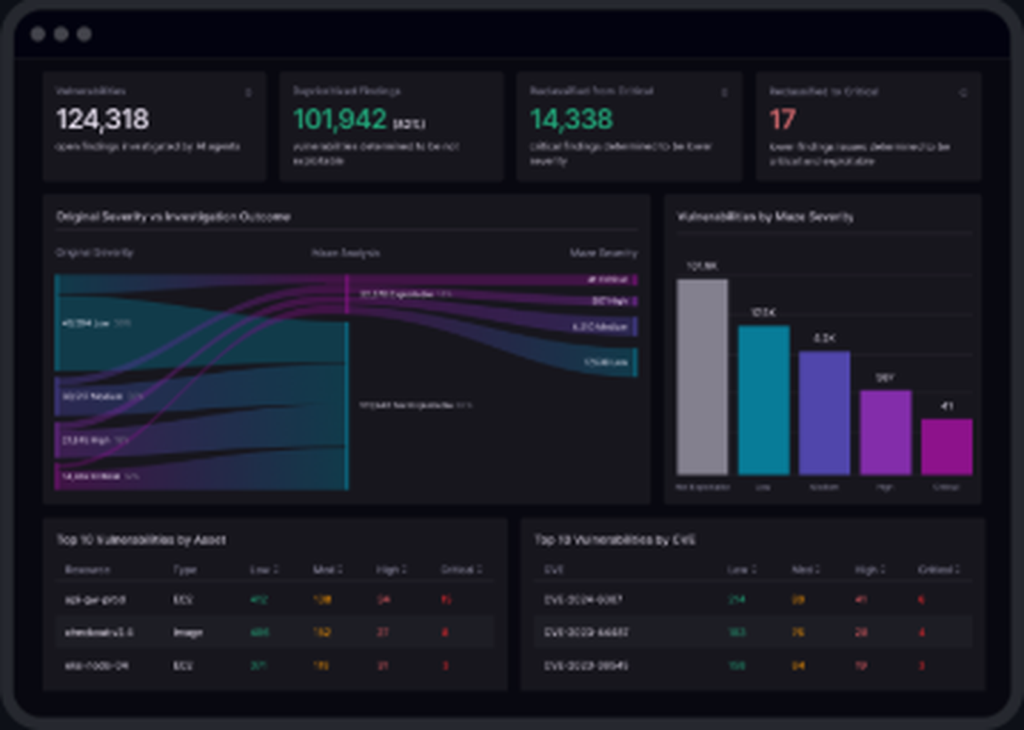
Maze is an AI-native vulnerability management platform that uses AI agents to investigate every vulnerability the way an expert security engineer would. Rather than ranking findings by severity alone, Maze researches what conditions each CVE requires, checks whether those conditions exist in the environment, and reaches a verdict backed by evidence. Non-exploitable findings are closed before they reach the team, and exploitable ones arrive with technical context and a routed fix.
Key features:
- Agentic vulnerability investigation: AI agents research each CVE, gather live context from the cloud environment, and determine whether exploitation is technically possible on each affected asset.
- Exploitability validation: Findings where a required prerequisite is missing are closed as not exploitable, with the technical evidence behind each verdict available for review.
- Contextual risk assessment: Impact and likelihood are assessed against what the affected workload can see, change, or take down, alongside exploit maturity and compensating controls.
- Root-cause remediation: Agents trace each vulnerability to its root cause, verify the fix, and route it to the owning engineer, with a single fix often resolving many findings.
- Agentless deployment: Maze connects through a read-only role in the cloud environment and an API connection to existing scanners, with no sensors to install.
- Code and cloud on one platform: Maze Code extends the same investigation engine to third-party dependencies (AI-SCA) and first-party code (AI-SAST), deduplicating findings across code and cloud into a single ticket.
Source: Maze
2. depthfirst

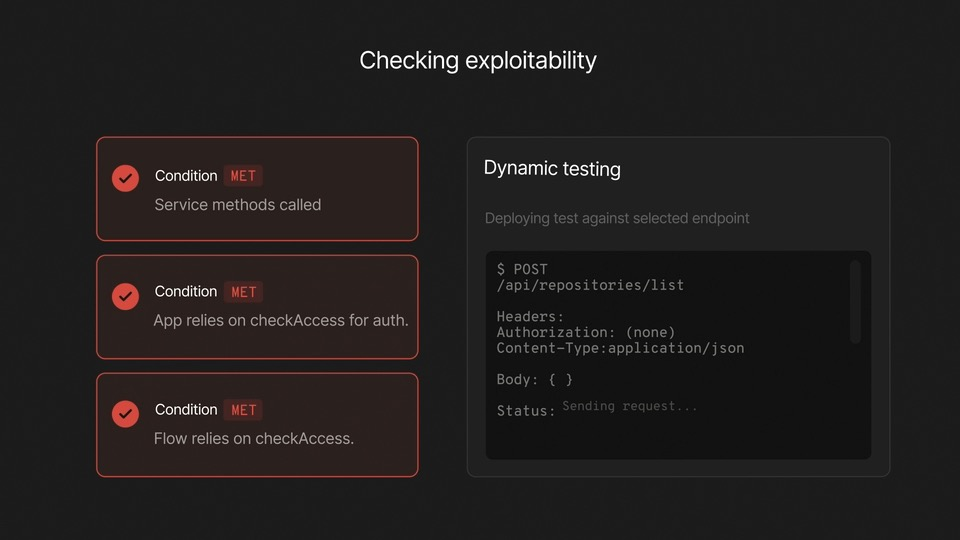
depthfirst is an AI-native application security platform that analyzes code, business logic, dependencies, secrets, and runtime behavior together to identify security weaknesses. It positions itself as a security operating system rather than a scanner. Instead of relying only on pattern matching, it maps components, data flows, entry points, and cross-service interactions to uncover vulnerabilities that emerge from how systems operate. The platform also validates findings and provides remediation guidance within developer workflows.
Key features:
- Code and business logic analysis: Examines code structure, data flows, and business logic to identify vulnerabilities that span multiple components and services.
- Attack path discovery: Models how attackers could move through an application to uncover chained vulnerabilities and exploitable paths.
- Supply chain risk analysis: Evaluates dependency trees and highlights vulnerabilities that have a viable execution path within the environment.
- Secrets and sensitive data detection: Identifies and validates exposed credentials and sensitive information across code repositories, CI/CD pipelines, and runtime environments.
- Agentic pentesting: Tests running applications against realistic attack paths to help determine whether vulnerabilities are exploitable.
- Developer-focused remediation: Provides actionable fixes and remediation recommendations that can be incorporated into existing development workflows.
Source: depthfirst

3. Cogent

Cogent uses AI agents to automate key stages of vulnerability management, including discovery, assessment, remediation, and reporting. The platform continuously investigates vulnerabilities, evaluates business risk, and supports remediation workflows with varying levels of automation. Its approach focuses on reducing exposure windows and helping security teams manage vulnerability volumes that exceed manual capacity.
Key features:
- Early vulnerability discovery: Identifies vulnerable software shortly after new disclosures, including cases where scanner coverage may not yet be available.
- Risk-based assessment: Uses asset and business context to score vulnerabilities and help prioritize remediation efforts.
- Automated remediation workflows: Recommends fixes, evaluates potential operational impact, and supports assisted or autonomous remediation actions.
- Exposure reporting: Generates reports and supporting evidence to track remediation progress and demonstrate risk reduction.
- Continuous AI-driven operations: Uses AI agents that perform tasks similar to security analysts, administrators, and engineers across the vulnerability management lifecycle.
- End-to-end vulnerability management: Combines discovery, assessment, remediation, and reporting capabilities within a single workflow.
Risk-Based Vulnerability Management Platforms
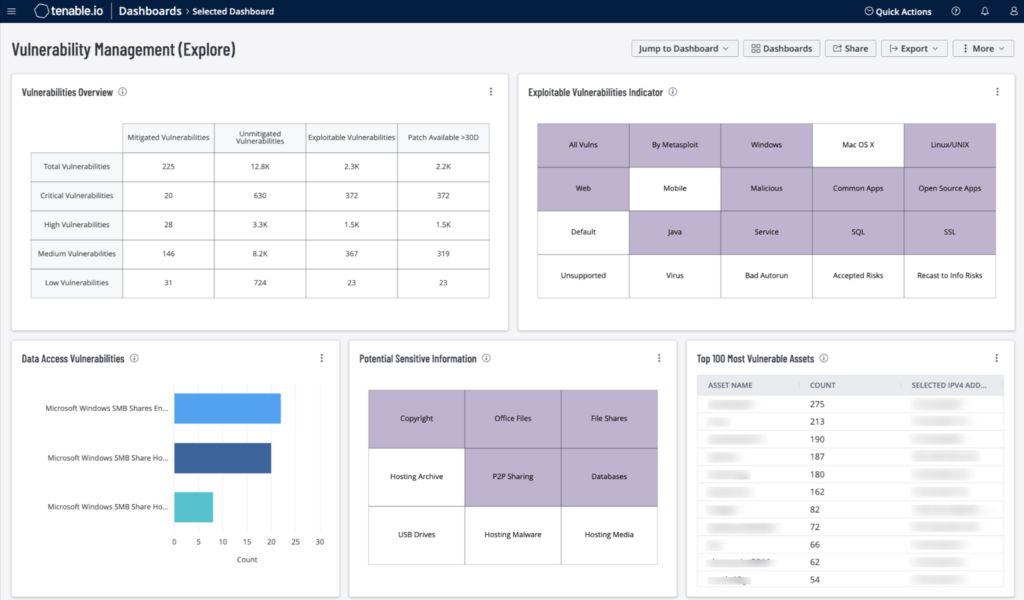
4. Tenable Vulnerability Management

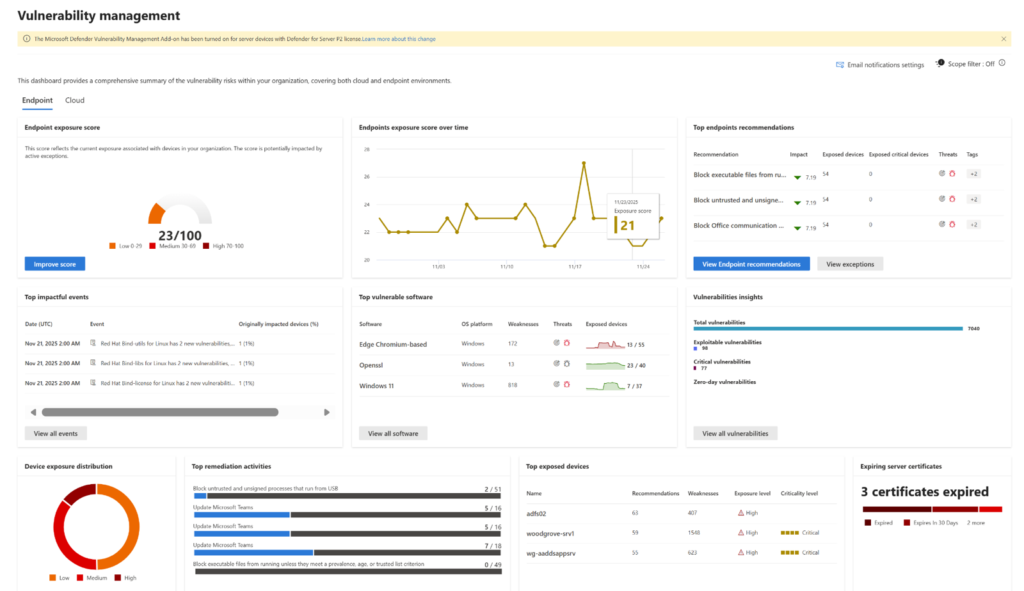
Tenable Vulnerability Management is part of the Tenable One exposure management platform. It combines vulnerability data with broader security context to help organizations identify, prioritize, and remediate exposures across modern attack surfaces. The platform emphasizes risk-based prioritization, unified visibility, and remediation workflows that connect vulnerability findings with overall exposure management efforts.
Key features:
- Unified asset visibility: Provides visibility into assets and vulnerabilities across diverse environments through a centralized platform.
- Contextual vulnerability analysis: Combines vulnerability findings with additional security context to improve understanding of exposure.
- Risk-based prioritization: Helps teams focus on the exposures that present the highest risk to the organization.
- Remediation optimization: Supports remediation planning and workflows designed to accelerate risk reduction.
- Exposure management integration: Connects vulnerability management with broader attack surface and exposure management capabilities.
- AI-assisted operations: Includes AI-powered capabilities to support analysis and response activities.
Source: Tenable
5. Qualys VMDR

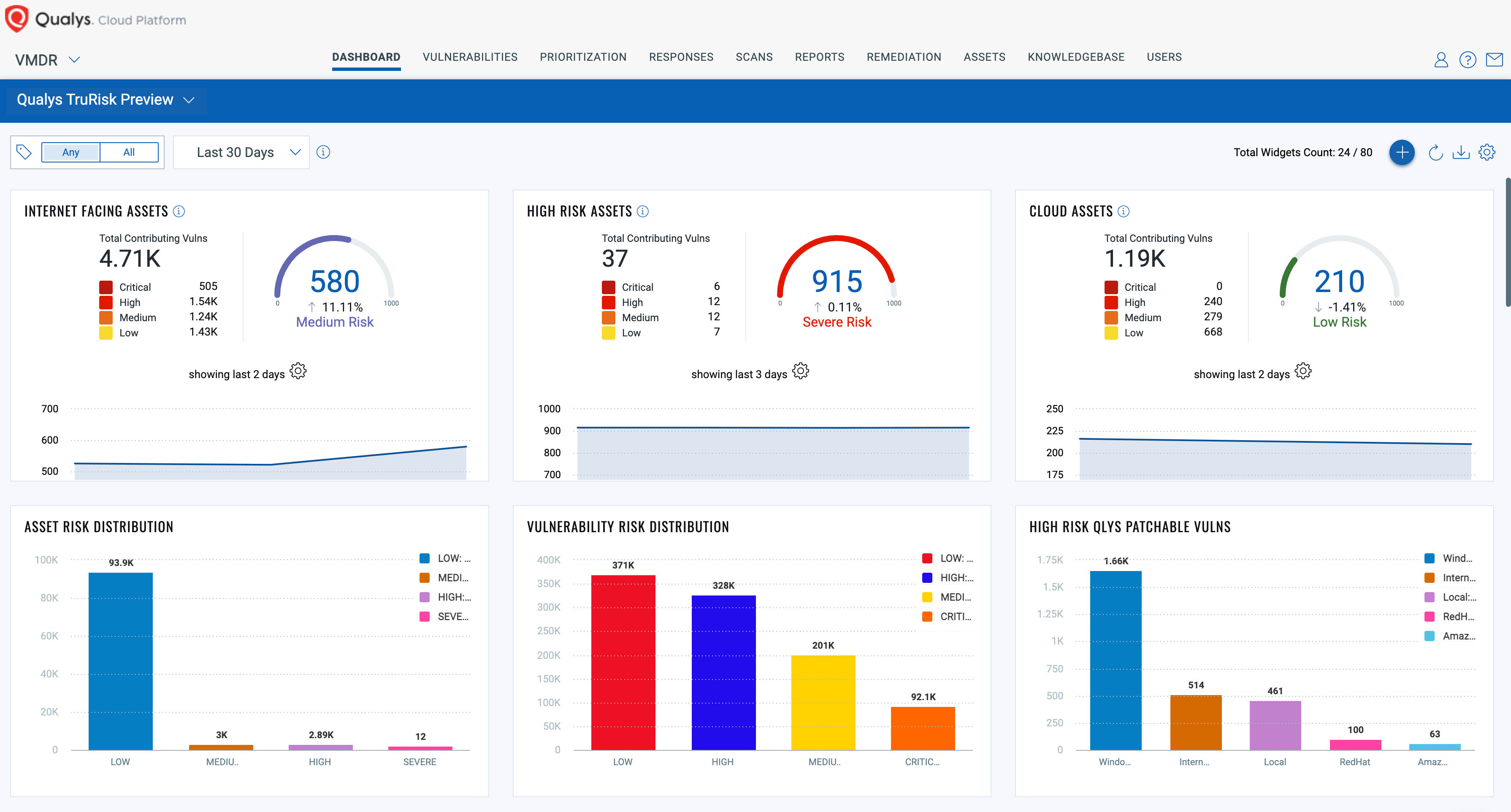
Qualys VMDR (Vulnerability Management, Detection, and Response) is a risk-based vulnerability management platform that combines asset discovery, vulnerability assessment, prioritization, and remediation in a single solution. It uses real-time threat intelligence and contextual risk analysis to help organizations identify critical vulnerabilities and reduce remediation times across on-premises, cloud, and internet-facing environments.
Key features:
- Asset discovery: Identifies known and unknown assets across on-premises, cloud, container, mobile, and internet-facing environments.
- Vulnerability and configuration assessment: Automates vulnerability scanning and compliance assessments to identify security weaknesses and misconfigurations.
- Risk-based prioritization: Uses threat intelligence, business context, and TruRisk scoring to prioritize vulnerabilities beyond traditional severity ratings.
- Automated remediation: Supports patch deployment, mitigation actions, and integration with IT service management platforms for ticketing workflows.
- Real-time threat intelligence: Incorporates continuously updated threat indicators to help prioritize actively exploited vulnerabilities.
- Unified risk management platform: Brings asset management, vulnerability management, prioritization, monitoring, and remediation into a single platform.
Source: Qualys
6. Microsoft Defender Vulnerability Management

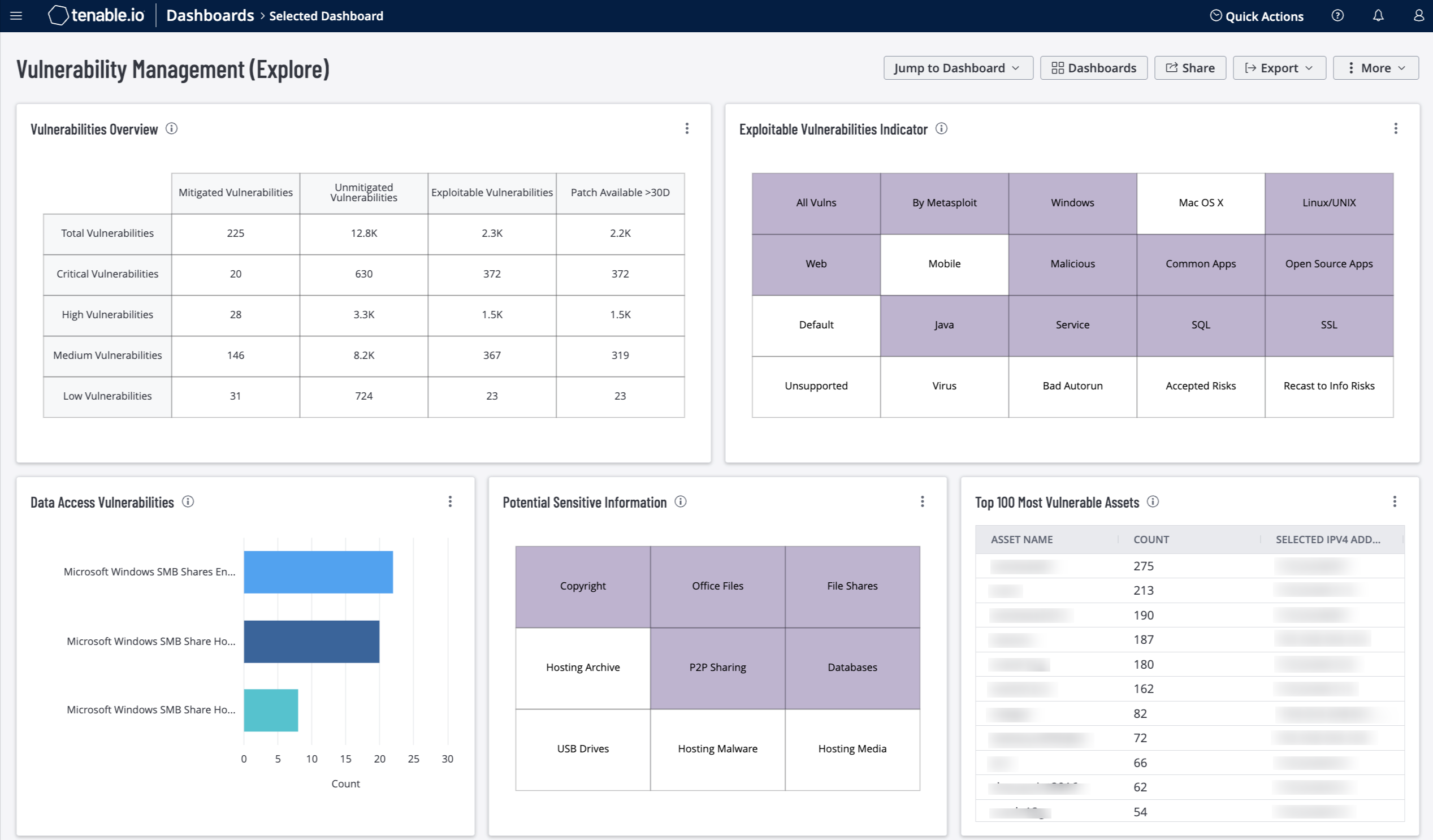
Microsoft Defender Vulnerability Management is a risk-based vulnerability management solution that provides asset visibility, vulnerability assessment, prioritization, and remediation capabilities across endpoints and network-connected assets. It combines vulnerability data with Microsoft threat intelligence, breach likelihood analysis, and business context to help organizations focus on the most significant risks and track remediation progress from a unified interface.
Key features:
- Continuous asset discovery and monitoring: Continuously identifies and tracks assets, including devices that are not always connected to the corporate network.
- Asset inventories: Maintains inventories of software, hardware, firmware, browser extensions, and digital certificates.
- Vulnerability assessment: Provides assessments for software vulnerabilities, security baselines, network shares, hardware, firmware, and certificates.
- Risk-based prioritization: Uses threat intelligence, exploit activity, business context, and device assessments to prioritize remediation efforts.
- Integrated remediation workflows: Enables remediation task creation, application blocking, alternative mitigation guidance, and remediation tracking.
- Exposure management integration: Consolidates vulnerability and exposure data within a unified exposure management experience.
- API-driven automation: Supports automation of vulnerability management workflows through APIs and integrations with Microsoft security tools.
Source: Microsoft

Gartner’s Vulnerability Management Paradigm and the Shift Toward Exposure Management
Gartner’s recent guidance emphasizes that vulnerability management should evolve beyond simply identifying and ranking vulnerabilities. Modern security programs must consider the broader concept of exposure management, which includes vulnerabilities, misconfigurations, identity risks, cloud exposure, attack paths, and other weaknesses that could be used by attackers.
This approach reflects a shift from point-in-time vulnerability lists to continuous threat exposure management. Instead of treating vulnerability management as a scanning and patching function, organizations should build a repeatable process for scoping assets, discovering exposures, prioritizing risks, validating exploitability, and mobilizing teams to remediate the most important issues.
For vulnerability management programs, this means expanding prioritization beyond CVSS scores and scanner output. Security teams should include business context, threat intelligence, asset criticality, reachability, exploitability, and remediation feasibility. This allows organizations to focus on reducing meaningful exposure rather than simply reducing the total number of vulnerabilities.
Vulnerability Management Best Practices
1. Prioritize Real Risk, Not Just CVSS Scores
CVSS scores provide a useful baseline for understanding vulnerability severity, but they should not be the sole factor used for prioritization. A vulnerability with a high CVSS score may present little practical risk if it affects an isolated system, while a lower-scoring vulnerability on a critical business application may require immediate attention.
Organizations should use risk-based prioritization that combines severity ratings with asset criticality, exposure, business impact, compensating controls, and threat intelligence. This approach helps security teams focus resources on vulnerabilities that are most likely to cause operational, financial, or regulatory harm.
2. Focus First on Known Exploited Vulnerabilities
Not every vulnerability is actively targeted by attackers. Security teams should prioritize vulnerabilities that have confirmed exploitation in the wild or are included in catalogs such as CISA’s Known Exploited Vulnerabilities (KEV) list. These vulnerabilities represent immediate and measurable risk because attackers are already using them successfully.
Incorporating threat intelligence into the prioritization process helps organizations identify which vulnerabilities are attracting active attacker interest. Addressing known exploited vulnerabilities quickly can significantly reduce the likelihood of compromise and improve overall risk reduction efforts.
KEV works best as an input rather than a verdict. It confirms that a vulnerability is being exploited somewhere in the wild, not that it can be exploited on your systems. A KEV-listed flaw may be unexploitable in your environment because a required condition is absent, while a vulnerability missing from KEV may be your most urgent risk.
3. Reduce False Positives and Alert Fatigue
Large-scale vulnerability scanning programs often generate significant volumes of findings, many of which may be duplicates, informational alerts, or false positives. Excessive noise can overwhelm security and operations teams, making it more difficult to identify vulnerabilities that require urgent action.
Organizations should continuously tune scanning policies, validate critical findings, and use automated correlation to eliminate redundant alerts. Risk-based filtering and contextual analysis help teams focus on vulnerabilities that are both real and meaningful, improving efficiency and increasing confidence in vulnerability management data.
4. Continuously Investigate Cloud Exposure
Cloud environments are highly dynamic. New workloads, storage resources, containers, and services can be deployed or modified within minutes, creating security gaps that traditional periodic scanning may miss. Misconfigurations, exposed services, and unmanaged assets are common sources of cloud-related vulnerabilities.
Organizations should implement continuous monitoring and assessment of cloud infrastructure across public, private, and hybrid environments. Integrating vulnerability management with cloud security tools helps identify exposed assets, configuration issues, and newly introduced vulnerabilities as changes occur.
5. Give Engineering Teams Actionable Remediation Guidance
Security teams are often responsible for identifying vulnerabilities, but remediation is usually performed by infrastructure, operations, or development teams. Vulnerability reports that only list technical findings without remediation guidance can slow response times and create confusion.
Effective vulnerability management programs provide clear, actionable recommendations for resolving issues. This includes patch information, configuration changes, mitigation options, affected systems, business impact, and remediation deadlines. Integrating findings directly into ticketing and workflow systems further improves accountability and accelerates remediation efforts.
6. Use Reachability Analysis for Better Vulnerability Prioritization
Reachability analysis helps organizations determine whether a vulnerable asset can actually be accessed by an attacker. This is especially important in cloud environments, where network paths, security groups, routing tables, load balancers, identity policies, and public endpoints can affect real-world exposure.
A vulnerability on an isolated internal workload may represent lower immediate risk than the same vulnerability on an internet-facing server. Reachability analysis adds this missing context by evaluating whether a vulnerable asset is reachable from the internet, from another network segment, or from a high-risk system inside the environment.
Reachability is a first qualifying signal rather than a verdict. A vulnerable asset can be fully reachable and still not exploitable, because a required feature is disabled or a compensating control blocks the path. Confirming exploitability after reachability is what turns a shorter list into a confident one and combining that with asset criticality and business impact is what lets remediation teams focus on issues that create realistic attack paths.
Conclusion
Effective vulnerability management is a continuous journey that requires proactive asset discovery, risk-based prioritization, and cross-team collaboration. By shifting focus from mere technical scanning to understanding real-world exploitability and business impact, organizations can significantly reduce their attack surface. A mature program transforms security from a reactive burden into a strategic advantage that protects critical assets and supports long-term operational resilience.