[ Vulnerability Management ]



TL;DR: Vulnerability management tools scan assets to find, prioritize, and fix security weaknesses. Best for AI-native investigation: Maze; for autonomous remediation: Cogent; for incumbent breadth: Tenable; for cloud-native context: Wiz.
What Are Vulnerability Management Tools?
Vulnerability management tools are essential cybersecurity software designed to scan network assets, applications, and devices to detect, prioritize, and remediate security weaknesses. Top tools in 2026 include Tenable (Tenable.io/sc), Qualys VMDR, and Rapid7 InsightVM. They offer automated scanning, risk-based prioritization, and compliance reporting to reduce attack surfaces.
Key features to look for:
- Comprehensive scanning: Ability to scan networks, containers, and applications.
- Risk-based Prioritization: Focuses on vulnerabilities posing the highest actual risk to your specific environment.
- Integration: Connects with SIEMs, ticket systems, and patch management tools.
- Reporting and Compliance: Delivers reports to ensure adherence to industry standards.
It is worth separating two things that often get grouped together. Scanners find vulnerabilities and sometimes apply basic prioritization using CVSS scores or the CISA KEV catalog. Management platforms sit on top of that output and handle the rest, deciding what actually matters, assigning ownership, tracking remediation, and proving risk went down. Some tools do both. Many do only the first.
In this article:
- Vulnerability Management Tools at a Glance
- Why Vulnerability Management Tools Matter
- Key Features to Look for in Vulnerability Management Tools
- Notable Vulnerability Management Tools
- How to Choose the Right Vulnerability Management Tool
Vulnerability Management Tools at a Glance
The table below summarizes the key differences between the tools covered in this guide. We explore each one in more detail in the sections that follow.
| Category | Solution | Best For | Key Strengths | Things to Consider |
| Modern AI-Native | Maze | Triaging which cloud and code vulnerabilities are truly exploitable | AI agents that investigate findings like a security engineer | Newer platform centered on cloud and application environments |
| Modern AI-Native | Cogent | Automating investigation and remediation across existing tools | Agentic AI lifecycle coverage with human governance | Very new vendor; value depends on connected data quality |
| Modern AI-Native | Zafran | Reducing critical vulns using existing security controls | Compensating-control context and mitigation before patching | Dashboard and reporting customization still maturing |
| Modern AI-Native | Depthfirst | Finding and fixing exploitable code and dependency vulnerabilities | Validates exploitability and ships merge-ready PR fixes | Centered on the code and application layer, not network VM |
| Cloud-Native Scanner | Wiz | Cloud-native vulnerability context from code to runtime | Agentless scanning with Security Graph attack-path context | Premium pricing and alert tuning at scale |
| Cloud-Native Scanner | Orca Security | Agentless cloud vulnerability management with full context | SideScanning with reachability and attack-path analysis | 24-hour scan cadence and reporting customization |
| Cloud-Native Scanner | Amazon Inspector | Automated vulnerability scanning for AWS workloads | Continuous, native scanning of EC2, ECR, and Lambda | AWS-centric scope and false-positive rate |
| Incumbent Platform | Qualys VMDR | Unified scanning, prioritization, and patching in one platform | TruRisk scoring with built-in patch and mitigation actions | Support responsiveness and dated reporting |
| Incumbent Platform | Rapid7 InsightVM | Vulnerability management unified with attack surface context | Same scanner with cloud, app, and attack-surface context | Reporting customization and on-prem/cloud sync |
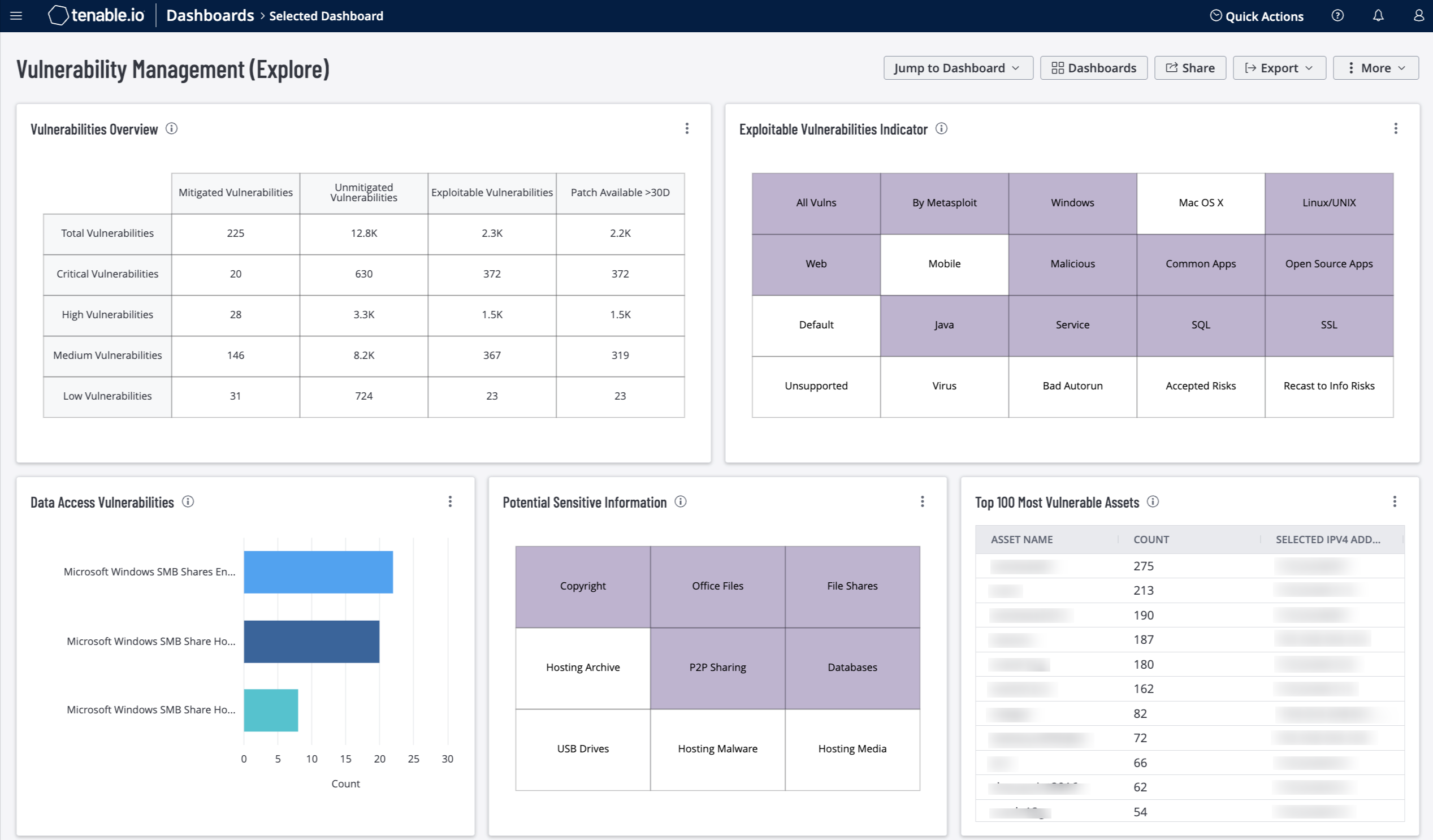
| Incumbent Platform | Tenable Vulnerability Management | Risk-based scanning across IT, cloud, and OT | Nessus-powered coverage with risk-based prioritization | Cloud tier cost and licensing clarity |
| Incumbent Platform | Microsoft Defender Vulnerability Management | Microsoft-centric and Windows-heavy environments | Continuous assessment with Microsoft threat intelligence | Reporting depth and third-party coverage |
| Open-Source Scanner | OpenVAS | Free, full-featured network vulnerability scanning | Authenticated and unauthenticated tests, daily-updated feed | Complex setup and dated interface |
| Open-Source Scanner | Nuclei | Fast, template-based scanning for known vulnerabilities | Community YAML templates updated within hours of new CVEs | Template quality varies; CLI, not a managed service |
| Open-Source Scanner | Nikto | Fast web server and misconfiguration scanning | Thousands of checks for risky files and server misconfigs | Noisy, not stealthy, and prone to false positives |
Why Vulnerability Management Tools Matter
Organizations face a constant stream of new vulnerabilities, misconfigurations, and exposed assets across on-premises and cloud environments. Vulnerability management tools help security teams continuously identify and reduce these risks before attackers exploit them.
- Identify security weaknesses early: Continuously scans systems, applications, and networks to detect vulnerabilities before they become attack paths.
- Reduce the attack surface: Uncovers outdated software, missing patches, insecure configurations, and exposed services so organizations can close security gaps.
- Improve prioritization of risks: Ranks vulnerabilities based on severity, exploitability, and asset importance.
- Automate security operations: Automates scanning, reporting, and remediation workflows to reduce manual work.
- Support compliance requirements: Helps maintain compliance and generate audit-ready reports.
- Increase visibility across environments: Provides centralized visibility across endpoints, servers, cloud resources, containers, and network devices.
- Accelerate remediation efforts: Tracks remediation progress, assigns tasks, and verifies resolution.
- Strengthen overall security posture: Continuous monitoring and remediation reduce the likelihood of successful attacks.
Key Features to Look for in Vulnerability Management Tools
Comprehensive Scanning
Comprehensive scanning is a foundational feature for any vulnerability management tool. The tool should scan a wide range of assets, including on-premises infrastructure, cloud environments, endpoints, and network devices. It must support both authenticated and unauthenticated scans to uncover vulnerabilities that require different levels of system access. Frequent automated scans help detect new assets and vulnerabilities and maintain an up-to-date view of risk.
A scanning engine should also detect configuration issues, missing patches, and outdated software versions. It should support custom scan policies and granular scheduling to minimize operational disruption. Integration with asset inventories helps ensure the scanning scope covers the entire environment. This approach reduces blind spots and gives security teams the visibility needed to make decisions.
Risk-Based Prioritization
Risk-based prioritization helps organizations focus on vulnerabilities that pose the greatest threat. Rather than treating all vulnerabilities equally, modern tools assess the context and potential impact of each finding. They consider exploitability, asset criticality, and internet exposure. This helps allocate resources so high-risk issues are addressed before less significant ones.
Effective prioritization often uses threat intelligence feeds, real-world exploit data, and business context to generate risk scores. By highlighting vulnerabilities that are actively exploited or more likely to be used in attacks, security teams can respond faster. This reduces the window of opportunity for attackers and improves risk management.
Integration
Integration capabilities help embed vulnerability management into broader security and IT workflows. Tools should integrate with ticketing systems, patch management platforms, SIEMs, and SOAR solutions. This allows vulnerabilities to be converted into remediation tasks, tracked through resolution, and correlated with other security events.
APIs and connectors support custom integrations and automation across tools. Integration reduces manual effort, speeds response times, and makes vulnerability data actionable within existing workflows. It also supports collaboration between security, IT, and development teams.
Reporting and Compliance
Reporting and compliance features help organizations communicate vulnerability status and meet regulatory requirements. Effective tools offer customizable dashboards, scheduled reports, and exportable formats for technical teams and executive leadership. Reports should present trends, risk levels, remediation progress, and compliance status.
Compliance modules can map vulnerabilities to regulatory standards and frameworks, simplifying audit preparation. Automated evidence collection and reporting help demonstrate due diligence. These features are important for regulated industries, where accurate reporting is required to avoid fines and reputational damage.
Remediation Guidance
Remediation guidance helps security teams address vulnerabilities with clear steps. Vulnerability management tools include recommendations, references to patches, and links to vendor advisories. This reduces time spent researching fixes and supports alignment with best practices.
Some tools offer workflow management to assign, track, and verify remediation tasks. Automated notifications and escalation help ensure critical vulnerabilities are not overlooked. These features improve efficiency and reduce the likelihood that vulnerabilities remain unaddressed.
Exploit Intelligence and Threat Context
Exploit intelligence and threat context inform security teams about the real-world risk of vulnerabilities. Tools that incorporate threat feeds and exploit databases can indicate whether a vulnerability is actively targeted. This context helps prioritize remediation based on current threat activity.
By correlating vulnerabilities with exploit kits, malware campaigns, and attack trends, these tools help organizations respond to emerging threats. This supports alignment between vulnerability management and threat intelligence programs and improves resilience to cyberattacks.
Exploitability Validation
A vulnerability is only exploitable once the prerequisites for exploitation are met in your environment. The strongest tools check whether those conditions are actually present on the affected asset, such as whether the vulnerable feature is enabled and whether an attacker can reach the affected code, then close what cannot be exploited. This is a different question from exploit intelligence, which tells you what attackers are doing elsewhere.
Notable Vulnerability Management Tools
How we selected these tools: We shortlisted vulnerability management tools based on scanning coverage, risk-based prioritization, remediation and integration capabilities, and reporting and compliance support.
Modern AI-Native Vulnerability Management
A newer generation of tools built to use AI agents to figure out what is actually exploitable, prioritize it, and guide remediation. Rather than scoring findings against fixed rules, these platforms investigate each one against the environment it sits in.
1. Maze

Best for: Triaging which cloud and code vulnerabilities are truly exploitable
Strengths: AI agents that investigate findings the way a security engineer would
Things to consider: Newer platform centered on cloud and application environments
Maze is an AI-native vulnerability management platform that uses AI agents to investigate findings across cloud and code. It covers cloud vulnerabilities such as CVEs in containers and virtual machines, third-party dependencies through AI-SCA, and first-party code through AI-SAST. The agents are built to catch zero-days before scanners detect them.
Rather than applying static rules or severity scores, Maze’s agents reason over evidence assembled from a customer’s code, cloud, runtime, and security controls. It connects through a read-only role to a cloud account or repository plus an integration with an existing scanner, with no sensors, eBPF, or software to install, and runs on single-tenant infrastructure deployable in any region.
Key features include:
- Cloud vulnerability investigation: Triages and remediates CVEs in containers and VMs and identifies zero-days before scanners detect them.
- Dependency analysis (AI-SCA): Finds, triages, and remediates CVEs in third-party code, using an existing scanner or Maze’s own.
- Code analysis (AI-SAST): Finds and fixes business-logic vulnerabilities that SAST tools miss, or triages results from an existing scanner.
- Runtime context without installation: Gathers runtime context, including inside containers, with no sensors, eBPF, or agents to install.
- Live asset inventory: Maintains a live SBOM that automatically gathers business and technical context about every asset.
- Workflow integrations: Works directly with coding agents such as Claude and Cursor, or routes findings to ticketing systems.
Limitations (based on publicly available sources):
- Cloud and application focus: The platform centers on cloud, container, dependency, and code vulnerabilities rather than broad on-premises network-device scanning.
- Works alongside existing scanners: Maze can draw on a customer’s existing scanner for some findings rather than fully replacing all scanning tools.
- Emerging track record: As a newer AI-native platform, it has a shorter public history than long-established vulnerability management tools.
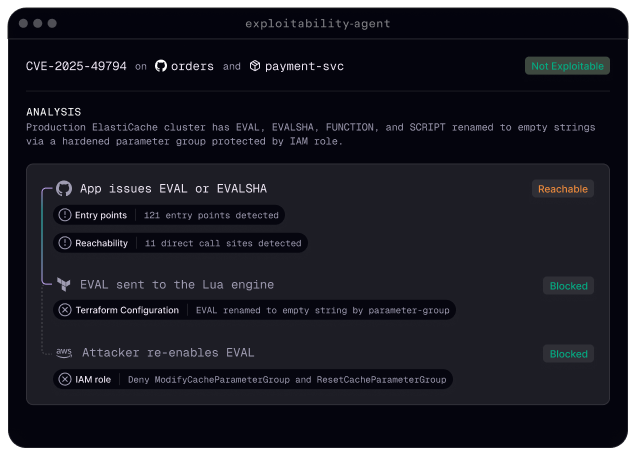
Source: Maze
2. Cogent

Best for: Automating investigation and remediation across your existing tools
Strengths: Agentic AI lifecycle coverage with human governance built in
Things to consider: Very new vendor; value depends on connected data quality
Cogent is an AI-native vulnerability management platform that applies specialized AI agents across the full lifecycle, from discovery through verified remediation. It identifies vulnerable software within minutes of disclosure, often before scanner signatures exist, and builds a unified, deduplicated view from a customer’s existing stack. It does not replace scanners, CNAPP, or CMDB tools; instead it acts as an orchestration layer over them.
The platform scores each finding by real exploitability and business impact in the specific environment rather than by CVSS defaults, then builds a remediation plan with a configurable level of autonomy that executes through existing workflow tools. It is built on three layers: an AI Data Fabric that normalizes data from connected tools, an AI Reasoning Engine of collaborating agents, and an Adaptive Execution layer with approval gates and audit logs.
Key features include:
- Rapid exposure discovery: Identifies vulnerable software within minutes of disclosure and flags exposure before scanner signatures are available.
- Cross-tool deduplication: Consolidates overlapping findings from multiple tools with source attribution and full provenance tracking.
- Context-based prioritization: Scores risk by exploitability and business impact in the environment, with factor-by-factor breakdowns and confidence levels.
- Configurable autonomous remediation: Determines a fix strategy, runs a pre-flight impact assessment, and executes through existing workflow tools at a chosen level of autonomy.
- Fix verification and reporting: Confirms a vulnerability is resolved, generates natural-language reports, and tracks SLA compliance and MTTR trends.
- Governance controls: Applies approval requirements, confidence thresholds, full data lineage, and logging of every AI action.
Limitations (based on publicly available sources):
- Orchestration-layer dependency: Cogent ingests data from existing scanners and tools rather than performing its own scanning, so results depend on the connected sources.
- Autonomy requires governance: Fully autonomous remediation is positioned for lower-risk environments, with human approval recommended for critical production systems.
- Early-stage vendor: Founded in 2025, Cogent has a limited public track record and little independent review coverage to date.
- Data reconciliation at scale: The vendor has cited reconciling conflicting data sources and improving AI reliability across complex environments as ongoing work.
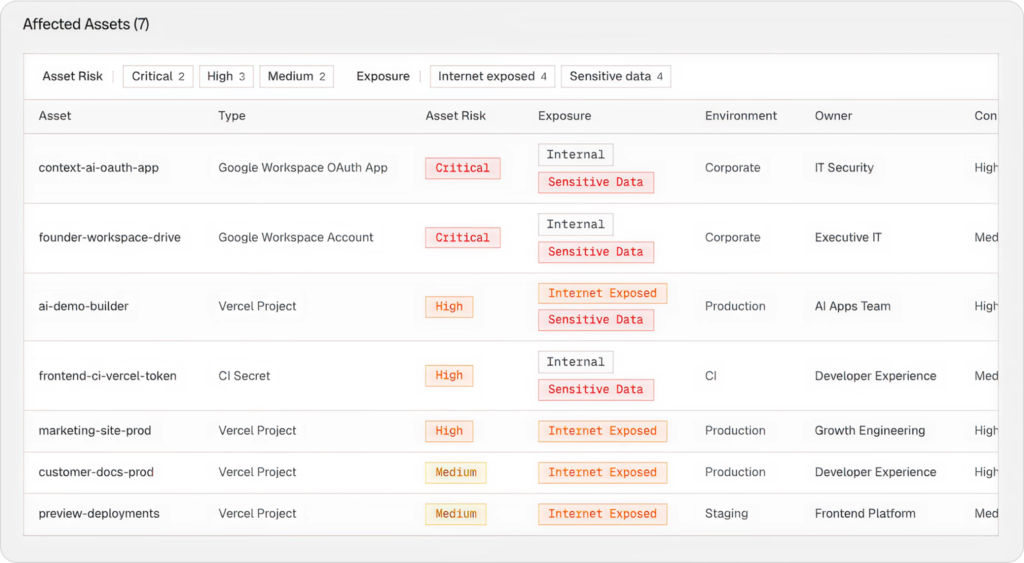
Source: Cogent
3. Zafran

Best for: Reducing critical vulnerabilities using your existing security controls
Strengths: Compensating-control context and mitigation before patching
Things to consider: Dashboard and reporting customization still maturing
Zafran is an AI-native threat exposure management platform that offers an alternative operating model for vulnerability management. It unifies findings from cloud, on-premises, and application security tools into a single deduplicated view, and can also run its own continuous detection without deploying new agents. It then applies context to show which vulnerabilities are genuinely exploitable.
That context includes runtime presence, internet reachability, exploitation in the wild, asset criticality, and the configuration of existing security controls. Zafran maps exposures to compensating controls and provides step-by-step mitigation so teams can reduce risk before patching begins. Its RemOps capability uses generative AI to consolidate overlapping remediation tasks and route them to the right owners through existing ticketing platforms.
Key features include:
- Unified findings: Aggregates, normalizes, and de-duplicates vulnerability data across cloud, on-prem, and AppSec into a single source of truth.
- Exploitability assessment: Evaluates runtime presence, internet reachability, active exploitation, asset criticality, and existing control mitigations.
- Control-based mitigation: Maps exposures to compensating controls and adjusts control policies to shrink exposure windows ahead of patch cycles.
- Agentic remediation: AI agents research CVE conditions, validate exploitability on live assets, and generate remediation scripts by simulating patch impact, with approval workflows.
- RemOps task routing: Consolidates overlapping CVEs into single remediation actions and routes them to owners through existing ticketing tools.
- Proactive exposure hunting: Hunts for exposure tied to new CVEs, zero-days, threat actors, and control gaps across the hybrid environment.
Limitations (as reported by users on PeerSpot):
- Dashboard customization: Reviewers note the starter dashboards and widgets are helpful but that customization options are limited.
- Reporting flexibility: Some users want richer, more customizable reporting to communicate risk to leadership and non-technical stakeholders.
- Integration edge cases: A reviewer reported a bi-directional ServiceNow sync that added extra assets to the ServiceNow module and affected licensing costs until it was resolved with the vendor.
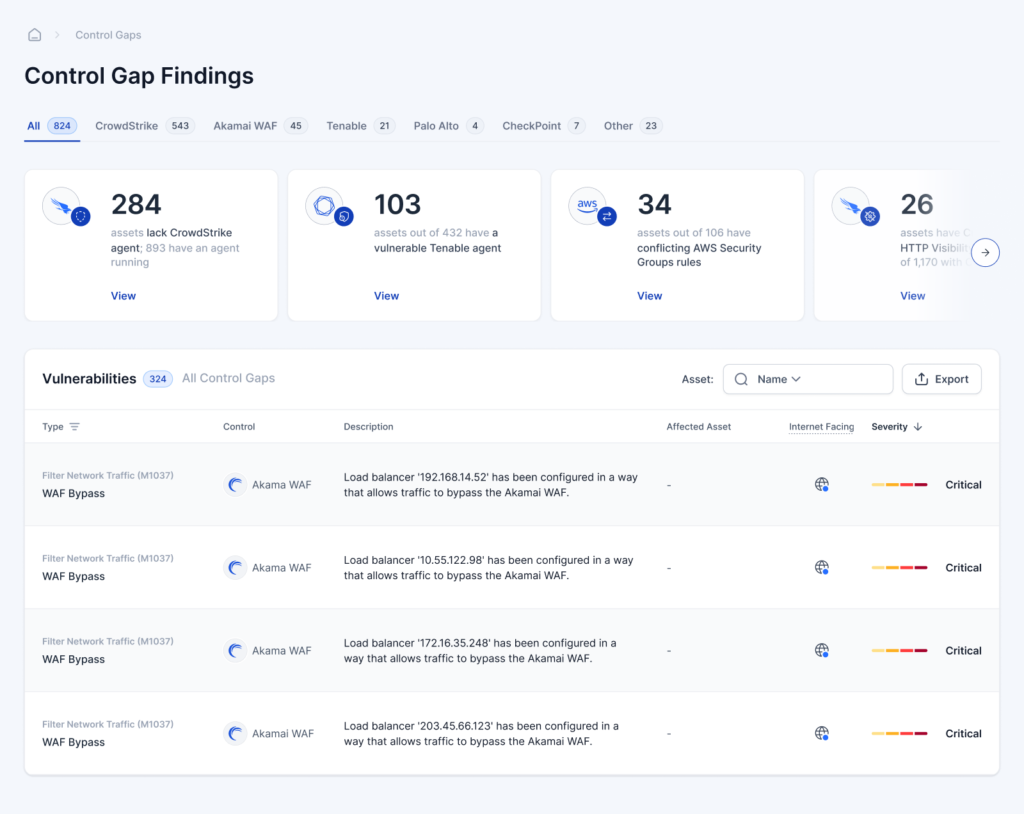
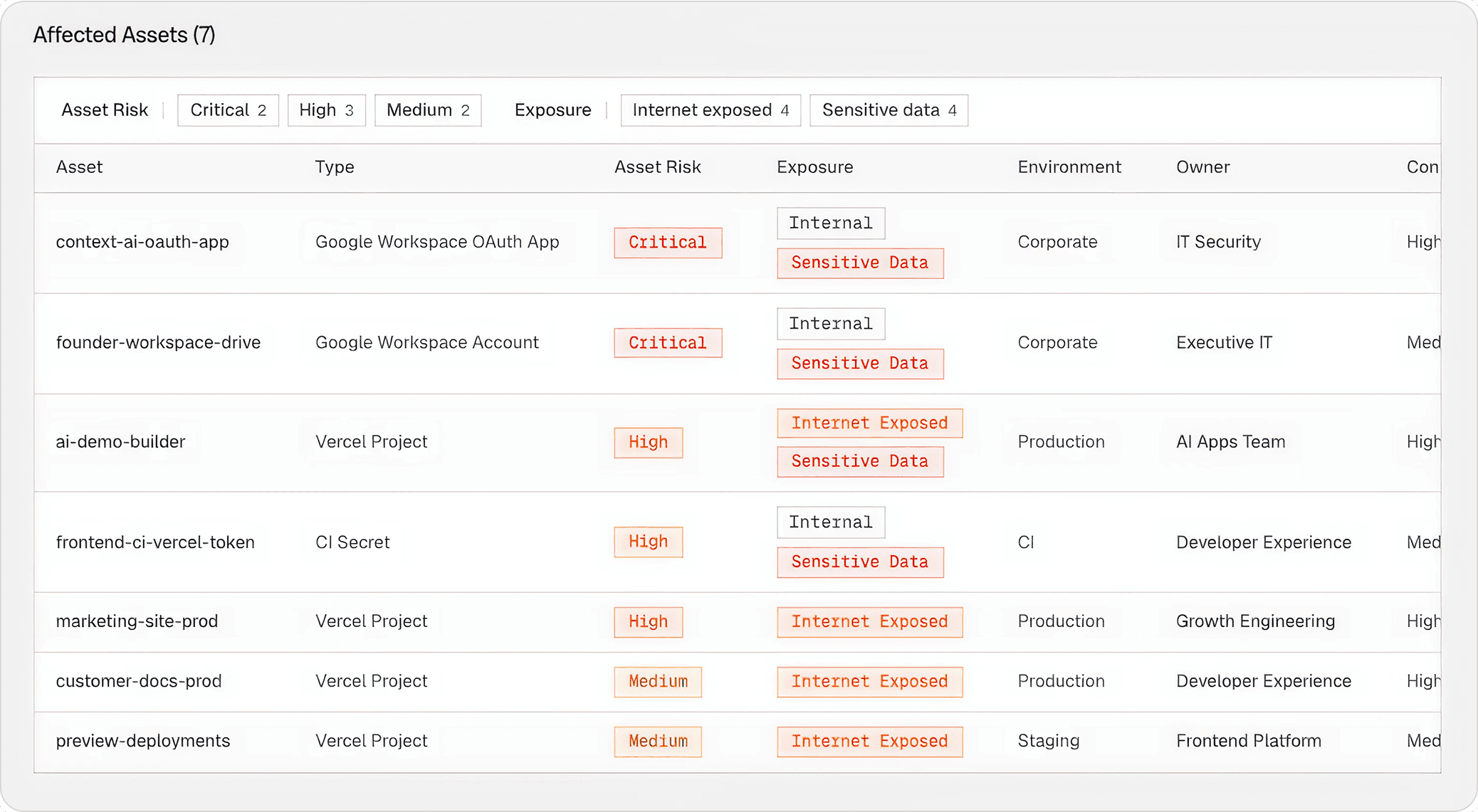
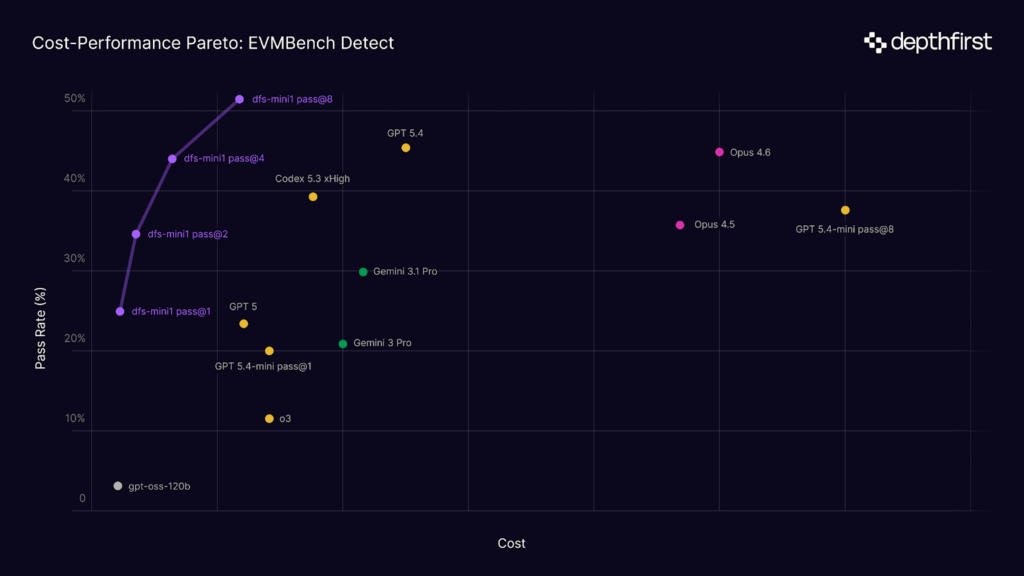
Source: Zafran

4. Depthfirst

Best for: Finding and fixing exploitable code and dependency vulnerabilities
Strengths: Validates exploitability and ships merge-ready pull-request fixes
Things to consider: Centered on the code and application layer, not network VM
Depthfirst offers an AI-native platform called General Security Intelligence whose agents reason across code, infrastructure, dependencies, and the runtime environment to find complex exploitable vulnerabilities, including business-logic flaws. It analyzes how a system works, from components and handlers to data flows and entry points, then reasons through each path the way an attacker would.
The platform follows a find, validate, fix, and verify loop. It runs a dynamic test against the running application so that only findings that can actually be triggered reach the queue, then generates a pull request for each confirmed vulnerability written against the customer’s own codebase and conventions. After a fix is merged, it replays the same attack and marks the issue resolved only when exploitation fails.
Key features include:
- Code analysis: Traces business logic, data flows, and cross-service interactions across the codebase to find real attack paths.
- Supply chain analysis: Traces risk through the full dependency tree and surfaces only vulnerabilities with a real execution path to them.
- Secrets and sensitive data detection: Detects and validates credentials across the codebase, CI/CD pipelines, and runtime environments.
- Agentic pentesting: Confirms which vulnerabilities are exploitable by testing the running application with real attack paths.
- Dependency firewall: Detects malicious behavior in dependencies before it spreads through the environment.
- Merge-ready fixes with verification: Opens a pull request for each confirmed vulnerability and re-runs the attack after merge to verify the fix.
Limitations (based on publicly available sources):
- Code and application focus: The platform centers on code, dependencies, secrets, and application testing rather than broad network or host vulnerability scanning.
- Pipeline integration required: Coverage depends on connecting to development workflows, such as installing a GitHub app with repository permissions.
- Human review of fixes: Fixes are delivered as pull requests that developers still need to review and merge.
- Emerging vendor: Founded in 2024, Depthfirst is early to market with limited independent review coverage.
Source: Depthfirst
Cloud-Native Vulnerability Scanners
Cloud security platforms that scan cloud workloads, containers, and code, with vulnerability management as one capability inside a broader suite.
5. Wiz

Best for: Cloud-native vulnerability context from code to runtime
Strengths: Agentless scanning with Security Graph attack-path context
Things to consider: Premium pricing and alert tuning at scale
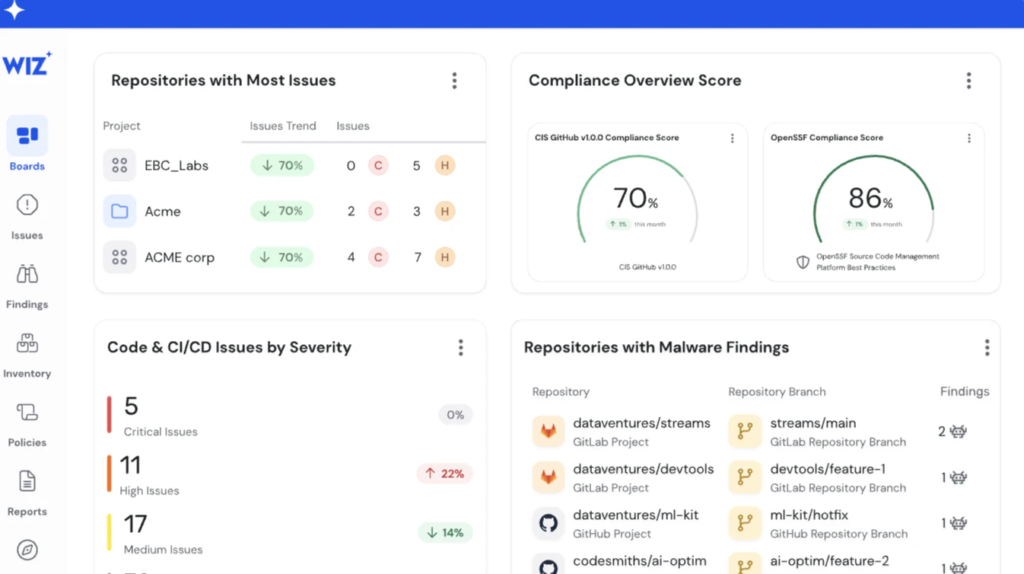
Wiz provides unified vulnerability management that assesses, centralizes, prioritizes, and remediates vulnerabilities across cloud, code, and on-premises environments in one platform. Its agentless-first, cross-cloud scanning draws on a catalog of more than 120,000 vulnerabilities across 40+ operating systems, and it can extend to on-premises assets through Wiz’s third-party aggregation and workload scanner.
Wiz also ingests findings from third-party scanners and tools such as pen tests, DSPM, SAST, and DAST, then correlates and enriches them on the Wiz Security Graph and validates external exposure with Wiz ASM. This graph-based context surfaces the vulnerabilities that lead to critical attack paths, while Wiz Projects and CMDB integration assign owners, and remediation guidance, one-click fixes, and patch recommendations help reduce mean time to remediate.
Key features include:
- Agentless assessment: Provides agentless, cross-cloud vulnerability scanning across 40+ operating systems with a 120,000+ vulnerability catalog.
- Third-party aggregation: Centralizes findings from other scanners and tools, including pen tests, DSPM, SAST, and DAST, into one platform.
- Graph-based prioritization: Uses the Wiz Security Graph and Wiz ASM to prioritize vulnerabilities tied to critical attack paths and external exposure.
- Ownership and remediation: Assigns owners through Wiz Projects and CMDB integration and offers one-click remediation and patch recommendations.
- Emerging threat visibility: Surfaces workload exposure to emerging threats and in-the-wild exploits through the Wiz Threat Center.
- Code-to-cloud coverage: Provides AI-powered remediation guidance across the code-to-runtime pipeline.
Limitations (as reported by users on PeerSpot):
- Pricing: Reviewers consider Wiz expensive, and note some capabilities are consumption-based and need cost monitoring.
- Alert noise: Users report duplicate alerts and false positives that require tuning in larger environments.
- Reporting and integrations: Some want more executive-style reporting and note the ServiceNow integration and certain API integrations could be stronger.
- Learning curve: The breadth of features and dashboards can feel overwhelming at first.
Source: Wiz
6. Orca Security
Best for: Agentless cloud vulnerability management with full context
Strengths: SideScanning coverage with reachability and attack-path analysis
Things to consider: 24-hour scan cadence and reporting customization
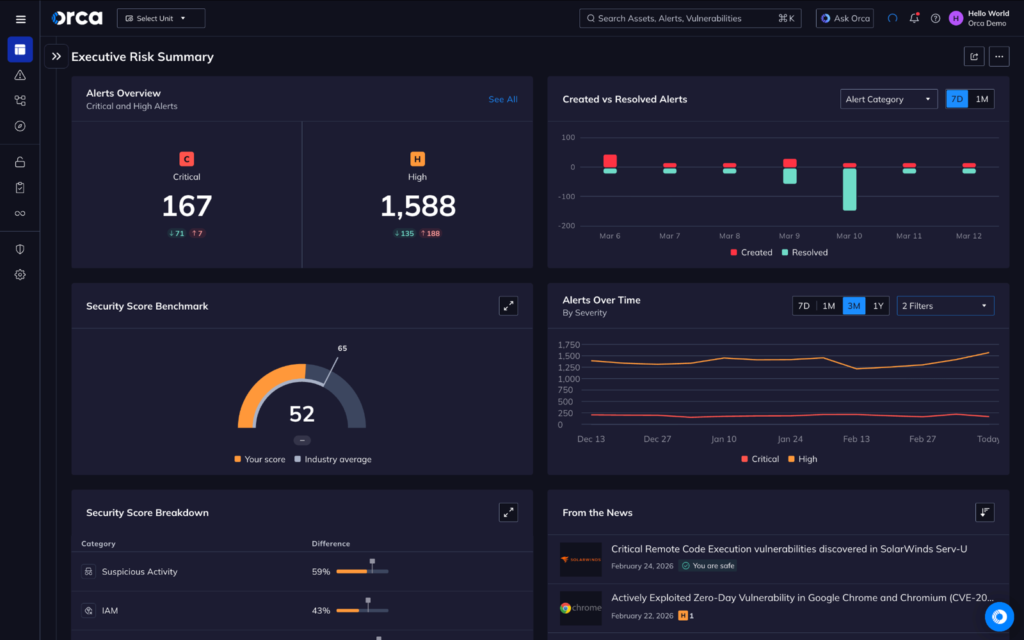
Orca Security provides agentless cloud vulnerability management that detects and prioritizes vulnerabilities with unified context across the cloud estate. Its patented SideScanning technology collects data from cloud configuration and the workload’s runtime block storage out-of-band, using account permissions only and without installing agents or affecting performance. It covers both cloud workloads and the cloud control plane in one platform.
Orca builds a full inventory of OS packages, applications, libraries, and versions, draws on 20+ vulnerability data sources, and considers the context of cloud assets rather than CVSS alone. Attack Path Analysis identifies dangerous risk combinations and assigns business-impact scores, presented as a visual graph, while reachability analysis narrows large volumes of container vulnerabilities to those that are actually executable at runtime.
Key features include:
- Agentless SideScanning: Collects configuration and workload data out-of-band using account permissions only, with no agents and no performance impact.
- Cloud-native inventory: Builds a full inventory of OS packages, applications, libraries, and versions across the cloud estate from 20+ data sources.
- Context-based prioritization: Considers asset context, connections, and risks rather than CVSS score alone to decide what to fix first.
- Attack path analysis: Identifies dangerous risk combinations, assigns business-impact scores, and visualizes them as attack-path graphs.
- Reachability analysis: Detects which vulnerable packages are executable at runtime, with deeper runtime detection available through Orca Sensor.
- Query and CVE lookup: Provides a query builder and a trending-CVE widget to locate a new CVE’s impact across the environment.
Limitations (as reported by users on PeerSpot):
- No real-time blocking: The agentless approach lacks real-time blocking, and detected malware may need manual removal.
- Scan cadence: Automatic scans are limited to roughly every 24 hours, which can delay alert updates.
- Reporting and customization: Reviewers want stronger vulnerability-management reporting, dashboard customization, and export options.
- Granular access and tagging: Some find role-based access and custom tagging insufficiently granular for hierarchical organizations.
Source: Orca Security

7. Amazon Inspector

Best for: Automated vulnerability scanning for AWS workloads
Strengths: Continuous, native scanning of EC2, ECR, and Lambda
Things to consider: AWS-centric scope and false-positive rate
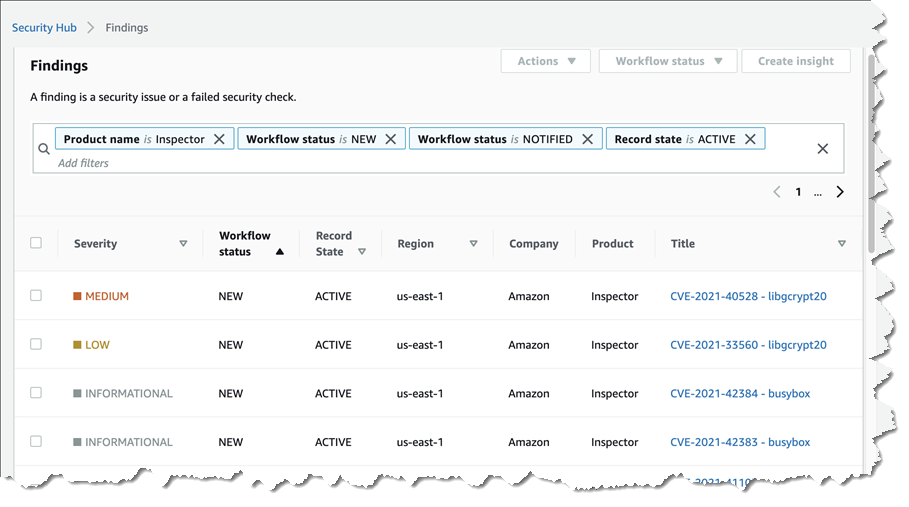
Amazon Inspector is an automated, continual vulnerability management service for AWS environments. It automatically discovers workloads such as EC2 instances, container images in Amazon ECR, and Lambda functions, as well as code repositories, and scans them for software vulnerabilities and unintended network exposure in near real time. It also extends to non-AWS resources such as code repositories and CI/CD tools.
Inspector generates a contextual risk score by correlating CVE information with network accessibility, helping teams prioritize remediation and reduce mean time to remediate. It draws on more than 50 sources of vulnerability intelligence, supports both agent-based and agentless scanning for EC2, and lets teams centrally manage software bill of materials exports. It integrates with AWS Security Hub and EventBridge and supports compliance frameworks such as NIST CSF and PCI DSS.
Key features include:
- Automated discovery and scanning: Continuously discovers and scans EC2 instances, container images, Lambda functions, and code repositories.
- Network exposure detection: Detects software vulnerabilities and unintended network exposure in near real time.
- Contextual risk scoring: Combines CVE data with network accessibility to produce risk scores that prioritize remediation.
- Vulnerability intelligence: Draws on more than 50 sources of vulnerability intelligence to expedite detection and routing.
- SBOM management: Centrally manages software bill of materials exports for monitored resources.
- AWS integrations: Integrates with AWS Security Hub and EventBridge and supports compliance frameworks such as NIST CSF and PCI DSS.
Limitations (as reported by users on PeerSpot):
- AWS-centric scope: Coverage centers on AWS-native resources, so broader or hybrid environments need additional tools.
- False positives: Reviewers report a relatively high false-positive rate.
- Remediation integration: Users want easier integration with patching services to act on findings.
- Limited custom checks: Flexibility to define custom vulnerability checks is limited, and some AWS service interdependencies add cost.
Source: Amazon

Incumbent Vulnerability Management Platforms
The established scanners and management platforms, strongest on breadth of asset coverage and compliance reporting.
8. Tenable Vulnerability Management

Best for: Risk-based scanning across IT, cloud, and OT attack surfaces
Strengths: Nessus-powered coverage with risk-based prioritization (VPR)
Things to consider: Cloud-tier cost and licensing clarity
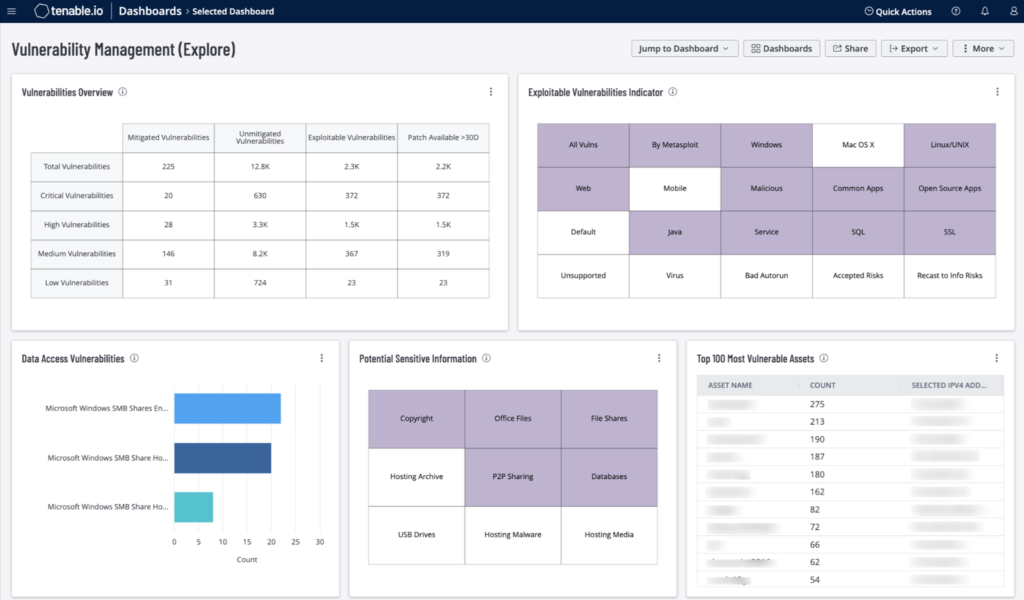
Tenable Vulnerability Management is a risk-based platform for finding, prioritizing, and remediating vulnerabilities across the attack surface. Powered by Nessus technology, it unifies vulnerability data with continuous asset scanning and automated risk prioritization. Continuous, always-on discovery assesses both known and unknown assets, including dynamic cloud and remote-workforce assets.
The platform identifies the most exploitable, business-impacting exposures using risk-based threat intelligence and critical asset identification, expressed through a Vulnerability Priority Rating. It accelerates remediation with guided steps and workflow integrations, and is part of the broader Tenable One exposure management platform, which unifies vulnerability data with other security domains for prioritization and reporting.
Key features include:
- Continuous asset discovery: Performs always-on discovery and assessment of known and unknown assets, including dynamic cloud and remote assets.
- Nessus-powered scanning: Uses Nessus technology to assess vulnerabilities across the environment with broad coverage.
- Risk-based prioritization: Goes beyond CVSS with a Vulnerability Priority Rating that weighs exploitability, asset criticality, and business impact.
- Guided remediation: Provides guided remediation steps and integrates with existing workflows, with patch simplification and compliance support.
- Exposure management integration: Connects into Tenable One to unify vulnerability data with identity, cloud, and other security data.
- Dashboards and reporting: Offers dashboards and reporting on exposures, remediation trends, and benchmarking.
Limitations (as reported by users on G2):
- Cost: Reviewers describe the platform, and the cloud edition in particular, as expensive relative to alternatives.
- Licensing clarity: Users point to licensing clarity as an area that could be improved.
- Dashboard customization: Some find dashboard customization limited for advanced needs.
- Support and documentation: Reviewers cite support response times, support bundled into pricing, and documentation quality as concerns.
Source: Tenable
9. Qualys VMDR

Best for: Unified scanning, prioritization, and patching in one platform
Strengths: TruRisk scoring with built-in patch and mitigation actions
Things to consider: Support responsiveness and dated reporting
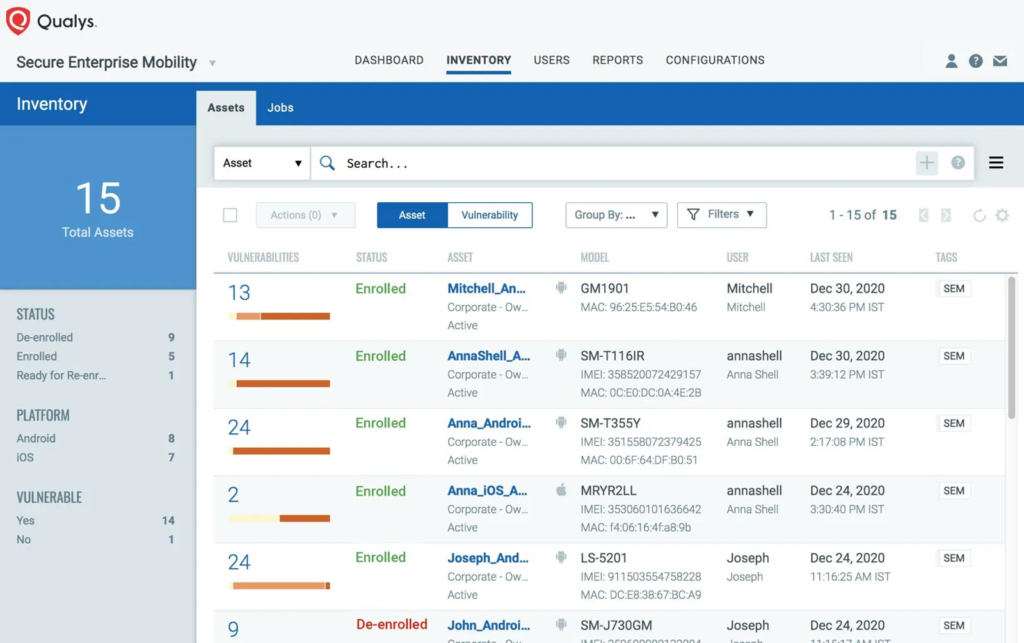
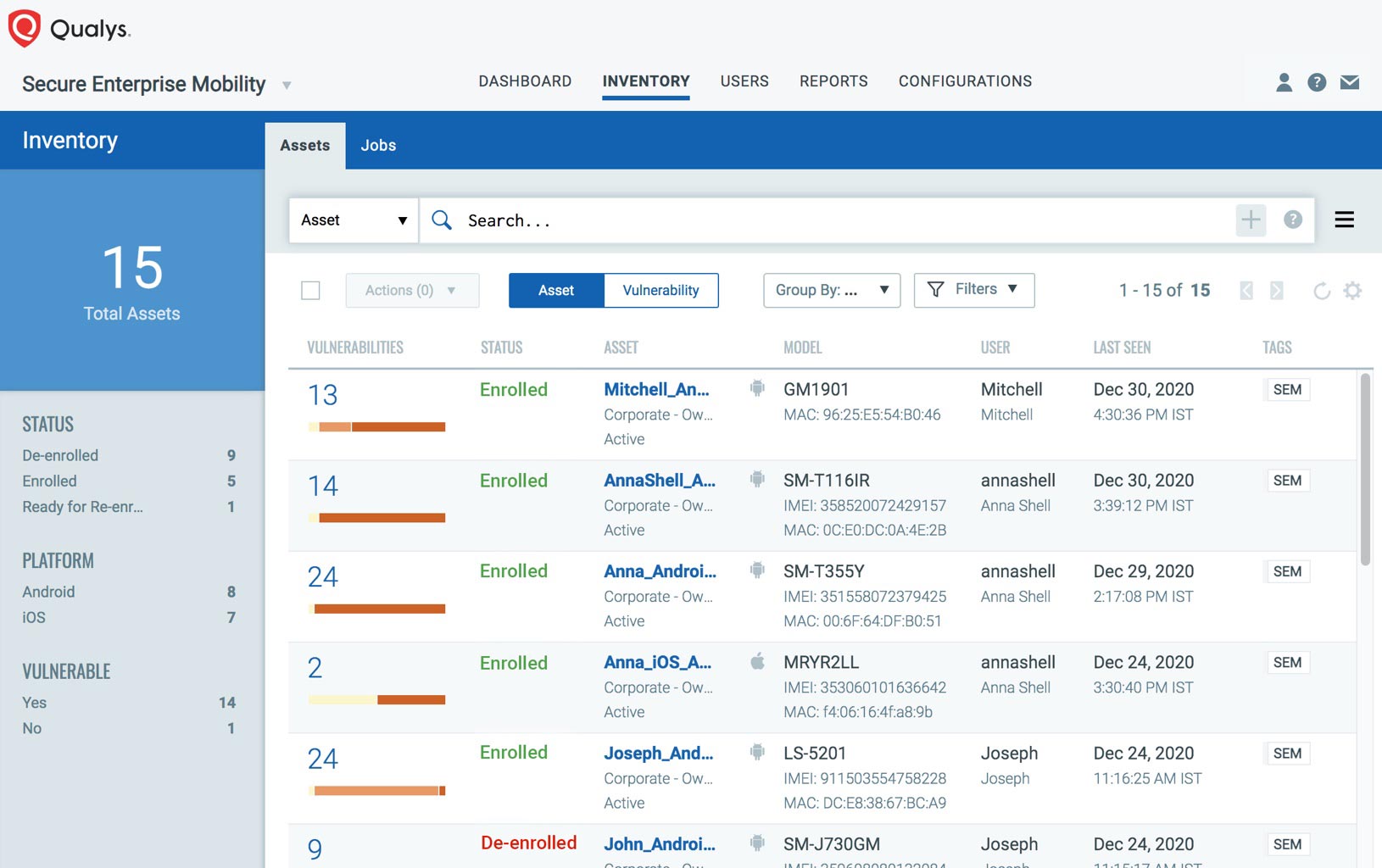
Qualys VMDR is a cloud-based platform that combines vulnerability management, detection, and response in a single workflow across a global hybrid-IT environment. It brings together asset inventory, vulnerability and configuration assessment, threat-based prioritization, and patch detection. It starts with asset discovery and inventory, then runs continuous assessments using cloud agents and a range of sensors.
VMDR prioritizes findings with TruRisk, which combines a Qualys Detection Score, a Qualys Vulnerability Score, and asset criticality into a single risk number, and incorporates real-time threat indicators such as active exploitation, ransomware, and CISA Known Exploited Vulnerabilities. Patch Management is built in, with no-code workflows for automated patching, while TruRisk Eliminate adds configuration-based mitigations and device isolation when patching is not feasible.
Key features include:
- Asset discovery and inventory: Continuously discovers and inventories devices across the hybrid environment as the starting point for assessment.
- Continuous assessment: Runs continuous vulnerability and configuration assessments using cloud agents and multiple sensor types.
- TruRisk prioritization: Scores risk from the Qualys Detection Score, Qualys Vulnerability Score, and asset criticality, factoring in real-time threat indicators and CISA KEV.
- Threat intelligence and ATT&CK mapping: Correlates findings with 25+ threat intelligence feeds and maps them to the MITRE ATT&CK matrix.
- Built-in patch management: Automates remediation through no-code, drag-and-drop workflows and integrates with ITSM tools such as ServiceNow and Jira.
- TruRisk Eliminate: Adds configuration-based mitigations and device isolation to address vulnerabilities when patching is not possible.
Limitations (as reported by users on Gartner Peer Insights):
- Support responsiveness: Some reviewers report slow response times from support teams.
- Patching gaps: A user notes that certain advertised application-patching capabilities did not work as expected.
- Dated reporting: Reviewers describe the reporting interface and output as feeling outdated.
Source: Qualys
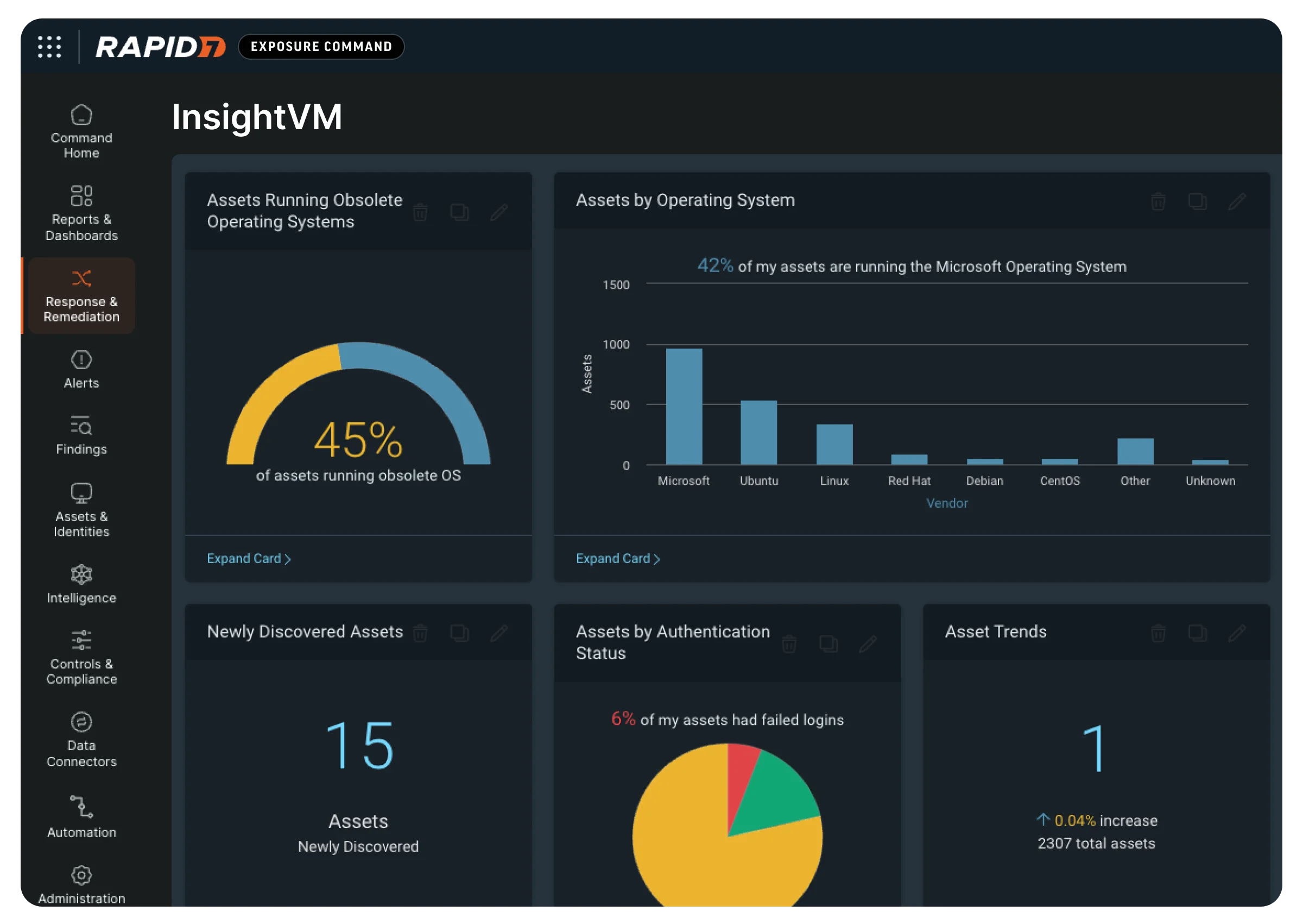
10. Rapid7 InsightVM

Best for: Vulnerability management unified with attack surface context
Strengths: The same scanner with cloud, app, and attack-surface context
Things to consider: Reporting customization and on-prem/cloud sync
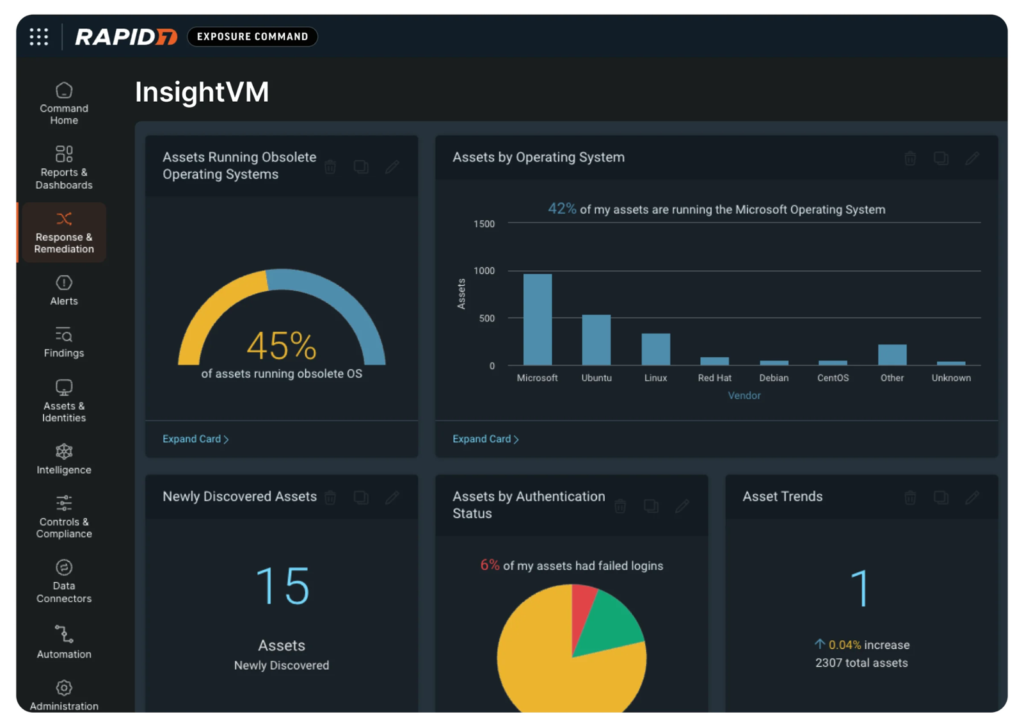
Rapid7 InsightVM is the vulnerability management technology that now powers Rapid7’s Exposure Command. It provides vulnerability scanning and connects those findings with attack surface, cloud, and application risk in a single Exposure Command view. The aim is to keep the same scanner while adding wider context so teams can prioritize what is actually reachable.
InsightVM’s internal scanning is paired with an outside-in attacker view, so internal exposure and external visibility together sharpen prioritization. Findings from vulnerability, attack surface, cloud, and application sources are brought into one console and one workflow built on a shared risk model. It is available within Exposure Command packages and can also be evaluated through a standalone InsightVM trial, including on-premises deployment.
Key features include:
- Vulnerability scanning: Provides the scanning engine that detects vulnerabilities across the environment.
- Reachability-based prioritization: Prioritizes vulnerabilities that are reachable across cloud, network, and application layers.
- Inside-and-outside context: Combines internal exposure data with an external attacker’s view to improve prioritization.
- Unified risk console: Brings vulnerability, attack surface, cloud, and application findings into one console and a shared risk model.
- Flexible deployment: Available through Exposure Command packages or as a standalone InsightVM deployment, including on-premises.
Limitations (as reported by users on PeerSpot):
- Reporting customization: Reviewers frequently cite limited reporting customization and complexity in building specific reports.
- False positives: Users report false positives that require tuning to keep data reliable.
- On-prem and cloud sync: Some note lag or poor synchronization between on-premises consoles and the cloud.
- Support response times: Reviewers mention delays in support, especially when issues are escalated.
Source: Rapid7
11. Microsoft Defender Vulnerability Management
Best for: Microsoft-centric and Windows-heavy environments
Strengths: Continuous, agent or agentless assessment with Microsoft threat intel
Things to consider: Reporting depth and third-party coverage
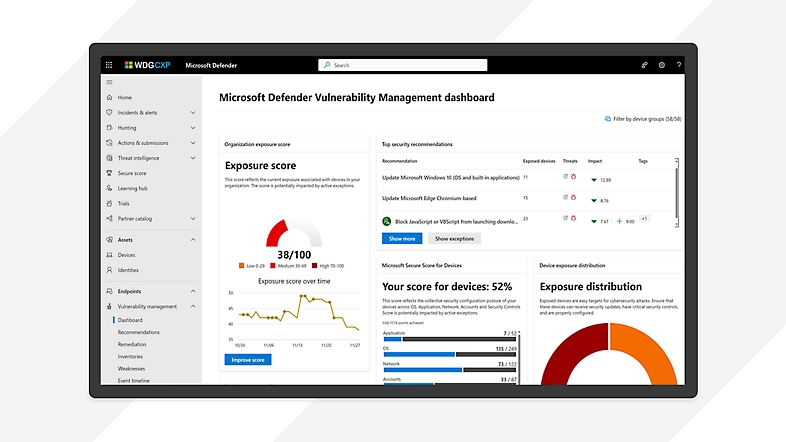
Microsoft Defender Vulnerability Management takes a risk-based approach to continuous vulnerability assessment, prioritization, and remediation. It continuously discovers and monitors assets without relying on periodic scans, and can detect risks even when endpoints are not connected to the corporate network. Coverage spans Windows, Linux, macOS, iOS, Android, and network devices, using agent-based or agentless scanning.
The platform prioritizes the biggest vulnerabilities on the most critical assets using Microsoft threat intelligence, breach-likelihood predictions, and business context. It provides entity-level inventories of devices, software, digital certificates, browser extensions, and firmware, and can block known vulnerable application versions. Built-in workflows and measures such as the exposure score and Microsoft Secure Score for Devices help security and IT teams remediate and track progress.
Key features include:
- Continuous asset monitoring: Replaces periodic scans with continuous discovery and monitoring, including off-network endpoints.
- Risk-based prioritization: Prioritizes critical assets using Microsoft threat intelligence, breach-likelihood predictions, and business context.
- Entity-level inventory: Inventories devices, software applications, digital certificates, browser extensions, and firmware.
- Application blocking: Blocks known vulnerable application versions or warns users with desktop alerts.
- Built-in remediation workflows: Connects security and IT with workflows and tracks progress through the exposure score and Secure Score for Devices.
- Flexible coverage: Provides agent-based and agentless scanning across endpoints, servers, containers, and cloud workloads.
Limitations (as reported by users on G2):
- Dashboard learning curve: Reviewers find the dashboard confusing for first-time users and say additional training is needed.
- Reporting depth: Users want more thorough reporting on vulnerabilities and their potential impact.
- Third-party coverage: Some note that support for third-party, non-Microsoft products is limited.
- Add-on and licensing complexity: Reviewers point to threat intelligence as a separate add-on and to licensing tiers that gate advanced features.
Source: Microsoft
Open-Source Scanners
Free scanners that find vulnerabilities but leave prioritization and remediation to your team.
12. OpenVAS

Best for: Free, full-featured network vulnerability scanning
Strengths: Authenticated and unauthenticated tests with a daily-updated feed
Things to consider: Complex setup and dated interface
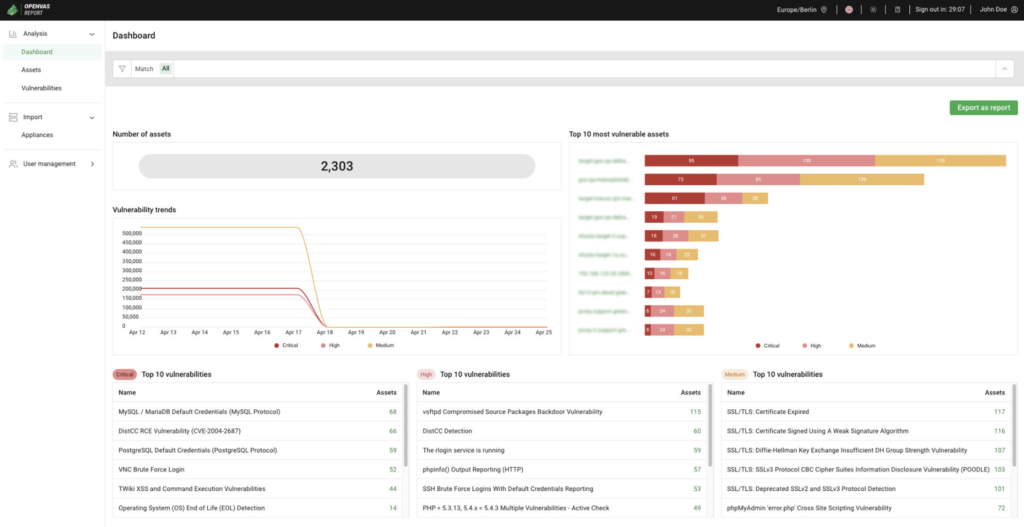
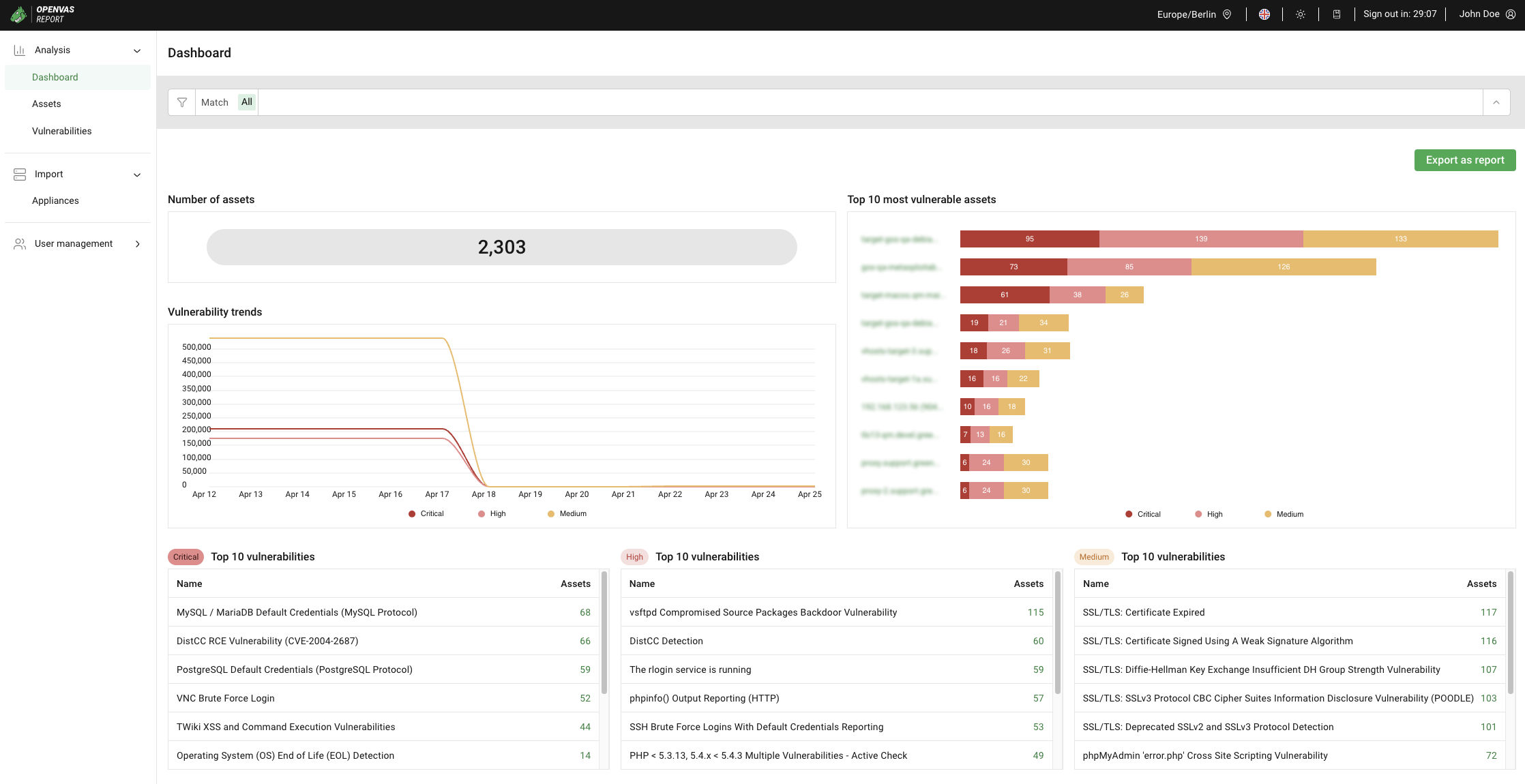
OpenVAS is a full-featured, open-source vulnerability scanner developed and maintained by Greenbone since 2006. It supports both unauthenticated and authenticated testing and works across a range of high-level and low-level internet and industrial protocols. Performance tuning allows it to handle large-scale scans.
The scanner includes a powerful internal programming language that lets users implement essentially any type of vulnerability test. Its detection tests come from a feed with a long history and daily updates. OpenVAS forms the OPENVAS Community Edition together with other open-source modules and also sits within Greenbone’s commercial OPENVAS SCAN product family.
Key features include:
- Authenticated and unauthenticated testing: Supports both credentialed and uncredentialed scans to assess assets at different access levels.
- Broad protocol support: Tests across many high-level and low-level internet and industrial protocols.
- Daily-updated feed: Pulls vulnerability tests from a feed with a long history and daily updates.
- Large-scale performance tuning: Includes performance tuning aimed at large-scale scanning.
- Custom test language: Provides an internal programming language to implement any type of vulnerability test.
- Open-source community edition: Available as the OPENVAS Community Edition alongside other open-source modules.
Limitations (as reported by users on G2):
- Complex setup: Reviewers note installation and configuration can be complex, with the recommended install method sometimes failing.
- Dated interface: Users describe the interface as confusing for newcomers, with options hidden and not always intuitive.
- False positives: Some report false positives in scan results.
- Reporting and feed depth: Reviewers say reports are not always easy to digest and that feed updates can lag behind some commercial scanners.
Source: OpenVAS
13. Nuclei

Best for: Fast, template-based scanning for known vulnerabilities
Strengths: Community YAML templates updated within hours of new CVEs
Things to consider: Template quality varies; it is a CLI, not a managed service
Nuclei is an open-source, community-powered vulnerability scanner from ProjectDiscovery built on a simple YAML-based templating engine. It uses a large template library to scan applications, cloud infrastructure, and networks for vulnerabilities and misconfigurations. The project reports 30,000+ GitHub stars, 900+ contributors, more than 12,000 templates, and over 50 million monthly scans.
Because detection logic lives in community-contributed templates rather than the engine, new CVE templates often appear within hours of public disclosure. Users can write their own templates, including with an AI-powered editor that turns internal vulnerability data into automated detection. Nuclei supports more than six protocols plus code protocols and can target web applications, APIs, networks, cloud configurations, infrastructure, and CI/CD pipelines.
Key features include:
- Template-based scanning: Uses a YAML-based DSL and a 12,000+ template library to detect known vulnerabilities and misconfigurations.
- Community-driven coverage: Draws on a large contributor community, with templates for new CVEs often released within hours of disclosure.
- Multi-protocol support: Scans across more than six protocols plus code protocols, covering web, network, DNS, and SSL services.
- Broad target coverage: Targets web applications, APIs, cloud configurations, infrastructure, and CI/CD pipelines.
- Real-world simulation: Runs tests the way an attacker would and captures full logs behind each test for triage.
- AI-powered template editor: Converts internal vulnerability data into automated detection templates.
Limitations (based on publicly available sources):
- Variable template quality: Community templates are not peer-reviewed like commercial signatures, so poorly written ones can cause false positives or miss edge cases.
- No application-logic coverage: Nuclei runs predefined checks rather than crawling an application, so it will not find custom application-logic flaws.
- Not a continuous service: It is designed as a command-line tool that runs and exits, so continuous scanning needs separate orchestration.
- Coverage tied to templates: Detection is limited to the subset of CVEs the community has converted into templates, and the format does not express every vulnerability type.
Source: Nuclei
14. Nikto

Best for: Fast web server and misconfiguration scanning
Strengths: Thousands of checks for risky files and server misconfigurations
Things to consider: Noisy, not stealthy, and prone to false positives
Nikto is an open-source web server scanner, written in Perl, that tests web servers for thousands of potential issues. These include dangerous files, misconfigured services, vulnerable scripts, and outdated server versions across hundreds of server types. It is structured with plugins that extend its capabilities and are updated with new security checks.
Nikto supports scan tuning to include or exclude entire classes of checks, such as injection, information disclosure, remote file retrieval, command execution, and authentication bypass. It offers SSL support, proxy support, authentication for protected realms, and several encoding-based evasion techniques useful for testing intrusion detection systems. Results can be saved in formats including CSV, JSON, HTML, XML, and plain text.
Key features include:
- Broad server testing: Checks web servers for dangerous files, misconfigurations, vulnerable scripts, and outdated versions across many server types.
- Scan tuning: Lets users include or exclude entire classes of checks, from injection and information disclosure to command execution and authentication bypass.
- Evasion techniques: Provides multiple encoding-based evasion options, useful for testing intrusion detection systems.
- SSL and proxy support: Scans HTTPS endpoints and can route through a proxy to reach servers behind firewalls.
- Mutation and enumeration: Uses mutation techniques to guess file names, directories, and usernames.
- Flexible output: Saves findings in CSV, JSON, HTML, XML, plain text, and SQL formats.
Limitations (based on publicly available sources):
- False positives: Nikto can be overzealous, flagging issues when a server returns 200 OK for missing pages, so findings need manual validation.
- Not stealthy: It makes thousands of requests and is easily detected in server logs and by intrusion detection systems.
- Breadth over depth: It focuses on web server identification and enumeration rather than exploitation or deep application-logic testing.
- No risk scoring or authenticated testing: It does not assign CVSS scores and does not natively test authenticated areas of complex applications.
How to Choose the Right Vulnerability Management Tool
Choosing the right vulnerability management tool starts with understanding the organization’s environment, risk profile, and remediation capacity. The solution should find vulnerabilities and help teams determine which issues are exploitable, reduce false positives, prioritize based on business risk, and move findings into remediation workflows. Modern programs rely on contextual investigation, exploitability analysis, and automated remediation guidance to reduce alert noise and focus on meaningful risk.
- Assess environment coverage: Choose a tool that supports endpoints, servers, cloud workloads, containers, applications, network devices, and third-party systems.
- Prioritize real-world risk over raw vulnerability counts: Look for tools that evaluate exploitability, asset criticality, internet exposure, compensating controls, and business impact.
- Evaluate remediation capabilities: Ensure the tool provides remediation guidance, patch information, configuration fixes, mitigation steps, and advisory links, along with task routing and verification.
- Check integration with existing security and IT tools: Confirm integration with SIEM, SOAR, EDR, ticketing systems, patch management tools, cloud security platforms, and DevOps workflows.
- Consider accuracy and false positive reduction: Choose a tool that validates whether vulnerabilities are relevant through contextual investigation and evidence-based findings.
- Look for strong reporting and compliance support: Ensure reporting supports technical and executive audiences and includes compliance mapping and remediation history.
- Evaluate ease of deployment and operational fit: Consider whether the tool requires agents, credentials, scanners, cloud connectors, or network changes.
- Match the tool to team size and maturity: Smaller teams may need automation and simplified dashboards, while larger enterprises may require customization and role-based access control.
- Review threat intelligence and exploit context: Select a tool that shows whether vulnerabilities are actively exploited or associated with campaigns.
- Test workflow efficiency before committing: Test the workflow from discovery to remediation, including ownership, ticket generation, fix guidance, and verification.