[ Product ]
From Rules to Reasoning: The Shift That Made Maze Possible

Summarize with AI


Summarize with AI
Some tools tried to help by layering additional datapoints onto findings so filtering rules could be applied. A common one: “Is this asset public-facing?”. This is how most products still operate, you apply a set of filters to make the intractable number of scanner findings somewhat manageable.
The practice of using rules like these to prioritise vulnerabilities is now widespread. We’ve met many teams that aligned with their C-suites on a fixed set of filters—what they’d fix, what they’d ignore.
The problem is that rules can capture only a tiny fraction of the context needed to truly assess risk. They’re directionally helpful compared to raw CVSS scores, but fall far short of what an in-depth investigation would uncover.
We built Maze because we believe you shouldn’t have to choose between comprehensive coverage and deep insight. The set of findings that matter is constantly evolving and your tooling should adapt to that.
One of the most common ways to filter findings we’ve seen is some variation of the following: IF public facing AND critical asset AND CVSS > 8, THEN high risk.
That’s still the state of the art in current vulnerability management products. But here’s the reality: over 90% of vulnerabilities are false positives when investigated in context. And, rules often fail to identify the edge cases where real breaches actually happen.
Before LLMs, the challenge wasn’t knowing we needed better logic, it was scaling it. Encoding nuanced logic across every OS, app stack, cloud provider, version, and misconfiguration simply wasn’t feasible. Building systems that could reason across all that context was out of reach.
Now, we can take every relevant signal (e.g. kernel versions, library paths, IAM roles, network configs) and reason over them dynamically, with a flexibility that was impossible just a few years ago.
LLMs changed the game by allowing us to reason across layers: infrastructure, runtime, configuration, and metadata. At Maze, we use LLMs to go far beyond “Is this asset public-facing?”. For every finding, our agents explore a deep decision tree that looks at prerequisites, mitigating factors, additional software in the context, and different layers of configuration. It’s not just about surfacing facts, it’s about interpreting them in context. LLMs let us navigate these branches dynamically and surface what actually matters.
Once we understand the problem clearly, we can also act. Remediation is no longer a game of static patches or suggesting major version upgrades that aren’t practical. With LLMs, we can generate actionable, context-aware suggestions across source code, infrastructure as code and cloud configurations.
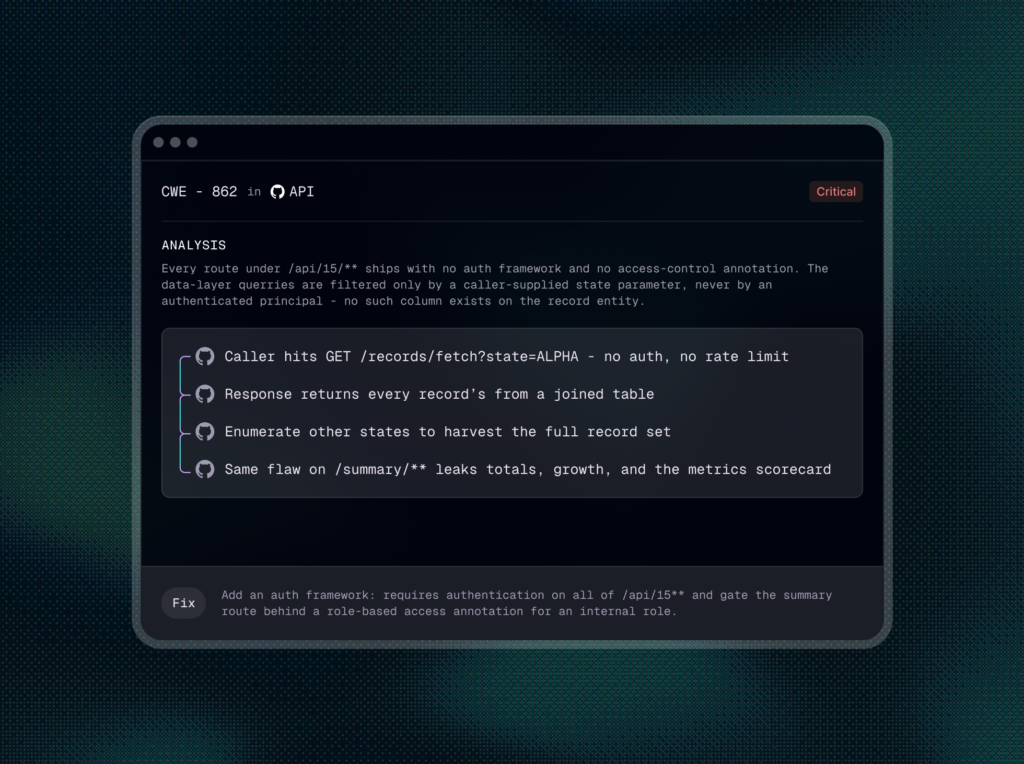
We don’t just tell you something’s wrong, we show you why it matters, and how to fix it.
When we started Maze, the concept of an “AI agent” barely existed in practice. Most of what we did early on was teaching LLMs to choose tools and provide input parameters correctly. There were no frameworks, orchestration layers or routers, just raw prompting and experimentation.
We’ve grown alongside the ecosystem. The timing couldn’t have been better.
Inference providers like AWS Bedrock now provide the enterprise-grade building blocks we needed. This gave us the confidence that our customers’ data would always remain under tight control. Tools like batch inference, prompt caching and sufficiently large context windows unlocked reliability and cost performance that couldn’t have been achieved before.
Maze sits at the intersection of LLM maturity, scalable infrastructure, and a real need for signal over noise in cloud security.
We couldn’t have built Maze five years ago. The technology just wasn’t there.
But now with the advent of LLMs and a mature ecosystem to support them, we can do what wasn’t possible before: provide deep contextual analysis at scale, with clear, actionable steps to reduce risk.
This isn’t about AI hype, it’s about finally having the tools to solve a long-standing, painful problem in security.
[ Product ]
[ Product ]
[ Product ]