[ Application Security ]
Top 14 SCA tools compared: basics and emerging capabilities

Summarize with AI


Summarize with AI
TL;DR: SCA tools inventory open source dependencies and flag vulnerable, malicious, or non-compliant components. Maze is best for knowing which dependency CVEs are actually exploitable in your environment, Endor Labs for reachability across transitive dependencies, Socket for malicious package detection, and Black Duck for license and compliance depth.
Software composition analysis (SCA) tools scan the third-party and open source dependencies in your software for security vulnerabilities, malicious packages, and license compliance issues.
Most of the code in a modern application wasn’t written by the team that ships it. A typical service pulls in dozens of packages directly, and each of those pulls in more, so the full dependency tree can run to hundreds or thousands of components that nobody on the team chose by name. SCA tools build an inventory of all of it, match each component against vulnerability databases and license data, and tell you which packages need attention, so you aren’t relying on developers to track every advisory themselves.
SCA is evolving from basic dependency inventory and CVE matching into a more context-aware form of software supply chain analysis. Modern tools still detect vulnerable components, license issues, and generate SBOMs, but they increasingly use reachability analysis, EPSS, runtime data, and application context to determine which findings matter. More advanced platforms go further by validating whether a reachable vulnerability is actually exploitable, correlating findings across scanners, and using cloud context such as network exposure and workload permissions.
Key features to look for in SCA tools:
The table below summarizes the key differences between the tools covered in this guide, including what each one is built around and where teams tend to hit friction, and we explore each of them in more detail in the sections that follow.
| Category | Solution | Best for | Key strengths | Things to consider |
|---|---|---|---|---|
| AI-native and exploitability-based | Maze | Cutting dependency backlogs down to exploitable findings | AI that finds and investigates every vulnerability, with the evidence behind each verdict | SaaS only, and you can’t bring your own LLM key |
| AI-native and exploitability-based | Endor Labs | Reachability across code, dependencies, and containers | Code context graph, evidence-backed call paths | Some reviewers find the interface still maturing |
| AI-native and exploitability-based | Socket | Catching malicious packages before they are installed | Behavior analysis of package code, install-time blocking | Slower interface, and the triage workflow is still developing |
| AI-native and exploitability-based | Semgrep Supply Chain | Teams already using Semgrep for SAST | Codebase-aware reachability, upgrade guidance | Custom rules take time to learn, and reporting exports are limited |
| Established and platform-integrated | Snyk Open Source* | Developer-first scanning in IDEs and pull requests | Risk Score prioritization, one-click fix PRs | Noise from low-severity findings, and costs rise at scale |
| Established and platform-integrated | Wiz Code | Teams already on Wiz that want code risk in the same Security Graph as their cloud | Security Graph links dependencies to cloud identity, network, and exposure context | SCA is lighter than in dedicated tools, and alert tuning takes time |
| Established and platform-integrated | Orca Security | Teams already on Orca that want SCA alongside their cloud security | Repository and image scanning with full SBOMs and reachability | Reporting is less customizable, and alert volume needs tuning |
| Established and platform-integrated | Black Duck SCA | License compliance and audit-heavy environments | Snippet, binary, and dependency scanning, KnowledgeBase | Higher pricing, a complex setup, and heavy on-premises requirements |
| Established and platform-integrated | Mend SCA | Reachability-based triage, with Mend Renovate for dependency updates | Call graph reachability, EPSS and CVSS 4.0 | On-premises integrations and implementation take effort |
| Established and platform-integrated | Sonatype Lifecycle | Policy-driven governance of open source use | Proprietary intelligence, Golden Pull Requests | Analysis is deepest for Java, and reporting is complex |
| Established and platform-integrated | Checkmarx SCA | Deep transitive scanning inside a wider AppSec suite | Exploitable path analysis, malicious package database | False positives without tuning, and slow scans |
| Open source and developer-native | Dependabot | Teams wanting free, GitHub-native dependency and security updates | Automated PRs for vulnerable and outdated dependencies, native Advisory Database integration | Basic next to dedicated SCA, and PR volume needs grouping and cooldown tuning |
| Open source and developer-native | OWASP Dependency-Check | Free CVE detection in Java and .NET builds | Build plugins, detailed reports, CPE-based matching | False positives, and NVD API rate limits without a key |
| Open source and developer-native | Syft and Grype | SBOM generation and scanning from the command line | SPDX and CycloneDX output, CI-friendly scanning | No policy engine, dashboards, or license workflow |
*Snyk now positions itself as an AI security platform, led by Evo, its agentic security product line.
Traditional SCA tools operate by scanning a project’s source code, build artifacts, and dependency manifests to create an inventory of all software components in use. This inventory covers direct dependencies explicitly included by developers, as well as transitive dependencies pulled in automatically. The tools then cross-reference this list with vulnerability databases, license registries, and other intelligence sources to flag issues such as security vulnerabilities, license incompatibilities, and outdated packages.
Once the analysis is complete, SCA tools present reports highlighting detected risks and suggesting remediation steps. These reports can be integrated into development pipelines, alerting teams to issues early in the software lifecycle. Some SCA solutions also offer automated remediation, proposing or applying updates for vulnerable components. Catching a vulnerable package in a pull request means the fix is a version bump the developer can make while the change is still fresh, instead of an urgent patch after the package is already running in production.
Related content: Read our guide to SCA security.
Early SCA tools focused on matching identified components and versions against known vulnerabilities, typically CVEs. When a match was found, teams used metrics such as the Common Vulnerability Scoring System (CVSS) to prioritize remediation, so a critical CVSS score generally received more attention than a medium or low score.
The problem is that CVSS describes the general technical severity of a vulnerability, not the risk it creates in a specific application, and a vulnerable package may be present without the application ever invoking the affected code. As dependency inventories grew, this approach produced large backlogs of findings, many of them scanner false positives, that security teams had to triage manually.
Modern SCA tools add context to reduce this noise, starting with policy rules that can account for factors such as package version, application type, deployment environment, and organizational risk requirements. Reachability analysis goes further by determining whether application code can actually reach the vulnerable function or execution path.
Tools can also incorporate the Exploit Prediction Scoring System (EPSS), which estimates the probability that a published CVE will be exploited in the wild. Combining CVSS, EPSS, reachability, and policy data helps teams prioritize vulnerabilities that are both relevant to the application and more likely to be exploited.
Each of those signals still leaves a gap, because reachability usually depends on a call graph that tends to break at dynamic calls, framework routing, and reflection, so the trace often stops before it can say whether the vulnerable code is reachable, while EPSS describes what attackers do across the internet rather than whether a vulnerability can be triggered in your application.
The next step is moving from prioritization toward proving whether a vulnerability is actually exploitable in a specific application. That requires analyzing more than package presence or static call paths, so tools may inspect runtime behavior, configuration, input paths, security controls, and the conditions required to trigger the vulnerable code.
That’s the investigation a security engineer would run if they had the time to do it for every finding. They’d start with what has to be true for the vulnerability to be exploited, such as an attacker controlling the input a deserialization bug needs, and then check the application for each condition. Rules can’t run that investigation, because every vulnerability needs its own set of checks, and AI is what makes it possible across a real dependency backlog.
Cloud context can make this assessment more precise, because an SCA finding can be evaluated alongside information about whether the workload is internet-facing, what permissions its identity has, which services it can access, and what network controls surround it. Combining application and cloud context helps distinguish theoretical vulnerabilities from findings that expose a practical attack path.
Exploitability validation determines whether the conditions required to exploit a vulnerability actually exist in the deployed environment. Reachability alone is not enough, because vulnerable code may be callable while an attack still depends on a specific configuration, input, permission, network path, runtime state, or other prerequisite that is absent.
Effective SCA tools evaluate these prerequisites using application, runtime, and infrastructure context. For example, they can determine whether an affected service is externally accessible, whether attacker-controlled input can reach the vulnerable code, or whether the workload has the permissions needed for exploitation to have an impact. This evidence helps teams focus remediation on vulnerabilities that represent practical attack paths rather than theoretical exposure.
Accurate SCA first depends on the inventory being right, because a vulnerability in a component the tool never found will never be flagged. Detection has to cover every language and package manager you use, and the best tools look beyond manifests to lockfiles, build output, and binaries, where vendored and copied code tends to hide.
Codebases that use several languages and complex build pipelines make this harder, because a Java service that bundles a JavaScript front end, or a container image that installs packages at build time, can hold dependencies that a manifest-only scan misses entirely. Tools that resolve dependencies the way your build does, using the exact versions it pulled in, give you an inventory you can trust.
Transitive dependency analysis is the process of identifying not just direct dependencies, but also the indirect ones brought in by those libraries. Many vulnerabilities and license conflicts reside in these transitive components, so a tool that stops at direct dependencies misses much of the risk. Log4Shell hit thousands of applications that had never added Log4j themselves, because it arrived as a dependency of a dependency.
An SCA tool needs to walk the full tree and keep track of how each package got there, because the fix depends on it. When the vulnerable package is three levels down, the right fix might be upgrading the direct dependency that brings it in rather than the vulnerable package itself, and the tool should tell you which one to change.
An SCA tool is only as good as the vulnerability data behind it, and public sources such as the National Vulnerability Database (NVD) and the GitHub Advisory Database are the starting point, and many vendors add proprietary feeds to fill gaps, correct affected version ranges, and publish advisories sooner.
The details matter as much as the coverage, because accurate affected and fixed versions decide whether you get a false positive or a missed vulnerability, and guidance on exploitability, affected versions, and available patches decides whether your team can act on a finding. The best tools also pick up newly disclosed vulnerabilities quickly and check them against code you’ve already shipped, so you know whether you’re affected before anyone asks.
Automated remediation helps teams address vulnerabilities quickly by recommending or applying fixes directly within development workflows. SCA tools can suggest version upgrades, patch applications, or configuration changes that resolve detected issues. Many integrate with source control to open a fix pull request for a specific vulnerability, so a developer reviews a change instead of researching one, and many also open automated pull requests on a schedule that keep dependencies current before a vulnerability ever lands in them.
Breaking changes are why teams hesitate to merge those pull requests, because a major version bump can rename or remove functions your code calls, change default behavior, or pull in new transitive dependencies with conflicts of their own. An upgrade that fixes a CVE can still fail the build or break a feature in production, so the most useful tools check what an upgrade will change in your code before they suggest it, choose the smallest version jump that fixes the vulnerability, and recommend a mitigation when no safe upgrade exists yet.
Related content: Read our practical guide to CVE remediation.
License risk management ensures that all open source components comply with organizational policies and legal requirements. SCA tools analyze the licenses associated with each dependency, flagging any that are incompatible with the intended use of the software. A copyleft license like the GPL or AGPL can require you to publish your own source code if you distribute software that includes it, which is a problem for a commercial product.
The best tools go beyond detection by interpreting license obligations and restrictions, such as requirements for attribution, distribution, or disclosure of source code. They let legal and engineering agree on rules once, such as which licenses to allow, warn on, or block, and then apply them automatically, so nobody has to review every new package by hand.
Software Bill of Materials (SBOM) generation is an increasingly important feature in SCA tools, driven by regulatory requirements and supply chain transparency initiatives. An SBOM is a structured list of all components, their versions, and associated metadata within a software product. Customers, auditors, and regulators increasingly ask for one, especially since the US federal government began requiring SBOMs from software suppliers and the EU Cyber Resilience Act set out SBOM requirements of its own.
SBOMs help organizations respond to incidents quickly, trace the impact of new vulnerabilities, and demonstrate compliance during audits. When a new vulnerability is disclosed in a popular package, an up-to-date SBOM tells you in minutes which applications include it, instead of leaving teams to search repositories by hand, and SCA tools that generate a new SBOM on every build keep that answer current.
Malicious package detection focuses on identifying open source components that have been intentionally compromised to carry out attacks, such as stealing data or executing unauthorized code. SCA tools use threat intelligence, heuristics, and behavioral analysis to flag suspicious packages, including those recently published or exhibiting unusual patterns.
Supply chain attacks on package registries have made this capability a priority, as in September 2025, when attackers phished an npm maintainer and published malicious versions of widely used packages such as chalk and debug, which together are downloaded billions of times a week. A CVE database won’t flag a malicious package until after it has been discovered and reported, so the best tools analyze what a package’s code does and block suspicious packages before a developer or build server installs them.
CI/CD integration enables SCA tools to operate within automated development pipelines, ensuring that dependency analysis and risk detection occur at every stage of the software lifecycle. A check on every pull request catches a vulnerable or malicious package while the developer who added it is still looking at the change, and a check in the build pipeline stops a risky release before it ships.
Strong CI/CD integration includes support for popular build systems, version control platforms, and notification channels. SCA tools should provide actionable feedback directly within developer workflows, such as blocking builds with critical vulnerabilities or automatically generating remediation pull requests. Blocking only on new risk that’s real matters, because a tool that blocks on every finding, or on vulnerabilities a developer didn’t introduce, teaches developers to work around it.
Organizations often run several security scanners across source code, build pipelines, container images, registries, and cloud environments. The same vulnerability can therefore appear repeatedly, with differences in package naming, severity, affected version data, or asset identifiers. Treating each scanner result as a separate issue creates duplicate tickets and forces teams to repeat the same investigation.
Multi-scanner ingestion consolidates these findings and correlates them using attributes such as CVE, package, version, artifact, and deployed asset. Effective deduplication creates one canonical finding per vulnerability per asset while retaining evidence from each scanner. Teams can then perform one investigation, track one remediation decision, and update all associated scanner findings from the same result.
How we selected these tools: We shortlisted software composition analysis tools based on dependency and transitive dependency detection, vulnerability and malicious package intelligence, reachability or exploitability analysis, license risk management, SBOM generation, and integration into CI/CD pipelines.
The tools in this group go past severity scores to work out whether a dependency vulnerability can actually hurt you. Most start with reachability, whether that’s static code reachability, which checks for a call path to the vulnerable function, runtime reachability, which records what code actually executes, or network reachability, which checks whether the service can be reached at all. Each of these is useful, and each leaves the same gap, because it answers whether there’s a path and not whether an attacker can use it.
Code can be reachable in the repository while the path is dead in production, and a reachable function can still be impossible to exploit when a configuration setting turns the vulnerable feature off, an attacker can’t control the input that reaches it, or a control sits in front of it. The best tools treat reachability as one piece of evidence and go on to check whether the prerequisites each vulnerability needs actually exist in your environment. AI-native platforms like Maze were built from the ground up to do that for every finding, investigating it the way a security engineer would with unlimited time and gathering context from your code, build, and cloud to decide whether it can be exploited, with the evidence behind each decision.

Best for: Reducing dependency findings to the ones that are exploitable
Strengths: AI that finds and investigates every vulnerability, exploitability verdicts with evidence, fixes where developers work
Things to consider: SaaS only, and you can’t bring your own LLM key
Maze’s founders spent years working alongside security teams, and they kept seeing the same thing. SCA tools were good at finding vulnerable packages and couldn’t gather the context to say which ones mattered, so teams either patched everything by severity score or let the backlog grow. They built Maze so that every vulnerability gets the investigation those teams never had the time to run.
Maze is built from the ground up so its AI can gather the context it needs, reason through each vulnerability, and make decisions the way your best security engineer would. For a dependency vulnerability, that means researching what the fix actually changed, finding the manifest that pulled the package in and the exact version your build used, tracing the path from your code to the vulnerable function, and following the package through the build to the workload it runs on. Instead of applying static rules, Maze’s AI works out what each finding needs and gathers it from your code, build, and cloud.
Findings that are reachable but not exploitable are closed before they reach the team, while exploitable ones are ranked by risk to the environment, traced to their origin, and routed as a pull request to the developer who owns the code. Where no fix exists, Maze recommends a mitigation instead, and every verdict can be opened to see the evidence behind it.
Key features include:


Best for: Reachability across code, dependencies, and container images
Strengths: Code context graph with evidence-backed call path analysis
Things to consider: Some reviewers find the interface still maturing and want more of the API exposed in the console
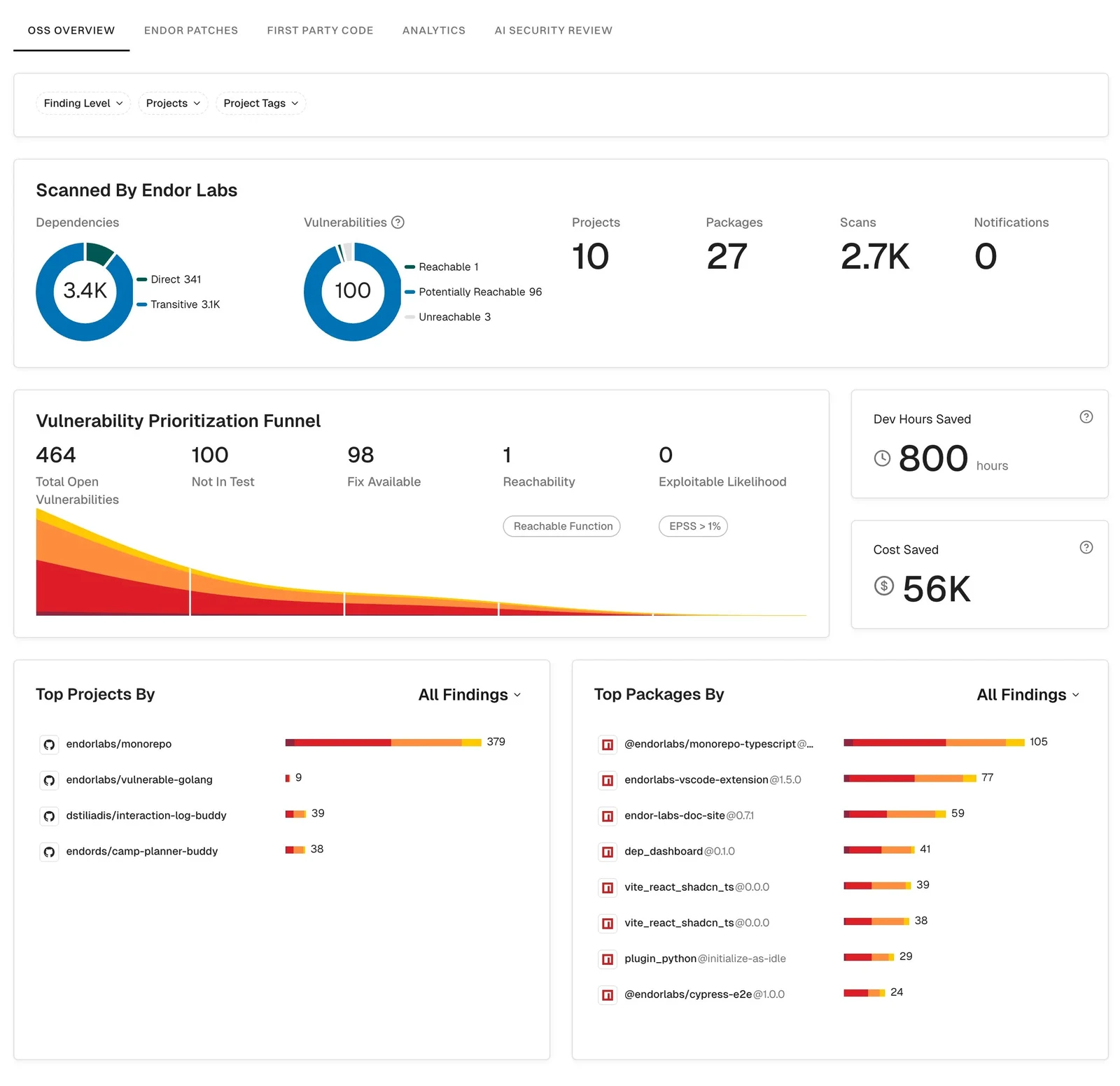
Endor Labs runs its SCA capability inside AURI, its application security platform, where the underlying technology is a code context graph that models first-party code, open source dependencies, container images, and the relationships between them, built with call graph analysis, data flow analysis, and function-level vulnerability intelligence.
That graph drives full-stack reachability, as Endor Labs traces data flow through first-party code, into direct and transitive dependencies, and down into container image layers to identify which vulnerabilities are reachable and exploitable. Findings arrive with data flow and call path evidence, and the platform can apply fixes through a coding agent.
Key features include:

Best for: Blocking malicious and compromised packages at install time
Strengths: Analyzes package behavior rather than only matching CVE lists
Things to consider: Slower interface, and the triage workflow is still maturing
Socket takes a different angle on dependency risk, because rather than only comparing package versions against vulnerability databases, it analyzes the package’s own code and behavior, flagging network calls, file access, shell execution, and obfuscation, which is how it catches malicious code that has no CVE yet.
The product is delivered as a set of enforcement points, with a GitHub App that comments on pull requests that introduce risky dependencies, a CLI for the terminal, and Socket Firewall, which blocks packages across the organization before any developer installs them. Reachability analysis, available on Socket’s paid plans, filters out CVEs your code can’t reach.
Key features include:

Best for: Teams already running Semgrep for static analysis
Strengths: Codebase-aware reachability with upgrade guidance
Things to consider: Custom rules take time to learn, and reporting exports are limited
Semgrep Supply Chain is the SCA component of the Semgrep platform, sitting alongside Semgrep Code for static analysis and Semgrep Secrets. It applies codebase-aware reachability analysis to open source dependencies, which the vendor reports as reducing false positives by up to 98 percent, with general availability support for critical and high severity findings across 13 languages.
Remediation is handled through a set of related capabilities rather than a single upgrade suggestion. Autofix pull requests automate dependency upgrades that resolve security issues, and Upgrade Guidance, currently in beta, combines program analysis with AI to flag potential breaking changes and explain the complexity and impact of an upgrade.
Key features include:
Established platforms built the SCA category, as Black Duck, Sonatype, Mend (originally WhiteSource), and Checkmarx made open source governance an enterprise practice, with deep vulnerability and license databases, policy engines, and on-premises and air-gapped options, while Snyk did more than anyone to bring dependency security to developers. Cloud security platforms like Wiz and Orca added SCA so code findings could sit next to everything else they know about your cloud, which suits teams that already run them.

Best for: Developer-first dependency scanning inside existing workflows
Strengths: Risk Score prioritization with automated fix pull requests
Things to consider: Alert noise on large projects and cost as teams scale
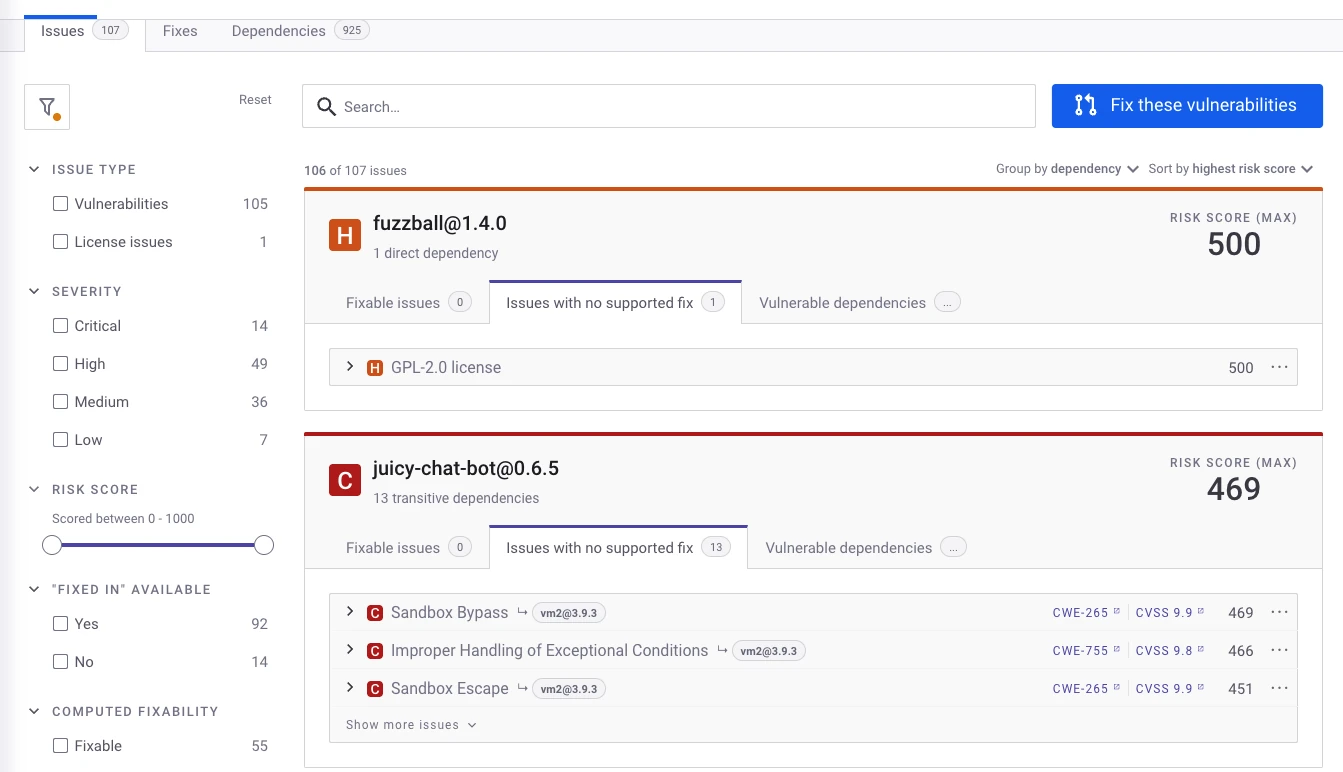
Snyk Open Source is the SCA product within the wider Snyk platform, and it scans dependencies at four points in the lifecycle, in the IDE and CLI as code is written, on pull requests before merge, inside CI/CD pipelines as a guardrail, and against the production environment to confirm exposure and monitor for newly disclosed issues.
Prioritization is handled through a Risk Score that goes beyond severity, evaluating more than a dozen factors including reachability, exploit maturity, and EPSS and CVSS scores. Teams can refine this further using business and application context to identify risks to mission-critical systems or those handling sensitive data.
*Snyk now positions itself as an AI security platform, led by Evo, its agentic security product line.
Key features include:

Best for: Teams already on Wiz that want code risk in the same Security Graph as their cloud
Strengths: Security Graph links dependencies to cloud identity, network, and exposure context
Things to consider: Some reviewers find SCA lighter than in dedicated tools, and alert tuning takes time
Wiz Code delivers software composition analysis as part of the broader Wiz Cloud Native Application Protection Platform, built on the Wiz Security Graph that ties code-level findings to cloud runtime context, identities, and attack paths. Rather than treating dependency scanning as an isolated exercise, Wiz Code examines a project’s dependency tree, including package lockfiles, installed libraries, and transitive dependencies, and links what it finds to whether the affected component is actually deployed, internet-facing, and reachable in production.
The platform connects to repositories and cloud environments without agents or infrastructure changes, and it can bring findings from third-party tools, such as Checkmarx for SAST, into the same view as its own scanners. Because Wiz Code sits inside the same product Wiz customers already use for cloud security posture management, the biggest practical benefit is a shared risk model rather than a separate console for application-layer findings.
Key features include:

Best for: Teams already on Orca that want SCA alongside their cloud security
Strengths: Repository and container image scanning with full SBOMs and reachability analysis
Things to consider: Reporting and dashboard customization are limited, and alert volume needs tuning
Orca Security delivers SCA as part of its shift-left application security capabilities, on the same platform it uses for cloud security without agents. Orca scans container images, filesystems, and Git repositories on every push or pull request for open-source risk, producing a full SBOM of code repositories that includes transitive dependencies, and it can also apply reachability analysis to determine whether a vulnerable package is actually invoked at runtime.
Because SCA findings sit on the same platform as Orca’s cloud posture, workload, and identity data, a vulnerable dependency and the container it runs in can be correlated into one risk view rather than two disconnected alerts. Teams can define and apply policies for source code, IaC, and container images from a central dashboard, including which risk threshold should fail a build and what enforcement action should follow.
Key features include:

Best for: License compliance, audits, and undeclared component discovery
Strengths: Dependency, binary, and snippet scanning with a curated database
Things to consider: Higher pricing and a complex initial deployment
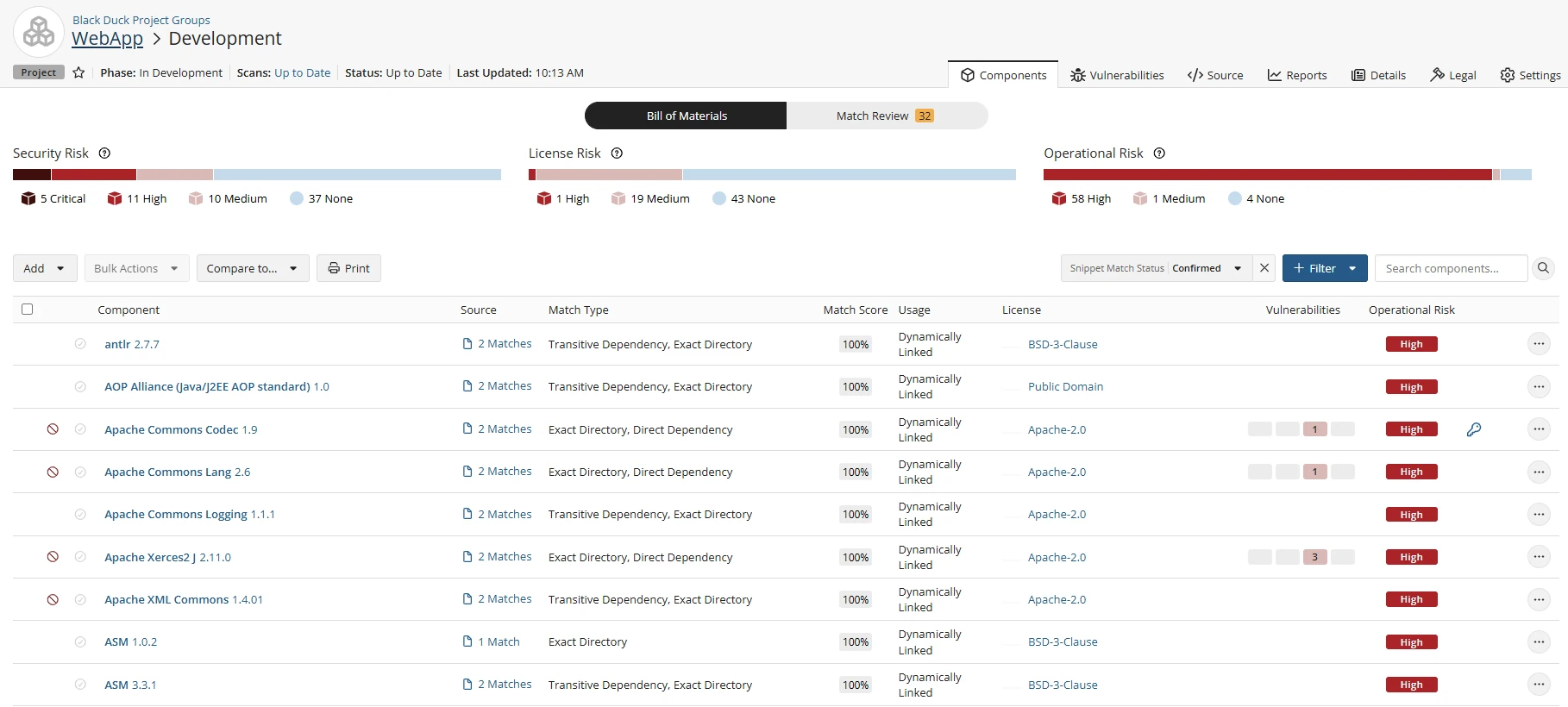
Black Duck SCA is built around detection breadth, so rather than relying solely on package manager declarations, it combines dependency analysis with, in its Enterprise edition, binary and firmware analysis, snippet detection, and language-agnostic signature scanning based on file and directory layouts, which surfaces open source that was never declared, was modified, or arrived inside a container.
Risk data comes from the Black Duck KnowledgeBase and Black Duck Security Advisories, curated by the vendor’s Cybersecurity Research Center. The KnowledgeBase covers more than 2,750 open source licenses with full license text, encoded obligations, and deep copyright data, which is the basis for its license compliance workflows.
Key features include:

Best for: Reachability-based triage, with Mend Renovate for automated dependency updates
Strengths: Call graph reachability, EPSS and CVSS 4.0 prioritization
Things to consider: On-premises integrations and implementation take extra effort
Mend SCA is the open source component of the Mend AppSec Platform, and its reachability analysis traces the full call graph from application code through direct and transitive dependencies to establish whether the application actually invokes the vulnerable function inside a flagged package, deprioritizing findings that are not reachable.
Prioritization then layers CVSS 4.0 severity scoring with EPSS exploitability data to produce a risk-adjusted backlog. Mend also pushes vulnerability information with reachability context into AI code assistants, so open source issues can be found and fixed before code is committed to the repository.
Key features include:

Best for: Policy-driven governance of open source across large portfolios
Strengths: Proprietary intelligence and remediation that avoids build breaks
Things to consider: Analysis is less deep outside Java, and the reporting interface is complex
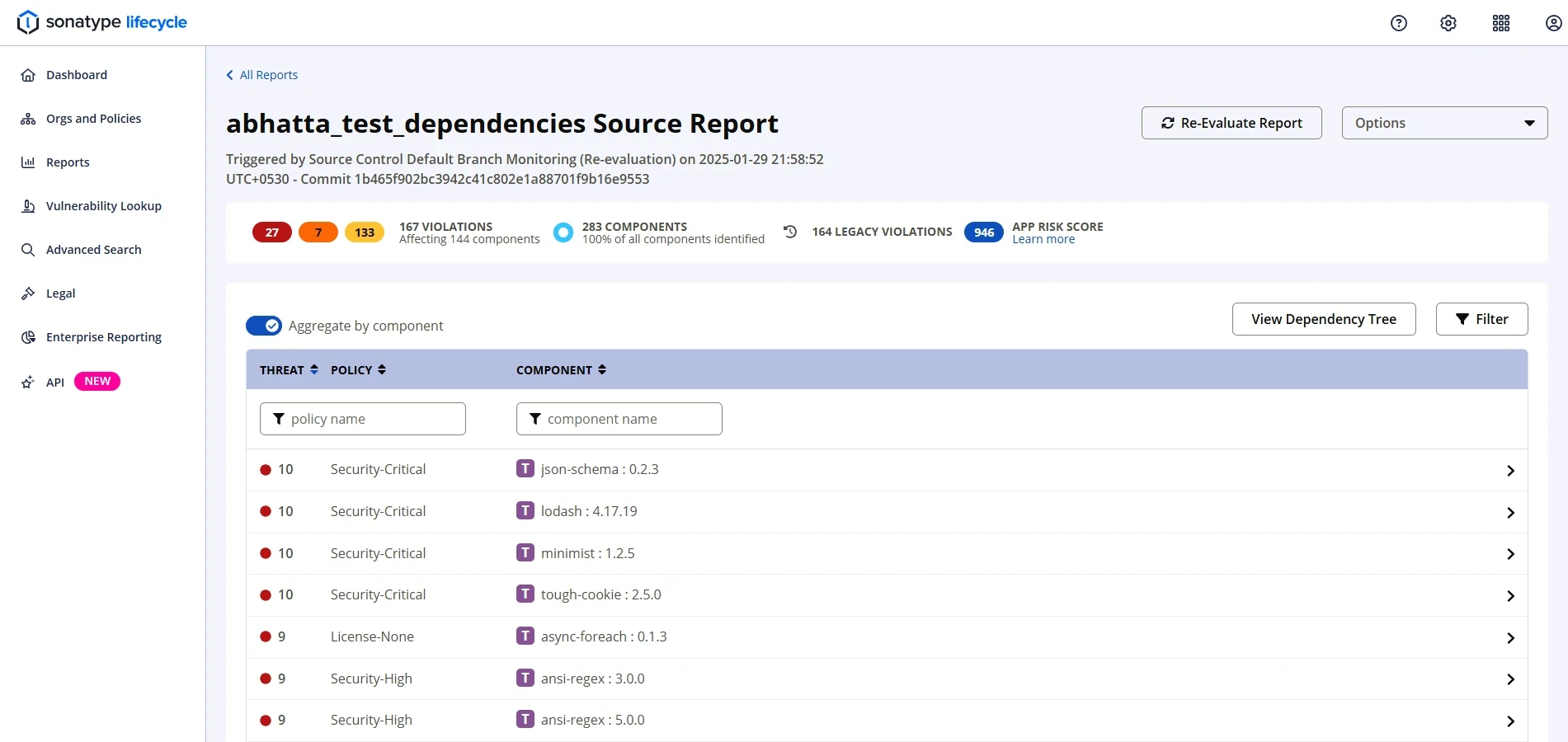
Sonatype Lifecycle is built on data that goes beyond public feeds, since Sonatype notes that nearly 65 percent of open source CVEs are missing CVSS scores assigned by the NVD, and its own research fills those gaps, which is the basis for the proprietary intelligence it applies to findings.
That intelligence feeds a policy engine and an automated remediation workflow, in which Golden Pull Requests are positioned as upgrades that do not break builds, waivers can be applied automatically to low-risk violations, and prioritization uses reachability, breaking change data, and upgrade availability rather than CVSS alone.
Key features include:

Best for: Deep transitive scanning within a broader AppSec platform
Strengths: Exploitable path analysis and a large malicious package database
Things to consider: Needs tuning per project, and scans are slower than some alternatives
Checkmarx SCA runs on the Checkmarx One platform alongside the vendor’s SAST, DAST, container, and API security scanners. Its dependency discovery covers directly and transitively referenced open source and private packages to unlimited depth, including packages held in on-premises and private JFrog Artifactory registries.
Malicious code detection is a significant part of the product, with Checkmarx analyzing nearly 2 million packages each month and maintaining a proprietary database of hundreds of thousands of malicious open source packages, which is used to identify and remediate compromised packages in an application.
Key features include:
Free and open source tools are where many teams start with SCA, and some stay with them for good. They’re quick to adopt, easy to run in a pipeline, and good at the core job of finding known vulnerabilities in your dependencies, while prioritization, policy, and reporting across many repositories are generally left to you.
Best for: Teams wanting free, GitHub-native dependency and security updates
Strengths: Automated PRs for vulnerable and outdated dependencies, native Advisory Database integration
Things to consider: Basic next to dedicated SCA, and PR volume needs grouping and cooldown tuning
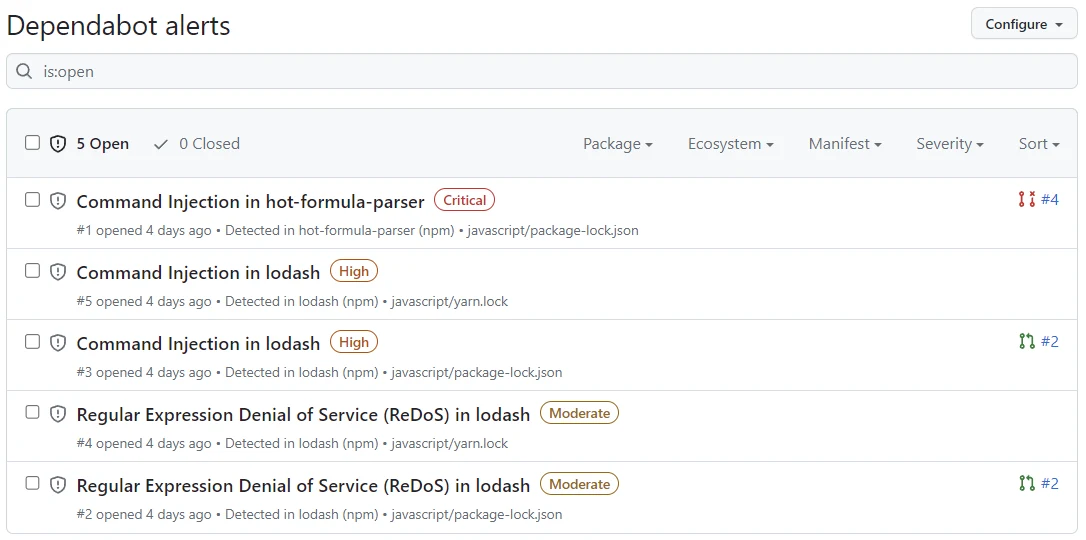
Dependabot is GitHub’s native dependency management tool, acquired by GitHub in 2019 and built directly into the platform. Dependabot security updates raise pull requests to patch dependencies with known vulnerabilities disclosed in the GitHub Advisory Database, while Dependabot version updates keep dependencies current on a schedule even when no vulnerability exists, based on a dependabot.yml configuration file checked into the repository.
Because it ships as a first-party feature, Dependabot requires no separate tool, account, or integration for GitHub users, and its alerts and pull requests appear directly in the repository’s Security tab and pull request queue. GitHub has continued to refine the noisier parts of the workflow, including a default three-day cooldown on version updates (introduced to reduce exposure to fast-moving malicious package releases) and support for grouping multiple dependency bumps into a single pull request.
Key features include:

Best for: Free CVE detection in Java and .NET build pipelines
Strengths: Build system plugins with detailed evidence-backed reports
Things to consider: CPE matching can produce false positives, and an NVD API key is strongly recommended
OWASP Dependency-Check was one of the earliest SCA tools, created in response to the OWASP Top 10 entry on using components with known vulnerabilities. It works by inspecting project dependencies with a series of analyzers, collecting evidence about each one, and using that evidence to identify a Common Platform Enumeration identifier.
Where a CPE is identified, the tool reports the associated CVE entries, and it maintains a local copy of NVD data hosted by NIST and updates itself automatically, and it supplements NVD with other sources including the Node Audit analyzer, OSS Index, RetireJS, and Bundler Audit for specific technologies.
Key features include:

Best for: SBOM generation and vulnerability scanning from the command line
Strengths: Standards-based SBOM output that pairs directly with scanning
Things to consider: No policy engine, dashboards, or license workflow
Anchore maintains a set of open source command line tools that split SBOM generation and vulnerability scanning into separate steps. Syft generates a Software Bill of Materials from container images and filesystems, giving visibility down to the file level and uncovering direct and transitive dependencies.
Grype then generates a list of known vulnerabilities from an SBOM, container image, or project directory, scanning both operating system and language-specific packages. Because the two are designed to work together, pairing Grype with a Syft-generated SBOM produces faster scans than scanning an image directly.
Key features include:
Modern SCA is moving beyond dependency inventories and severity-based CVE lists toward determining which software supply chain risks require action. The best programs combine accurate direct and transitive dependency discovery with reachability, exploitability context, malicious package detection, license controls, SBOMs, and remediation inside developer workflows. The right approach should reduce duplicate and theoretical findings while giving teams enough evidence to prioritize vulnerabilities that create practical risk in their applications and deployed environments.